Need to Know: Instead of chasing momentum stocks into the graveyard, do this instead, strategist says

Last year’s winners haven’t been doing so hot. On Monday, the ARK Innovation ETF
ARKK,
+1.52%
,
which surged 153% in 2020, closed higher for only the second time in 14 sessions, and has dropped 24% this year. “We believe you should invest based on what you see, and what you see is high multiple, unprofitable tech get slaughtered with the selling starting to seep into other areas,” says Matthew Tuttle, the chief executive and chief investment officer at Tuttle Capital Management.

Michael Darda, chief economist and market strategist at MKM Partners, has a similar warning, but first he wanted to give a reality check. After the Powell Pivot and the signal the head of the Federal Reserve likely supports faster tapering, he says some investors are worried the central bank may tighten too much. “There is virtually no evidence that the Fed is getting in front of the curve in a destabilizing way,” replies Darda. “Bond market inflation expectations pulling back from ‘too high’ levels to ‘still elevated’ levels relative to an average 2% per annum path for inflation do not represent a material tightening in monetary policy.”

The last time the labor market was near current levels of utilization, real interest rates were 2 percentage points higher, he notes. The breakdown in the relationship between metals and gold, and the 10-year Treasury yield, is more evidence of distortions in the bond market, he adds. “If the bottom were suddenly falling out of global and/or domestic industrial demand, the resilience of metals to gold would be highly unlikely,” he says.

Despite monetary policy that is as loose as a goose, Darda still warns that assets that are priced for perfection against record profits and liquidity could falter for any number of reasons, which already is happening for the highest valued names in the Nasdaq-100.

“We continue to take an upbeat view on the reopening stocks which have been crushed and also small cap value,” says Darda. “We remain bearish on hyper-valued growth. Back in the old days, high valuations used to mean lower expected future returns. Blinded by liquidity and false expectations of the proverbial Fed put, we fear that some investors are chasing momentum into the graveyard.”

The buzz

Intel
INTC,
+3.53%

is planning to list shares of its self-driving-car unit, Mobileye.

MongoDB
MDB,
-4.63%

surged 18% in after-hours trade, as the database software company reported a narrow-than-forecast loss on higher revenue than expected.

The Securities and Exchange Commission has opened an investigation into a whistleblower’s complaint against Tesla’s
TSLA,
-0.59%

SolarCity business. Elon Musk, the chief executive of Tesla, which made $1.6 billion from selling regulatory credits last year, said he’s against federal legislation that would provide tax credits for union-made electric vehicles.

Digital World Acquisition Company
DWAC,
-2.58%

rose 5% in premarket trade, after Rep. Devin Nunes, who unsuccessfully sued an online parody cow, announced he was retiring from Congress to head Trump Media & Technology Company, which the SPAC is planning to merge with.

Craig Wright won a court case over control of $50 billion of bitcoin
BTCUSD,
+2.61%
,
though it isn’t yet clear he’s the inventor of the cryptocurrency.

Data on the trade deficit, productivity and consumer credit are set for release.

The markets
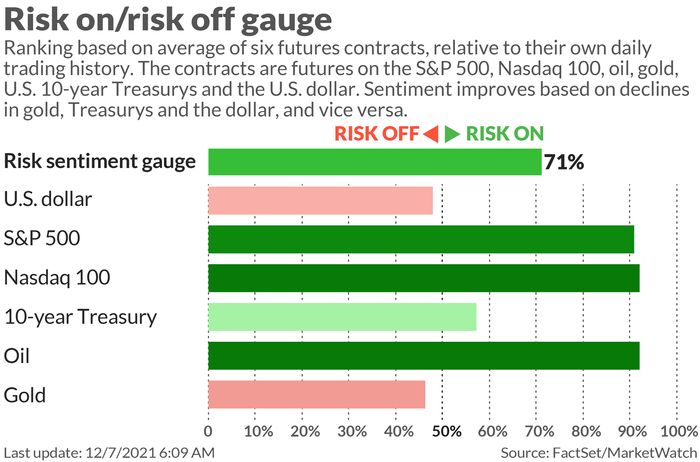
It’s looking like a second day of gains are in store for Wall Street, with futures on the Dow Jones Industrial Average
YM00,
+1.03%

up over 300 points.

Crude-oil futures
CL.1,
+3.37%

also were strong for a second day, rising past $71 per barrel.

Need to Know starts early and is updated until the opening bell, but sign up here to get it delivered once to your email box. The emailed version will be sent out at about 7:30 a.m. Eastern.

Top tickers

As of 6 a.m. Eastern, here are the most active tickers on MarketWatch.

Ticker

Security name

TSLA,
-0.59%
Tesla

AMC,
-0.76%
AMC Entertainment

GME,
-3.06%
GameStop

NIO,
+0.59%
NIO

DXY,
+0.06%
U.S. dollar index

TMUBMUSD10Y,
1.434%
10-year Treasury note

ES00,
+1.34%
E-mini S&P 500 futures contract

DJIA,
+1.87%
Dow Jones Industrial Average

BABA,
+10.40%
Alibaba Group

AAPL,
+2.15%
Apple

Random reads

Someone paid $450,000 to be rapper Snoop Dogg’s neighbor — in the metaverse.

Kansas City police on Sunday chased an elusive suspect — a camel.

Here’s what one photographer calls the clearest photos of the Sun.

Want more for the day ahead? Sign up for The Barron’s Daily, a morning briefing for investors, including exclusive commentary from Barron’s and MarketWatch writers.

If I’d invested £1,000 in Royal Mail shares 5 years ago, here’s how much I’d have today

Shares of Royal Mail Group (LSE:RMG) are among the most popular stocks to own in the UK. In fact, just 10 financial institutions have almost 40% of all the outstanding shares on their books. But is this vast popularity reflected in the share price performance? Or should I be looking elsewhere for lucrative investment opportunities?

A closer look at the performance of Royal Mail shares

Similar to my recent dive into Lloyds, Royal Mail shares have delivered pretty underwhelming results, despite their popularity. Over the last five years, the stock has only generated a return of around 11%. That’s the equivalent of an annualised gain of 2.7%, barely beating inflation, meaning a £1,000 investment in December 2016 would now be worth around £1,110.

5 Stocks For Trying To Build Wealth After 50

Markets around the world are reeling from the coronavirus pandemic… and with so many great companies trading at what look to be ‘discount-bin’ prices, now could be the time for savvy investors to snap up some potential bargains.

But whether you’re a newbie investor or a seasoned pro, deciding which stocks to add to your shopping list can be a daunting prospect during such unprecedented times.

Fortunately, The Motley Fool UK analyst team have short-listed five companies that they believe STILL boast significant long-term growth prospects despite the global upheaval…

We’re sharing the names in a special FREE investing report that you can download today. And if you’re 50 or over, we believe these stocks could be a great fit for any well-diversified portfolio.

Click here to claim your free copy now!

That’s still better than the disappointing -3% yielded by the FTSE 100 index. And when including the additional income generated by dividends, Royal Mail’s performance does improve. But not enough to satisfy my wealth-building expectations. So, what happened?

From what I can tell, the company grew somewhat complacent over the years, allowing other logistic fulfilment and delivery businesses to steal market share. With its letter delivery division slowly losing steam, its parcel segment left underdeveloped for quite some time, Royal Mail shares have unsurprisingly suffered.

Having said that, management finally seems to be taking action. With increased investments into new logistics centres, e-commerce fulfilment, and international expansion, the stock looks like it could be at the start of a comeback. But with an elevated level of debt on the books, is there a better company for me to invest in?

A future king of online shopping delivery solutions?

There are plenty of parcel delivery firms serving the e-commerce industry today. And most are pretty similar, with no major discernible advantage beyond the size of operations. That’s why Clipper Logistics (LSE:CLG) has caught my attention.

Instead of offering a bog-standard parcel delivery service, the company takes it one step further to provide a complete order fulfilment ecosystem. That means beyond handling delivery, the group offers returns management, inventory tracking, warehousing, and a plethora of other support services uniquely designed for each of its customers.

As such, retailers can focus entirely on developing and selling their products, while Clipper Logistics handles everything related to getting those products into customers’ hands. And this solution has proven to be immensely popular when looking at its client list. Halfords, ASOS, and Morrisons are among many leading businesses letting Clipper handle all their order fulfilment needs. So, I’m not surprised to see the share price jump more than 80% over the last five years.

That’s nearly eight times more than Royal Mail shares have managed to deliver. But it’s not without its risks. As it charges its customers on a usage basis, an economic downturn could significantly affect the revenue stream. After all, if consumers start saving instead of spending, the need for Clipper’s services will naturally start to fall. But given what the company has managed to achieve so far, that’s a risk I’m willing to take for my portfolio.

And it’s not the only growth stock that has outperformed Royal Mail shares. Here is another that looks like an even more promising opportunity for my portfolio…

FREE REPORT: Why this £5 stock could be set to surge

Are you on the lookout for UK growth stocks?

If so, get this FREE no-strings report now.

While it’s available: you’ll discover what we think is a top growth stock for the decade ahead.

And the performance of this company really is stunning.

In 2019, it returned £150million to shareholders through buybacks and dividends.

We believe its financial position is about as solid as anything we’ve seen.

  • Since 2016, annual revenues increased 31%
  • In March 2020, one of its senior directors LOADED UP on 25,000 shares – a position worth £90,259
  • Operating cash flow is up 47%. (Even its operating margins are rising every year!)

Quite simply, we believe it’s a fantastic Foolish growth pick.

What’s more, it deserves your attention today.

So please don’t wait another moment.

Get the full details on this £5 stock now – while your report is free.


Zaven Boyrazian has no position in any of the shares mentioned. The Motley Fool UK has recommended Clipper Logistics. Views expressed on the companies mentioned in this article are those of the writer and therefore may differ from the official recommendations we make in our subscription services such as Share Advisor, Hidden Winners and Pro. Here at The Motley Fool we believe that considering a diverse range of insights makes us better investors.

Expert tips for anyone looking to buy a house in 2022

Image source: Getty Images


According to the Nationwide House Price Index, house prices averaged £252,687 in November, which is a 0.9% increase month on month. With house prices continuing to rise, it’s crucial that buyers know the best time to make an offer and how to get the best deal on a property.

Here are six expert tips for anyone looking to buy a house in 2022.

1. Be prepared

The house buying process doesn’t start when you come across a property and contact the estate agent for a viewing. It starts weeks before you even find a house to purchase.

Of course, there might be a specific area you want to live in; research the area and even make physical visits on different days and times. If you find that it meets your needs, start looking at new listings and compare them.

As you do this, keep in mind that the true cost of buying a house comprises more than just the deposit and the mortgage. You need to account for costs like Stamp Duty, surveys, removals and solicitors.

2. Identify the best times to buy a house

Though the best time to buy a house will most likely depend on your personal circumstances, there are some particular times of year when houses are cheaper. Examples include during the winter months and during holiday periods. It’s wise to take advantage of such times.

3. Consider getting a mortgage in principle

A mortgage in principle acts as confirmation that a lender is willing to lend you a particular amount to buy a property. There are two main benefits:

  • It shows the seller that you are a serious buyer, which can move you to the front of the queue in the buying process
  • You get to know exactly what you can afford when looking for a suitable house

Ross Counsell, chartered surveyor and director at GoodMove, explains, “Working with a mortgage broker throughout the house buying process can help you understand which mortgages are best for you.”

4. Create a checklist before viewing properties

Viewing a property, especially one you like, carries some excitement. However, this can make buyers forget to perform necessary checks. It’s recommended to have a prewritten and well-thought-out checklist of things you want to confirm when you view the property.

5. Try to target houses under your budget

House prices are hitting record highs. And with high competition, some buyers are finding themselves making offers above the asking price.

It makes sense to look for houses slightly below your budget so that you have room to make an offer above the asking price and remain within your budget. If you manage to secure the property at or below the asking price, then you’ll have money left in your budget that you can put to good use.

6. Be patient and try to be flexible

We are already seeing stiff competition among home buyers. This can lead to poor decisions that only cause expensive mistakes down the line.

Ross Counsell recommends being patient and understanding that the home buying process takes time. Many things can go wrong, but it’s important to understand that even if a deal for a home you really wanted falls through, there will be others you’ll love just as much.

Ross also points out that it helps to be flexible and easy to work with, especially if you’re in a property chain. It makes the buying process easy, smooth and successful for everyone.

Products from our partners*

Top-rated credit card pays up to 1% cashback

With this top-rated cashback card cardholders can earn up to 1% on all purchases with no annual fee. Plus, there’s a sweet 5% welcome cashback bonus (worth up to £100) available during the first three months!

Those are just a few reasons why our experts rate this card as a top pick for those who spend regularly and clear their balance each month. Learn more here and check your eligibility before you apply in just 2 minutes.

*This is an offer from one of our affiliate partners. Click here for more information on why and how The Motley Fool UK works with affiliate partners.Terms and conditions apply.

Was this article helpful?

YesNo


Some offers on The Motley Fool UK site are from our partners — it’s how we make money and keep this site going. But does that impact our ratings? Nope. Our commitment is to you. If a product isn’t any good, our rating will reflect that, or we won’t list it at all. Also, while we aim to feature the best products available, we do not review every product on the market. Learn more here. The statements above are The Motley Fool’s alone and have not been provided or endorsed by bank advertisers. John Mackey, CEO of Whole Foods Market, an Amazon subsidiary, is a member of The Motley Fool’s board of directors. The Motley Fool UK has recommended Barclays, Hargreaves Lansdown, HSBC Holdings, Lloyds Banking Group, Mastercard, and Tesco.


Understanding Social Security: Can I receive survivor benefits from my ex-wife before I claim my Social Security?

We receive a lot of questions by email, and we can’t possibly respond to all of them. We do use the emails to produce new columns based on the general questions. Occasionally an email presents a specific situation that we’ll address in a column by itself. Today is just such a column.

Dear MarketWatch,

My ex-wife died in October 2020. We married in 1984 and divorced in 2000. She remarried, I have not remarried. She was 70 years old at the time of death. I was 61 at the time of her death. I contacted Social Security to try to claim spousal benefits. They indicated that I made too much money; I am still working full time making approximately $45,000 annually.

Is there another way that I may receive her benefits until such time (66+) that I choose to collect my own benefits? My own benefit will be a far greater monthly amount than she was getting. Thank you.

Dear reader,

It’s important to understand how survivor benefits and benefits based on your own working record are handled, so that you can make the most of each benefit. It is possible to coordinate the timing of filing for each benefit (if your circumstances permit), such that you might take advantage of one benefit for a period of time, and then switch over to the other benefit when it has increased to the maximum (or some arbitrary date).

Read: New proposal would improve Social Security’s finances and modestly increase benefits

In this email you’re referring to survivor benefits, not spousal benefits, just to be clear. The initial problem in this case is that you’re earning too much from your job to be able to receive a benefit from Social Security — the earnings limit (which is $19,560 in 2022) is lower than your full-time earnings by quite a lot. At this earnings level, most (probably all) of any Social Security survivor benefit would be withheld due to your level of earnings. Once a person reaches Full Retirement Age (FRA, somewhere between 66 and 67, depending on year of birth), this earning limitation will no longer apply.

Read: This hidden wrinkle in Social Security can help you decide when to file for benefits

But since you’re under FRA, for every $2 over the earnings limit, $1 of Social Security benefits is withheld. Income from your job is $45,000, so this is a total of $25,440 over the limit. This means that a total of $12,720 ($1 for every $2 over the limit) would be withheld from any Social Security benefit that you might be eligible for. Assuming that the survivor benefit from your late ex-wife is something less than $1,060 (the monthly equivalent of $12,720), then the entire amount is withheld, and you would receive nothing from that benefit.

But putting the earnings limitation aside, let’s look at the rest of this situation. From our calculations above, it’s safe to assume that the survivor benefit is approximately $1,000. You indicate that your own benefit will be something “far greater” than the survivor benefit, so let’s just put that at $2,000 for the sake of the example.

Read: Find out what Social Security knows about you

The question is: Is there a way I can receive the survivor benefit until such time (assuming you mean Full Retirement Age) that I choose to receive my own benefits? Unfortunately, as we saw above due to the earnings limitation, the answer is no. If, however, you chose to stop working, or limit your earnings to something less than the $45,000 job, you could receive at least a portion of the Social Security survivor benefit in the interim.

In addition, during the year that you’ll reach FRA, there is a much more liberal earnings limit ($51,960 in 2022, and only $1 of every $3 over the limit is withheld). When you get to that year, there is no reason to forgo the survivor benefit (reduced a bit since you’re still under FRA), since your income is below the earnings limit. You could receive the full amount of the survivor benefit up to your month of Full Retirement Age, and then switch over to your own retirement benefit.

Read: The messy math of Social Security, spousal benefits, and when to claim

The reason you’re able to make this switch is because the survivor benefit and your own retirement benefit are unaffected by the deeming rules. (As a refresher, just know that the deeming rules require that if you’re eligible for a spousal benefit and a retirement benefit based on your own record, if you file for one benefit you’re deemed to have filed for both, there’s no separating the two. The deeming rules do not apply between survivor benefits and retirement benefits.)

To better explain this, let’s say you have left the $45,000 job, so the earnings limitation doesn’t apply. At age 61, when your ex-wife died, you would be eligible to receive a reduced survivor benefit based on her record, while still delaying your own retirement benefit to a later date. Receiving the survivor benefit at an earlier age has no impact on your own retirement benefit.

Read: The quick and easy way to lose your life savings

The reverse also holds true: if your own benefit was something smaller than the survivor benefit, you could start receiving your own retirement benefit as early as age 62 (at a significant reduction), and then at FRA switch over to the much larger survivor benefit. Filing for one of these benefits early has no impact on the other benefit — this is why the two can be coordinated in this manner.

Read: Government announces surprising hike in Medicare Part B premiums

Going back to the original example with the limitation: In this case, once you reach FRA, you could file for and receive the survivor benefit, and continue delaying your own retirement benefit to a later date when the delay credits have maximized the benefit. Assuming your FRA is 67 and you delay your retirement benefit until you turn 70, the resulting benefit at that time could be as much as $2,480 (for three years’ worth of delay credits on your original benefit of $2,000). Meanwhile, you would be receiving the survivor benefit (based on your late ex-wife’s record) for three years.

Have a Social Security question? Write us at HelpMeRetire@marketwatch.com.

Gen Xers set to spearhead an equity release boom in 2022: should you consider it?

Image source: Getty Images


Equity release, the financial product that allows homeowners to unlock the value of their home, could see a huge upturn in 2022. This is according to financial broker Norton Finance, who says that rising house prices, the increased cost of living and adverse employment conditions could see many Gen Xers turn to equity release in 2022.

Here’s what Gen Xers need to know about equity release, including its benefits and drawbacks, as well as potential alternatives.

What has happened with Gen Xers recently?

According to Norton Finance, the pandemic has disproportionally affected Gen Xers and older workers in general. Some have been put on furlough, while others have had their incomes slashed or been made redundant. Here are a few stats that highlight the adverse employment conditions for older workers during the pandemic:

  • 25.4% of employees aged 55-64 were furloughed during the pandemic, along with 30.9% of those aged 65 and above.
  • The number of unemployed over 50s was 22.2% more in September 2021 than at the start of the pandemic.
  • 11% of over 50s made redundant during the pandemic left the job market entirely.
  • 14% of older people had lower incomes at the end of 2020 than they had before the pandemic.

What’s the likelihood of Gen Xers turning to equity release to fund their living costs?

Events of the past 20 months, including adverse employment conditions, rising costs of living and pension policy changes mean that many Gen Xers are facing an uncertain and potentially difficult financial future.

As a result, many are likely to begin considering new financial steps that they may not have considered previously or sooner than they had planned.

For those who are homeowners, Norton expects many to progressively turn to their homes as a way to supplement living expenses.

What do Gen Xers need to know about equity release?

Equity release is typically available to those over the age of 55.

For some of the nearly one million Gen X-ers who will turn 55 in 2022, equity release could be a great way to access funds from their most valuable asset – their home – and use it to fund their living expenses without having to relocate.

But equity release is not without its drawbacks. According to Norton Finance, homeowners must understand that an equity release plan isn’t just free cash.

It is a plan that will take value out of your house. It will therefore have a direct impact on what you can leave to your beneficiaries as an inheritance.

You may also be charged compound interest on some equity release products, meaning the amount you owe can become greater than with other loans. Equity release also comes with a number of fees that you must ensure you can afford. That is why you need to do your research before you commit.

It may be a good idea to seek the advice of a qualified equity release financial advisor. They can assess your situation and advise you on whether this is a viable option for you.

To find a qualified equity release adviser, head over to the ERC member directory.

What are good alternatives to equity release?

If you come to the conclusion that equity release is not appropriate, you have other options to raise cash. 

One is to downsize. Downsizing can give you extra cash that you can use to fund your expenses. A smaller home also means lower utility bills, home insurance and maintenance costs.

If you do not fancy moving to a smaller place, another good alternative is renting out a portion of your home to generate regular income.

Products from our partners*

Top-rated credit card pays up to 1% cashback

With this top-rated cashback card cardholders can earn up to 1% on all purchases with no annual fee. Plus, there’s a sweet 5% welcome cashback bonus (worth up to £100) available during the first three months!

Those are just a few reasons why our experts rate this card as a top pick for those who spend regularly and clear their balance each month. Learn more here and check your eligibility before you apply in just 2 minutes.

*This is an offer from one of our affiliate partners. Click here for more information on why and how The Motley Fool UK works with affiliate partners.Terms and conditions apply.

Was this article helpful?

YesNo


Some offers on The Motley Fool UK site are from our partners — it’s how we make money and keep this site going. But does that impact our ratings? Nope. Our commitment is to you. If a product isn’t any good, our rating will reflect that, or we won’t list it at all. Also, while we aim to feature the best products available, we do not review every product on the market. Learn more here. The statements above are The Motley Fool’s alone and have not been provided or endorsed by bank advertisers. John Mackey, CEO of Whole Foods Market, an Amazon subsidiary, is a member of The Motley Fool’s board of directors. The Motley Fool UK has recommended Barclays, Hargreaves Lansdown, HSBC Holdings, Lloyds Banking Group, Mastercard, and Tesco.


Is this £1.66 UK stock the key to building a passive income?

Building a passive income can be quite a challenge. Fortunately, the stock market is an easy-to-access method of doing just that. Dividends can be lucrative for investors. And the idea of simply receiving money for doing nothing but holding shares in a business is quite an attractive proposition.

There are plenty of UK shares that offer this possibility. But like anything in life, nothing is risk-free. Companies that find themselves in financial difficulties can easily decide to cut or even cancel dividends outright. And such decisions are usually paired with a substantial decline in the share price. In other words, just because a stock offers a dividend doesn’t mean it’s a reliable source of passive income.

5 Stocks For Trying To Build Wealth After 50

Markets around the world are reeling from the coronavirus pandemic… and with so many great companies trading at what look to be ‘discount-bin’ prices, now could be the time for savvy investors to snap up some potential bargains.

But whether you’re a newbie investor or a seasoned pro, deciding which stocks to add to your shopping list can be a daunting prospect during such unprecedented times.

Fortunately, The Motley Fool UK analyst team have short-listed five companies that they believe STILL boast significant long-term growth prospects despite the global upheaval…

We’re sharing the names in a special FREE investing report that you can download today. And if you’re 50 or over, we believe these stocks could be a great fit for any well-diversified portfolio.

Click here to claim your free copy now!

That’s why, when I’m looking to bolster my income portfolio, I’m specifically looking for businesses that have strong financials, as well as room to grow, so that dividends can scale up over time. With that in mind, I’ve spotted shares of one UK firm that I believe meet these criteria.

Solving one of e-commerce’s biggest problems

The ongoing transition to online shopping accelerated as Covid-19 forced everyone to stay at home last year. Many non-essential retailers quickly doubled down on expanding their e-commerce offerings. But with such a sudden spike in activity, a serious problem emerged for businesses selling physical goods. I’m talking about the UK’s short supply of warehouse space.

Relatively speaking, the construction time of a new warehouse isn’t that long. However, acquiring land near a central logistics hub has become increasingly challenging, causing well-connected warehouse property values to climb considerably. And with inflation creeping into the economy, this trend appears to be accelerating.

For online retailers, that’s not fun. But for Warehouse REIT (LSE:WHR), it’s a dream come true. As the name suggests, this firm buys, rents and sells warehouses primarily for the e-commerce industry. And it returns the bulk of its profits to shareholders through dividends, generating a sizable stream of passive income.

At today’s share price of £1.66, the dividend yield sits at around 3.7%.  That hardly makes it the highest yielding stock out there. But dividends have actually increased annually by an average of 50% over the last three years. Assuming the firm can continue delivering this impressive payout growth, Warehouse REIT could be an essential piece in building a passive income through the stock market.

Becoming a landlord to build passive income isn’t risk-free

By investing in Warehouse REIT, I’m effectively becoming a landlord who doesn’t have any responsibilities. That certainly sounds more enticing than pursuing a buy-to-let strategy. And it’s one of the reasons why I’m tempted to add the stock to my portfolio. But there are some caveats.

The rising demand for warehouse space hasn’t gone unnoticed by the rest of the industry. And the firm has a pretty long list of competitors. Consequently, bidding wars on properties are becoming more commonplace. As such, it’s possible management could either start missing out on opportunities or begin overpaying for new locations. Either way that doesn’t bode well for the longevity of shareholder dividends. And it potentially compromises my potential passive income stream. Therefore, this is something I’ll be watching closely.

But e-commerce isn’t the only industry ripe with dividends. The renewable energy sector is filling with passive income opportunities such as…

Our 5 Top Shares for the New “Green Industrial Revolution”

It was released in November 2020, and make no mistake:

It’s happening.

The UK Government’s 10-point plan for a new “Green Industrial Revolution.”

PriceWaterhouse Coopers believes this trend will cost £400billion…

…That’s just here in Britain over the next 10 years.

Worldwide, the Green Industrial Revolution could be worth TRILLIONS.

It’s why I’m urging all investors to read this special presentation carefully, and learn how you can uncover the 5 companies that we believe are poised to profit from this gargantuan trend ahead!

Access this special “Green Industrial Revolution” presentation now


Zaven Boyrazian has no position in any of the shares mentioned. The Motley Fool UK has recommended Warehouse REIT. Views expressed on the companies mentioned in this article are those of the writer and therefore may differ from the official recommendations we make in our subscription services such as Share Advisor, Hidden Winners and Pro. Here at The Motley Fool we believe that considering a diverse range of insights makes us better investors.

Shanta Gold’s share price just crashed. Is this a buying opportunity?

The Shanta Gold (LSE: SHG) share price is down by more than 20%, as I write, after the Africa-based gold miner warned that 2021 production would be up to 15% lower than expected. Shanta shares have now fallen by nearly 40% over the last 12 months.

Today’s fall was triggered by news of technical issues at its New Luika gold mine in Tanzania. These have now been fixed, according to CEO Eric Zurrin. My sums suggest that if Shanta’s 2022 forecasts remain unchanged, this stock could be seriously cheap after today’s crash. Should I consider buying Shanta Gold shares for my portfolio after today’s crash?

5 Stocks For Trying To Build Wealth After 50

Markets around the world are reeling from the coronavirus pandemic… and with so many great companies trading at what look to be ‘discount-bin’ prices, now could be the time for savvy investors to snap up some potential bargains.

But whether you’re a newbie investor or a seasoned pro, deciding which stocks to add to your shopping list can be a daunting prospect during such unprecedented times.

Fortunately, The Motley Fool UK analyst team have short-listed five companies that they believe STILL boast significant long-term growth prospects despite the global upheaval…

We’re sharing the names in a special FREE investing report that you can download today. And if you’re 50 or over, we believe these stocks could be a great fit for any well-diversified portfolio.

Click here to claim your free copy now!

What’s gone wrong?

Gold production at Shanta’s flagship New Luika mine has been held back during the fourth quarter by two technical issues. The company says it’s experienced “operational difficulties” relating to supplies of an “unreliable emulsion product” and problems with underground charging units.

According to chief executive Zurrin, emulsion supplies are back to normal, and the charging units have now been fixed.

Unfortunately, these issues forced the company to temporarily change its mining schedule to focus on less productive areas of the underground mine. As a result, Shant’s 2021 gold production is now expected to range 55,000-57,000 ounces this year. This compares to previous guidance in August for 60,000-65,000 ounces.

Why I think Shanta could be cheap

Today’s news is disappointing, but it doesn’t sound too serious to me. 2021 was always expected to be a transitional year for Shanta Gold, with much lower profits than in 2020.

However, 2022 forecasts suggest a strong recovery in earnings. Ahead of today, broker consensus estimates for next year suggested Shanta could generate a net profit of $18.6m in 2022. That’s equivalent to forecast earnings of $2.1 cents per share. At Shanta Gold’s current share price, I estimate that this would price the stock at just six times 2022 earnings.

It’s too soon to be sure, but based on today’s announcement, I don’t see any reason why 2022 forecasts should be cut. If I’m right, then I can see some potential value here, especially as Shanta’s financial position remains strong, with around $20m of net cash and available resources.

Should I buy now?

Shanta has several interesting exploration projects underway but, at the moment, all the company’s revenue comes from the New Luika mine. This means any disappointment here can have a big impact, as we’ve seen today.

One concern for me is that Shanta’s gold production also fell during the first half of this year. This was caused by lower quality ore containing less gold than in 2020. Today’s disappointment adds to this shortfall.

After such a difficult year, I’m not sure how confident I can be in forecasts for 2022. More problems might lie ahead. Although I can see some attractions at Shanta Gold, the situation feels too speculative for me.

For this reason, I won’t be buying Shanta shares today. However, I will keep watching for further news.

FREE REPORT: Why this £5 stock could be set to surge

Are you on the lookout for UK growth stocks?

If so, get this FREE no-strings report now.

While it’s available: you’ll discover what we think is a top growth stock for the decade ahead.

And the performance of this company really is stunning.

In 2019, it returned £150million to shareholders through buybacks and dividends.

We believe its financial position is about as solid as anything we’ve seen.

  • Since 2016, annual revenues increased 31%
  • In March 2020, one of its senior directors LOADED UP on 25,000 shares – a position worth £90,259
  • Operating cash flow is up 47%. (Even its operating margins are rising every year!)

Quite simply, we believe it’s a fantastic Foolish growth pick.

What’s more, it deserves your attention today.

So please don’t wait another moment.

Get the full details on this £5 stock now – while your report is free.


Roland Head has no position in any of the shares mentioned. The Motley Fool UK has no position in any of the shares mentioned. Views expressed on the companies mentioned in this article are those of the writer and therefore may differ from the official recommendations we make in our subscription services such as Share Advisor, Hidden Winners and Pro. Here at The Motley Fool we believe that considering a diverse range of insights makes us better investors.

What’s going on with the Vodafone share price?

The Vodafone (LSE: VOD) share price has continued to underperform the market over the past few weeks. The stock registered a small bounce between the beginning and last week of November, but it has since resumed its decline.

Following this performance, shares in Vodafone have fallen 14%, excluding dividends over the past 12 months. By comparison, the FTSE All-Share Index has returned 13% over the same timeframe. This implies that the stock has underperformed the broader market by 27%, excluding dividends. 

5 Stocks For Trying To Build Wealth After 50

Markets around the world are reeling from the coronavirus pandemic… and with so many great companies trading at what look to be ‘discount-bin’ prices, now could be the time for savvy investors to snap up some potential bargains.

But whether you’re a newbie investor or a seasoned pro, deciding which stocks to add to your shopping list can be a daunting prospect during such unprecedented times.

Fortunately, The Motley Fool UK analyst team have short-listed five companies that they believe STILL boast significant long-term growth prospects despite the global upheaval…

We’re sharing the names in a special FREE investing report that you can download today. And if you’re 50 or over, we believe these stocks could be a great fit for any well-diversified portfolio.

Click here to claim your free copy now!

Vodafone share price drop 

Shares in the company dropped in November after it reported its fiscal first half 2022 results. The figures showed a 22% decline in operating profit, although overall group service revenue increased by 2.8%. Cash generated by operating activities increased 7.4% in the period. 

These numbers were not particularly inspiring. Operating profit slipped due to higher capital spending costs and a lack of lucrative roaming fees. Free cash flow generated by operating activities also collapsed. 

The company’s adjusted free cash flow for the period totalled €23m, down from €451m in the prior-year period. Net debt increased by 0.9% to €44.3bn.

According to the corporation, cash flow will be weighted to the second half. Management is guiding for adjusted free cash flow of €5.3bn for the current financial year. 

If Vodafone hits this projection it may be able to make a dent in its debt pile, which is one of the company’s biggest challenges. Management is focusing on getting debt under control and has been selling off assets to try and streamline the business. 

Until the company can make a material dent in its debt mountain, I think the market will continue to give the business a wide berth. Without a strong balance sheet, Vodafone may struggle to make the investments required to stay ahead of its competition.

The firm may also have to cut its dividend if it suffers a sudden decline in profitability, as paying off debt holders is far more important than rewarding shareholders. 

Challenging outlook 

Put simply, it looks as if the market is avoiding the Vodafone share price because of the company’s weak balance sheet and declining profitability. 

If the organisation hits its free cash flow targets for the year, it may be able to reduce debt, and this could help improve investor sentiment. As the economic recovery starts to gain traction, the company’s profits may also recover, which would only enhance investor sentiment further. 

As such, I am cautiously optimistic about the outlook for the Vodafone share price. That is why I would buy the stock as a speculative position for my portfolio today.

If the company can capitalise on the economic recovery, reduce debt and cut costs, earnings will recover, and the market may rerate the stock to a higher growth multiple. On the other hand, if the group continues to struggle, the stock may continue to underperform the market.


Rupert Hargreaves has no position in any of the shares mentioned. The Motley Fool UK has no position in any of the shares mentioned. Views expressed on the companies mentioned in this article are those of the writer and therefore may differ from the official recommendations we make in our subscription services such as Share Advisor, Hidden Winners and Pro. Here at The Motley Fool we believe that considering a diverse range of insights makes us better investors.

What’s going on with the JD Sports share price?

At first glance, it might look as if the JD Sports (LSE: JD) share price has crashed in the past few weeks. The stock has plunged from around 1,100p to 225p at the time of writing. 

However, this is nothing more than a cosmetic change. At the beginning of October, management recommended what is known as a share split. The company issued five new shares for every existing share, splitting the stock to reduce the share price. 

5 Stocks For Trying To Build Wealth After 50

Markets around the world are reeling from the coronavirus pandemic… and with so many great companies trading at what look to be ‘discount-bin’ prices, now could be the time for savvy investors to snap up some potential bargains.

But whether you’re a newbie investor or a seasoned pro, deciding which stocks to add to your shopping list can be a daunting prospect during such unprecedented times.

Fortunately, The Motley Fool UK analyst team have short-listed five companies that they believe STILL boast significant long-term growth prospects despite the global upheaval…

We’re sharing the names in a special FREE investing report that you can download today. And if you’re 50 or over, we believe these stocks could be a great fit for any well-diversified portfolio.

Click here to claim your free copy now!

In theory, this has not had an impact on individual shareholders. The value of the business remains the same. It is just the number of shares outstanding that has changed. And with each investor being given five new shares for every existing share, each shareholders’ percentage claim on the underlying business has not changed. 

When it announced the decision to split the stock, management noted that the resulting smaller share price would increase the “efficiency” of trading and “improve the liquidity and marketability of the company’s shares.

Put simply, the JD Sports share price has become easier for investors to trade. There has been no impact on the underlying business. 

Booming sales 

According to the company’s latest trading updates, sales and profits are growing rapidly. The group reported a record result for the first half of its financial year, with revenue totalling £3.9bn, up from £2.5bn last year. Profit before tax jumped to £365m, up from £42m in the prior-year period. 

And JD has plenty of capital to push forward with its growth ambitions. It had a net cash position on the balance sheet of just under £1bn the end of July 2021. 

Management is investing heavily to boost the group’s international and local footprint. Much of the investment is going into enhancing logistics networks, with significant leases signed on new warehouse facilities this year. 

Despite the company’s breakneck growth, management is maintaining a conservative stance. The organisation is wary of additional pandemic trading restrictions, which is why it is hoarding cash. The threat of disruption from e-commerce is also driving the group’s heavy investments in infrastructure and logistics facilities to improve customer service and streamline the fulfilment process. 

The outlook for the JD Sports share price 

Despite these risks and challenges, I believe that the JD Sports share price looks attractive at current levels. The company is one of the most successful UK retailers, and its investment initiatives suggest that the business is not going to slow down any time soon.

I am also encouraged by the company’s strong balance sheet. Many retailers have collapsed in the past due to high levels of borrowing. It does not look as if JD is going to make the same mistake. 

As such, I would be happy to buy the stock for my portfolio today as a growth play. As the economic recovery continues, I think the corporation will continue to report rapid revenue growth. 

FREE REPORT: Why this £5 stock could be set to surge

Are you on the lookout for UK growth stocks?

If so, get this FREE no-strings report now.

While it’s available: you’ll discover what we think is a top growth stock for the decade ahead.

And the performance of this company really is stunning.

In 2019, it returned £150million to shareholders through buybacks and dividends.

We believe its financial position is about as solid as anything we’ve seen.

  • Since 2016, annual revenues increased 31%
  • In March 2020, one of its senior directors LOADED UP on 25,000 shares – a position worth £90,259
  • Operating cash flow is up 47%. (Even its operating margins are rising every year!)

Quite simply, we believe it’s a fantastic Foolish growth pick.

What’s more, it deserves your attention today.

So please don’t wait another moment.

Get the full details on this £5 stock now – while your report is free.


Rupert Hargreaves has no position in any of the shares mentioned. The Motley Fool UK has no position in any of the shares mentioned. Views expressed on the companies mentioned in this article are those of the writer and therefore may differ from the official recommendations we make in our subscription services such as Share Advisor, Hidden Winners and Pro. Here at The Motley Fool we believe that considering a diverse range of insights makes us better investors.

Kelley Blue Book: With a sectional sofa and a joystick, is this Hyundai SUV concept a sign of EVs to come?

Hyundai’s next electric car may be a 3-row SUV with a driving range of 300-plus miles and a design that blends gentle curves with a pixelated lighting theme. Of that much, we’re confident. The sectional couch, though? That might have to go.

The Ioniq 7?

At the recent Los Angeles Auto Show, Hyundai
HYMTF,
-0.10%

unveiled a concept car that probably previews its next electric vehicle (EV). Concept cars are often showcases for an automaker’s most outlandish ideas. But sometimes, they preview upcoming models. The Hyundai SEVEN concept seems likely to be a little of both.

The Hyundai SEVEN concept


Hyundai

On the outside, it’s an attractive midsize SUV large enough to house three rows of seating. It borrows the pixelated lights of Hyundai’s upcoming Ioniq 5 EV – a smaller, 2-row compact SUV expected to reach showrooms in the spring. That, and the SEVEN name, have led many to speculate that what we’re looking at here is the future Hyundai Ioniq 7.

A plausible look … mostly

The SEVEN mates those little light squares to a unique body that blends slab-sided boxiness with rounded corners to create a look that is at once sleek and brawny. From the front, it’s a conventional enough mien to fit into traffic today. From the rear, it’s a different story. The back is nearly all one piece of glass – a fantastic showroom style but one that might not work as well in practice for anyone who doesn’t obsessively clean their car.

Also see: Toyota’s new electric SUV: Everything you need to know about the 2023 bZ4X

Shared components with an existing EV

The SEVEN rides on the same platform as the Ioniq 5.

The first generation of electric cars most manufacturers have built are essentially gasoline-powered cars converted to carry batteries and electric motors in the places they would otherwise carry engines and gas tanks. But the second-generation – cars like this – are built from the ground up as EVs.

For these, engineers build the batteries, motors, and suspension into a skateboard-like flat unit that runs underneath the cabin. Designers can scale up and down these units to build cars of different sizes. So the same mechanical bits can underlie a compact SUV and a large one.

Hyundai has announced plans for an astonishing 23 electric cars by 2025. Most will be built on the same EV skateboard unit.

Hyundai says that in the SEVEN, the combination is good for more than 300 miles of range and can recharge to 80% of full capacity in just 20 minutes. They don’t give horsepower figures. In the smaller Ioniq 5, buyers can order that same hardware with 167, 225, or 320 horsepower and in front- or all-wheel-drive configurations.

A wild interior that probably won’t see production

Mounting all of the mechanics underneath the floor also frees designers to play with cabin space in unique ways. And play they have. Inside is where the SEVEN departs from showroom-ready.

The Hyundai SEVEN concept with its swiveling lounge chairs.


Hyundai

The SEVEN uses coach-style doors with no central pillar, so passengers can open almost the entire cabin to the outside. Inside, designers put two swiveling lounge chairs – one for the driver in the traditional position and a second to the driver’s right but set further back as if in a second row. What’s in the traditional front passenger’s seat space? An ottoman, of course. So that second “row” passenger can put their feet up.

The third row isn’t exactly a bench seat. It’s more a sectional sofa. The driver’s seat can swivel back to face it when parked, creating a nice living room set you can drive anywhere.

Check out: Mazda gets all burly and outdoorsy with its rugged new CX-50

As for how you drive the thing, Hyundai chose to see Tesla’s
TSLA,
-0.59%

pilot yoke and raise them one joystick. The driver’s seat, Hyundai says, “features a retractable control stick that hides away when not in use.”

Other fanciful ideas include sterilizing UVC lights that “help clean the living space of bacteria and viruses” and an airflow system designed to “reduce cross-contamination among passengers and isolate the airflow between front and rear occupants.”

Will we ever see this for sale?

So, will the SEVEN appear in Hyundai showrooms anytime soon?

Not like this, no. But it’s worth noting that, shortly before debuting the Ioniq 5, Hyundai showed off a concept car it called the 45. The Ioniq 5 on its way to showrooms soon looks remarkably like that concept car — on the outside.

Also read: Your complete guide to MPGe, the electric equivalent of miles per gallon

A 3-row Ioniq 5 SUV, sized like the Hyundai Palisade but sharing its platform with the Ioniq 5 is a logical next step in Hyundai’s electrification plan. It could very well use the body of the SEVEN, albeit probably without the fully transparent liftgate.

It’s just unlikely to have a sectional sofa and a joystick. Three rows of conventional seating and a steering wheel would suit this car just fine.

This story originally ran on KBB.com

Financial News

Daily News on Investing, Personal Finance, Markets, and more!

Financial News

Policy(Required)