
The Ratings Game: Wells Fargo launches coverage of four cannabis stocks

Wells Fargo analyst Chris Carey on Thursday initiated coverage of four cannabis stocks, with Scotts Miracle-Gro Co. drawing the most bullish comments, in a sign of Wall Street’s growing interest in the sector.

Wells Fargo assigned an overweight rating to Scotts Miracle-Gro
SMG,
+4.83%
,
the maker of fertilizer and owner of the Hawthorne line of hydroponic equipment for growing cannabis. He rated GrowGeneration Corp.
GRWG,
+5.34%

and Hydrofarm Holdings Group Inc.
HYFM,
+2.22%

as equal weight and Canopy Growth Corp.
CGC,
+1.63%

WEED,
+0.78%

an underweight.

Carey set a price target of $180 a share for Scotts Miracle-Gro and said the stock is “flashing green” as a buying opportunity. The stock has dropped 30.3% in 2021, compared with a rise of 22.3% by the S&P 500 index.
SPX,
+1.38%

“We see opportunity: a stock well off its April highs, a discount to peers, and
fundamental opportunity – leader in lawn/garden and hydroponics – still ahead,” Carey wrote in a research note.

While recent volatility in the hydroponic volatility remains an “elephant in the room”, the U.S. West coast cannabis market is working through oversupply, causing
hydroponic market turbulence against already record year-ago comps, he said.

“Strong operators can take advantage of market dislocations, and we think SMG can re-run its FY18 playbook to consolidate more share (key driver of hydroponics growth),” he wrote.

Unlike its peers, Scotts Miracle-Gro is also well established in the broader garden sector with a major presence at major retailers such as Home Depot Inc. and Lowe’s Cos. Inc.
LOW,
+0.76%
,
he said.

Carey set a price target of $18 a share on GrowGeneration, which he described as “the top hydroponic retailer in N. America” with 2021 revenue growth greater than four times its level in 2019. It’s also valued at a discount to the fast-growth retail sector.

GrowGeneration shares are down about 61.8% this year, compared with a loss of 24.5% by the Cannabis ETF
THCX,
+2.39%
.

“The runway looks attractive, with a strategy to increase store count +60% by end-2023; internal initiatives (e-commerce, private label); and continued momentum of U.S. cannabis, a key driver of hydroponic category demand,” Carey wrote.

Meanwhile, Hydrofarm Holdings, a wholesaler, distributor, and manufacturer of hydroponic equipment and supplies in North America, drew a price target of $33 a share. as a “pure play” in the space, Carey said

Hydrofarm Holdings shares are down 44.9% in 2021.

“HYFM generates all revenue and profit in hydroponics, one of few federally legal ways to play secular U.S. cannabis growth — that’s a long-term positive,” he wrote. “However, during bouts of market volatility, as is happening now on
the U.S. west coast, this means HYFM is exposed. “

Cannabis retailer and manufacturer Canopy Growth Corp drew an $8 price target.

Carey said the stock “still looks overvalued” despite its roughly 59% slide this year.

“We think it’ll be tough to hit ‘breakeven’ revenue near-term barring a change in U.S. federal cannabis laws, and are below consensus,” he wrote.

As the Aston Martin share price hits 2021 lows, is now the right time to buy?

Yesterday, the Aston Martin (LSE:AML) share price hit its lowest level since the year began. It traded at just above 1,300p, before rallying slightly. At the moment, the share price sits at 1,398p. Given that it has traded up to 2,290p this year, the extent of the fall over the past few months is clear. So is now the right time for me to buy the shares?

A falling knife over time

First, let’s consider the share price from a long-term perspective. Over a three-year period, the shares are down 94%. That’s quite a staggering figure. Over one year, it’s a more tame 14.6%. 

5 Stocks For Trying To Build Wealth After 50

Markets around the world are reeling from the coronavirus pandemic… and with so many great companies trading at what look to be ‘discount-bin’ prices, now could be the time for savvy investors to snap up some potential bargains.

But whether you’re a newbie investor or a seasoned pro, deciding which stocks to add to your shopping list can be a daunting prospect during such unprecedented times.

Fortunately, The Motley Fool UK analyst team have short-listed five companies that they believe STILL boast significant long-term growth prospects despite the global upheaval…

We’re sharing the names in a special FREE investing report that you can download today. And if you’re 50 or over, we believe these stocks could be a great fit for any well-diversified portfolio.

Click here to claim your free copy now!

Fundamentally, I could argue that the IPO price back in 2018 of 19,000p overvalued the business, so it was always going to correct lower over time. Added to this was the hit from the pandemic. With the UK and other countries falling into a recession, demand for luxury sports cars fell considerably. The pandemic also created a spiral, with lower revenue forcing the business to restructure debt.

In the short term, the Aston Martin share price has fallen due to news that CFO Kenneth Gregor is stepping down. This news last week saw the shares move lower, as he’s a key cog in the board management machine at the company. The good news is that he’ll be staying on until next summer, so the transition with his successor should be a smooth one.

Considering both sides

When looking for reasons to justify a turnaround in the Aston Martin share price, I can point to the latest financial results up to and including Q3. For the first nine months of the year, revenue jumped 173% compared to 2020. This means that it’s on track to meet the full-year guidance set out earlier in the year. 

Guidance looking forward to 2022 is also positive. The transformation project taking place at the moment includes various exciting product launches. That means new editions of the popular SUV, as well as hybrid vehicles and other supercars. With this pipeline, I think that demand (and revenue) should continue to rebound next year. This should help to pull the Aston Martin share price higher if the financial outlook is also met.

On the other hand, there are still risks ahead. The luxury sector is one of the hardest hit during economic downturns. With uncertainty around Covid-19 still very much a factor, we could be in for a tough winter. If economic data starts to disappoint, I think the share price could struggle to move higher. Negative sentiment could be a real drag here.

On top of this, net debt is still a concern. It stood at £808.6m in the Q3 results. When I consider that total revenue for the business in 2021 was £736.4m, it puts it in perspective!

Overall, I do think that the Aston Martin share price can do well in years to come. However, I’m going to hold off buying right now until I get more clarity on the impact of the new virus variant.

5 Stocks For Trying To Build Wealth After 50

Markets around the world are reeling from the coronavirus pandemic…

And with so many great companies still trading at what look to be ‘discount-bin’ prices, now could be the time for savvy investors to snap up some potential bargains.

But whether you’re a newbie investor or a seasoned pro, deciding which stocks to add to your shopping list can be a daunting prospect during such unprecedented times.

Fortunately, The Motley Fool is here to help: our UK Chief Investment Officer and his analyst team have short-listed five companies that they believe STILL boast significant long-term growth prospects despite the global lock-down…

You see, here at The Motley Fool we don’t believe “over-trading” is the right path to financial freedom in retirement; instead, we advocate buying and holding (for AT LEAST three to five years) 15 or more quality companies, with shareholder-focused management teams at the helm.

That’s why we’re sharing the names of all five of these companies in a special investing report that you can download today for FREE. If you’re 50 or over, we believe these stocks could be a great fit for any well-diversified portfolio, and that you can consider building a position in all five right away.

Click here to claim your free copy of this special investing report now!


Jon Smith and The Motley Fool UK have no position in any of the shares mentioned. Views expressed on the companies mentioned in this article are those of the writer and therefore may differ from the official recommendations we make in our subscription services such as Share Advisor, Hidden Winners and Pro. Here at The Motley Fool we believe that considering a diverse range of insights makes us better investors.

Revealed! How homeowners are cashing in on rising house prices

Source: Getty Images


House prices are surging and the average homeowner has seen their property rise in value by almost £30,000 over the past year. This statistic comes at a time when many first-time buyers are finding themselves unable to get on the property ladder.

So how are homeowners spending their newfound wealth? New research reveals all.

House prices: what’s happened over the past 12 months?

House prices are at record highs, with the latest data from the Office for National Statistics revealing that the average home now costs £270,000. That’s a £28,000 increase in the space of a year.

This means first-time buyers now have to find £54,000 for a typical 20% deposit on the average home. This is a huge challenge for many wannabe homeowners given that the average UK salary (before tax) is just £31,285.

How are homeowners benefiting from rising house prices?

Record house prices paint a bleak picture for first-time buyers. Despite this, new research reveals how homeowners are happily cashing in on their accelerating housing wealth.

According to UK Finance, many homeowners used the Stamp Duty holiday to purchase a second home. Its data reveals that the average sum withdrawn from housing equity for ‘other purposes’ peaked at £106,000 when the Stamp Duty holiday was in effect.

The data doesn’t specify what these ‘other purposes’ were. But the size and timing of such withdrawals suggest booming housing equity was used for second homes. This theory is shared by Sarah Coles, senior personal finance analyst at Hargreaves Lansdown.

She explains, “Property is the new piggy bank. Since August 2020, we’ve been withdrawing more and more equity when we remortgage, as rising property prices have given people the confidence to raid the equity in their home, and the Stamp Duty holiday persuaded them that this was the time to snap up a second property.”

Coles goes on to explain how many homeowners sought second homes as a result of government-imposed lockdowns last year. She explains “The attractions of a holiday home were magnified by lockdowns, when people realised the limitations of full-time city life.

“Meanwhile, runaway house prices presented them with the opportunity to take more equity from their home, and the Stamp Duty holiday provided a window during which they could pay far less tax.

“The period before the Stamp Duty holiday was tapered in June was a golden opportunity to buy a holiday home or a buy-to-let property, because while buyers still had to pay the Stamp Duty surcharge, they didn’t pay any other Stamp Duty on the first £500,000 of the property, cutting their tax bill by thousands of pounds.”

What else did the data reveal?

Aside from funding second homes, UK Finance’s data also reveals homeowners used their housing equity to fund home improvements. According to its research, the average amount withdrawn for home improvements stood at a whopping £50,000.

Many will be frustrated at the unfairness of growing house prices. This may be particularly the case among young people, who are facing a colossal challenge to buy their own home.

However, it’s worth pointing out that some homeowners released equity last year to help their offspring buy property. Known as the ‘Bank of Mum and Dad’, Hargreaves Lansdown’s Sarah Coles explains this concept in more detail.

“Some of these homeowners will have been raiding their own homes to fund cash for a deposit for their children to get onto the property ladder. It’s one reason why despite deposits being less affordable than ever for first-time buyers (a 20% deposit is 110% of income on average), demand from first-timers meant that prices of homes sold to first-time buyers have been rising faster than the rest of the market.”

Coles also commented on the typical £50,000 withdrawn for home improvements. She says this has helped to push up the cost of labour and materials.

“Lockdown persuaded us to make changes to our homes, and in some cases freed up the cash to get started. This meant a boom in demand for labour and materials, which has pushed prices up, and meant raiding the property piggy bank even more comprehensively to cover the cost.”

Are you on the lookout for a mortgage? Whether you’re looking to finance a second home, or otherwise, see our list of top-rated mortgage deals.

Products from our partners*

Top-rated credit card pays up to 1% cashback

With this top-rated cashback card cardholders can earn up to 1% on all purchases with no annual fee. Plus, there’s a sweet 5% welcome cashback bonus (worth up to £100) available during the first three months!

Those are just a few reasons why our experts rate this card as a top pick for those who spend regularly and clear their balance each month. Learn more here and check your eligibility before you apply in just 2 minutes.

*This is an offer from one of our affiliate partners. Click here for more information on why and how The Motley Fool UK works with affiliate partners.Terms and conditions apply.

Was this article helpful?

YesNo


Some offers on The Motley Fool UK site are from our partners — it’s how we make money and keep this site going. But does that impact our ratings? Nope. Our commitment is to you. If a product isn’t any good, our rating will reflect that, or we won’t list it at all. Also, while we aim to feature the best products available, we do not review every product on the market. Learn more here. The statements above are The Motley Fool’s alone and have not been provided or endorsed by bank advertisers. John Mackey, CEO of Whole Foods Market, an Amazon subsidiary, is a member of The Motley Fool’s board of directors. The Motley Fool UK has recommended Barclays, Hargreaves Lansdown, HSBC Holdings, Lloyds Banking Group, Mastercard, and Tesco.


Economic Report: U.S. trade deficit sinks 18% in October as exports surge

The numbers: The U.S. trade deficit sank almost 18% in October after a big surge in exports and barely any growth in imports. Traffic jams at domestic ports that have slowed the arrival of foreign-produced goods.

The trade gap shrank to $67.1 billion from a record 81.4 billion in the prior month, the government said Tuesday. Economists polled by The Wall Street Journal had forecast a $67 billion deficit.

U.S. exports climbed 8.1% to $223.6 billion

Imports edged up less than 1% to $290.7 billion in October.

Big picture: The steep drop in the October trade gap from a record high just one-month earlier is likely a one-off.

The surge in exports won’t be sustained and persistent delays at U.S. ports in unloading waiting ships have curbed imports. Those problems will eventually clear up.

Throughout the pandemic, the U.S. has been running unusually high deficits. Americans have been buying lots of foreign-made goods amid a strong economic revival, but other countries have been slower to recover and that’s reduced their appetite for American-made goods.

Read: Jekyll-and-Hyde U.S. jobs report not as ugly as it looks

Market reaction: The Dow Jones Industrial Average
DJIA,
+1.87%

and S&P500
SPX,
+1.17%

were set to open higher in Tuesday trades.

Deep Dive: A sales surge might make this industry your best stock market play for 2022

This has been quite a year for many industries, and not only because of sales rebounds after so many businesses were temporarily shut down during the early stages of the coronavirus pandemic.

Unprecedented stimulus payments by the federal government to consumers have helped feed pent-up demand, and with component supply disruptions, the most obvious distortion has been seen on auto-dealer lots.

This is why David Dineen, the chief investment officer for global small-cap at Spouting Rock Asset Management, believes that three large auto-dealer chains are well-positioned for stock-price gains in 2022 and beyond.

“We are coming off trough sales for this economic cycle” for new cars, he said during an interview.

Spouting Rock Asset Management is based in Bryn Mawr, Penn., and has $3.1 billion in assets under management.

The supply shortage has led to a decline in sales of new cars and light trucks to a seasonally adjusted annualized rate (SAAR) of 14.4 million units in October from a SAAR of 18. 8 million in April, according to the Bureau of Economic Analysis.


Federal Reserve Bank of St. Louis

Dineen described the October SAAR as “a recessionary level,” underscoring an opportunity for investors, because the auto dealers trade at lower valuations than auto manufacturers and parts suppliers.

Bad ‘comps’ for many industries in 2022

When covering financial results, Wall Street analysts and the financial media are fixated on year-over-year comparisons because of seasonality. But those “comps” can paint a confusing picture. For example, an industry whose sales dropped during the early days of the coronavirus pandemic in the first quarter of 2020 might have shown stellar “improvement” a year later, even if its sales hadn’t come close to recovering to pre-pandemic levels.

Artificially high year-over-year increases in sales, profits or cash flow this year may be followed by much slower growth rates as business in various industries gets closer to pre-pandemic norms.

According to Dineen, “you will have difficult comps for much of consumption in 2022.”

And that’s why he thinks large dealers who sell new cars are a good place for investors who wish to make another pandemic rebound play.

Low valuations for auto dealers

The auto dealers as a group have suffered a “re-rating” by investors as the shortage of new cars has caused sales to tumble, while creating upward price pressure and shortages of used cars.

To illustrate how this has affected stock valuations relative to earnings, we looked at the six auto dealers included in the S&P 1500 Composite Index
SP1500,
+1.25%

(made up of the S&P 500
SPX,
+1.17%
,
the S&P 400 Mid Cap Index
MID,
+1.99%

and the S&P Small Cap Index
SML,
+2.41%

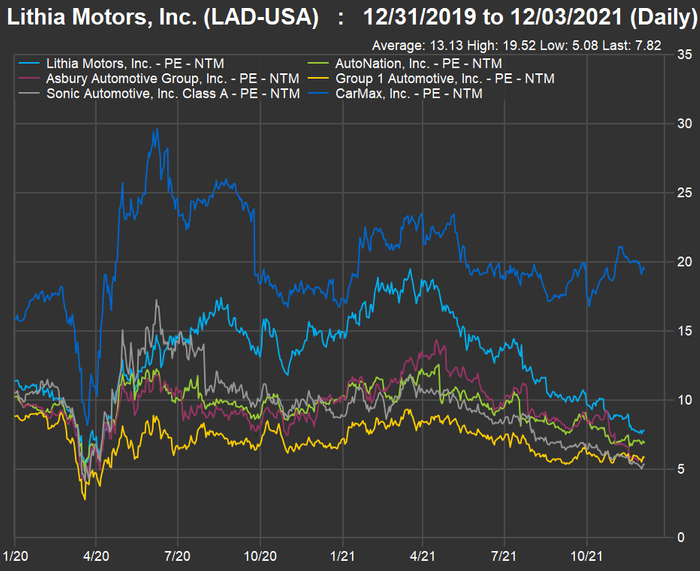
). Here’s how forward price-to-earnings ratios for the six car dealers have moved since the end of 2019:


FactSet

The forward P/E ratios are based on rolling 12-month earnings estimates among analysts polled by FactSet. Click on the tickers for more about each company. Click here for Tomi Kilgore’s detailed guide to the wealth of information for free on the MarketWatch quote page.

The exception to downward P/E movement for these dealers has been CarMax Inc.
KMX,
+1.28%
.

“CarMax has had the most leverage to the used car market, which has been on fire,” Dineen said. The five other dealers on the chart sell both new and used vehicles. Looking ahead over the next two years, as the supply chain presumably recovers and new-car production rebounds, he favors AutoNation Inc.
AN,
+0.43%
,
Asbury Automotive Inc.
ABG,
+4.44%
,
and Sonic Automotive Inc.
SAH,
+5.31%

for an increase in P/E ratios and share prices.

For CarMax, comparisons may get “slippery” over the next two years, if a return to 2019 or 2020 sales levels for new cars causes the used-car market to cool, Dineen said.

Here’s an easier way to compare current forward P/E ratios for the six dealers in the Composite 1500 to their pre-pandemic levels. The list is sorted by market capitalization:

Company

Ticker

Market cap. ($mil)

Forward P/E – Dec. 3, 2021

Forward P/E – Dec. 31, 2019

Average forward P/E since Dec. 31, 2019

CarMax Inc.

KMX,
+1.28%
$23,425

19.5

15.9

20.1

Lithia Motors Inc.

LAD,
+1.06%
$8,899

7.8

11.4

13.1

AutoNation Inc.

AN,
+0.43%
$8,164

6.9

10.3

9.6

Asbury Automotive Group Inc.

ABG,
+4.44%
$4,031

5.8

10.6

9.6

Group 1 Automotive Inc.

GPI,
+2.31%
$3,730

5.9

8.9

7.1

Sonic Automotive Inc. Class A

SAH,
+5.31%
$1,465

5.4

10.5

9.7

Source: FactSet

In contrast to the three dealers he favors (AutoNation, Asbury and Sonic), Dineen pointed out that Ford Motor Co.
F,
+0.42%

trades at a forward P/E of 9.8, while General Motors Co.
GM,
+0.22%

trades at a forward P/E of 8.7. Meanwhile, auto-parts retailers trade much higher, with O’Reilly Automotive Inc.
ORLY,
+0.34%

at a forward P/E of 21.6, AutoZone Inc.
AZO,
+0.91%

at 18.3 and Advance Auto Parts Inc.
AAP,
+1.39%

at 17.4.

Read: AutoZone stock jumps after big profit beat and sales that rose above forecasts, while gross margins decline

Wall Street’s view

Here are expected compound annual growth rates (CAGR) for sales for the six dealers, based on consensus estimates through calendar 2023 among analysts polled by FactSet. Sales numbers are in millions.

Company

Ticker

Estimated revenue – 2021

Estimated revenue – 2022

Estimated revenue – 2023

Two-year estimated sales CAGR

CarMax Inc.

KMX,
+1.28%
$27,946

$30,102

$30,372

4%

Lithia Motors Inc.

LAD,
+1.06%
$22,700

$27,224

$32,416

19%

AutoNation Inc.

AN,
+0.43%
$25,726

$27,369

$28,384

5%

Asbury Automotive Group Inc.

ABG,
+4.44%
$9,623

$15,236

$16,290

30%

Group 1 Automotive Inc.

GPI,
+2.31%
$13,676

$16,343

$18,034

15%

Sonic Automotive Inc. Class A

SAH,
+5.31%
$12,343

$16,890

$18,684

23%

Source: FactSet

Here’s a summary of opinion among brokerage firms’ analysts polled by FactSet:

Company

Ticker

Share “buy” ratings

Share neutral ratings

Share “sell” ratings

Closing price – Dec. 6

Consensus price target

Implied 12-month upside potential

CarMax Inc.

KMX,
+1.28%
61%

33%

6%

$144.50

$152.15

5%

Lithia Motors Inc.

LAD,
+1.06%
80%

13%

7%

$293.88

$469.15

60%

AutoNation Inc.

AN,
+0.43%
33%

67%

0%

$124.57

$156.13

25%

Asbury Automotive Group Inc.

ABG,
+4.44%
60%

40%

0%

$174.24

$249.25

43%

Group 1 Automotive Inc.

GPI,
+2.31%
67%

33%

0%

$206.08

$270.50

31%

Sonic Automotive Inc. Class A

SAH,
+5.31%
67%

22%

11%

$50.14

$71.14

42%

Source: FactSet

CarMax has 61% “buy” or equivalent ratings. However, the stock is close to its target price. The analysts see high double-digit upside for all the others, even though only a third rate AutoNation a buy.

How does Tesla fit in?

When asked about the long-term viability of new-car dealers, in light of Tesla Inc.’s
TSLA,
-0.59%

non-dealer distribution model for its electric vehicles, Dineen said: “What really matters to us is valuation.”

“There is no question that Tesla is an awesome company,” he said, but he added that Tesla’s stock is “priced to win 100% of electric-vehicle sales.”

“When we look at automotive in general, we think the dealers make the most sense,” he said.

Don’t miss: Tesla’s stock is still cheap, says manager of new ETF who made Musk’s EV company its No. 1 holding

Metals Stocks: Gold futures edge up, even as dollar, yields inch higher

Gold futures were rising slightly on Tuesday, but a rally in global stocks, an advance in Treasury yields and a firming dollar may cap the move for the precious commodity.

February gold
GCG22,
-0.13%

GC00,
-0.13%

was trading $4.50, or 0.3%, higher at $1,784 an ounce, after the yellow metal on Monday lost 0.3%.

Treasury yields across the curve were edging up, with the 10-year Treasury note
TMUBMUSD10Y,
1.451%

at around 1.45%, while the U.S. dollar was up by less than 0.1% at 96.381, as gauged by the ICE U.S. Dollar Index
DXY,
+0.23%
.
Richer yields can undercut appetite for non-yielding gold and a stronger greenback can make the dollar-priced commodity more expensive to overseas buyers.

Meanwhile, equities globally were headed higher, diminishing some of the appeal of precious metals, amid hopes that the omicron variant of the coronavirus will prove less damaging to the economy than feared.

Commodity strategists make the case that strong demand for commodities and healthy import and export data out of China may be helping to support buying in gold and other safe-haven assets, despite the factors that would typically serve as headwinds for prices.

“A strong rally in raw commodity sector leader crude oil early this week is supporting upside price action in the metals markets,” wrote Jim Wyckoff, senior analyst at Kitco.com, in a daily note.

March silver
SIH22,
+0.23%
,
meanwhile, rose 14 cents, or 0.6%, to reach around $22.40, after declining 1% on Monday.

Bond Report: Treasury yields edge up as omicron fears ease and Fed meeting next week looms

U.S. Treasury yields edged up again Tuesday morning, as fears about the economic impact of omicron variant of the coronavirus eased, while investors awaited the possibility of the Federal Reserve reducing its bond purchases at a faster pace at its policy meeting next week.

What are yields doing?
  • The 10-year Treasury note
    TMUBMUSD10Y,
    1.451%

    yields 1.437%, up slightly from 1.433% on Monday at 3 p.m. Eastern Time.

  • The rate for the 30-year Treasury
    TMUBMUSD30Y,
    1.774%
    ,
    known as the long bond, was at 1.765%, up from 1.758%.

  • On Monday, the 10- and 30-year Treasurys saw their biggest one-day yield gains since Nov. 10.

  • The 2-year Treasury note yield
    TMUBMUSD02Y,
    0.675%

    was at 0.659%, compared with 0.633% on Monday afternoon. On Monday, the 2-year, which is more sensitive to shifts in interest-rate expectations, hit its highest rate since Nov. 24,

What’s driving the market?

Stocks and commodities were rallying on Tuesday, putting pressure on safe-havens such as government bonds, with the Dow Jones Industrial Average
DJIA,
+1.87%
,
the S&P 500 index
SPX,
+1.17%

and the Nasdaq Composite
COMP,
+0.93%

poised for another day of strong gains, on hopes that the omicron variant of the coronavirus that causes COVID-19 will be less severe and therefore less harmful to the global economic recovery.

Investors were also taking some comfort in the People’s Bank of China’s decision on Monday to reduce the reserve requirement ratio for banks by 0.5 percentage point to 8.4%, starting Dec. 15.

Those factors combined have put some pressure on Treasury yields, but returns on government debt still remain relatively low considering that the Federal Reserve next week is likely to announce a plan for faster tapering of its monthly bond purchases to combat surging inflation.

See: Fed is widely seen backing a faster taper next week

However, Treasurys have drawn some bids because fixed-income investors have been positioning as if the Fed will make a policy mistake that hurts the economy.

The Fed’s next policy gathering is set for Dec. 14-15 and policy makers are in a media blackout period until then.

Looking ahead, investors will be watching a report on U.S. international trade at 8:30 a.m., as well as data on productivity and costs.

Meanwhile, an auction of $54 billion in 3-year notes
TMUBMUSD03M,
0.058%

is scheduled for 1 p.m. ET.

What strategists are saying
  • “Treasury prices are a bit weaker on lighter flows…We continue to look for higher yields ahead of the Fed taper between now and in early 2022,” wrote Tom di Galoma, managing director of Treasurys trading at Seaport Global securities, in a daily note.

Are these FTSE 100 shares (including a 5.7% dividend yield) too cheap to miss?

Antofagasta’s (LSE: ANTO) a FTSE 100 share I’m paying close attention to because of its exceptional all-round value. Firstly, the blue-chip copper miner changes hands on a forward price-to-earnings growth (PEG) ratio of just 0.1. And I know that any sub-1 reading suggests a stock could be undervalued. The company boasts a chunky 4.7% dividend yield too.

Concerns over future Chinese consumption have ratcheted up this week as property giant Evergrande edged closer to default. This threatens to smack the entire commodities-hungry Chinese economy and not just the retail sector. China sucks up more than 50% of all produced copper.

5 Stocks For Trying To Build Wealth After 50

Markets around the world are reeling from the coronavirus pandemic… and with so many great companies trading at what look to be ‘discount-bin’ prices, now could be the time for savvy investors to snap up some potential bargains.

But whether you’re a newbie investor or a seasoned pro, deciding which stocks to add to your shopping list can be a daunting prospect during such unprecedented times.

Fortunately, The Motley Fool UK analyst team have short-listed five companies that they believe STILL boast significant long-term growth prospects despite the global upheaval…

We’re sharing the names in a special FREE investing report that you can download today. And if you’re 50 or over, we believe these stocks could be a great fit for any well-diversified portfolio.

Click here to claim your free copy now!

This is a danger I believe is more than reflected in Antofagasta’s cheap share price of £14, however. I’d actually buy the company’s shares because I expect copper demand to take off as electric vehicle build rates boom. Vast amounts of metal are needed to make the cars and the related infrastructure to help them run. Miners like Antofagasta are in the box seat to exploit this trend.

Another FTSE 100 bargain share?

I think Tesco’s (LSE: TSCO) share price also looks cheap on paper. At a price of 283p the FTSE 100 supermarket also trades on a forward PEG ratio of 0.1.

For a firm with its immense market clout, and more specifically its key position in the fast-growing online grocery segment, this might seem too good to be true. The boffins at Statista reckon sales here will rocket 43.8% during the five years to 2024. Projected growth for online grocery is higher than any other part of the retail industry.

I still fear for Tesco as competition grows, though, and particularly from discounters like Aldi and from Amazon. These companies are expanding their operations online and in the real world to try to grab Tesco’s crown. I’m also concerned by the threat of rising costs in response to soaring inflation and worker shortages. Indeed, strike action is looming at the retailer’s depots in a dispute over wages. It also faces spiralling product costs worsened by supply chain issues.

5.7% dividend yields

I’d be more content to park my cash with Barratt Developments (LSE: BDEV). I already own shares in this FTSE 100 housebuilder and I’m considering upping my stake given the strength of Britain’s housing market. According to Halifax , house prices in the UK rose 3.4% between September and November. This was the fastest rate of growth since 2006.

These figures illustrate how robust the underlying health of Britain’s housing market is. Full-fat Stamp Duty has returned in recent months. But a myriad of factors continue to push buyer demand through the roof, from ultra-low interest rates and generous mortgage products from lenders, to ongoing Help to Buy support for first-time purchasers.

I don’t think Barratt’s low share price reflects the strength of trading conditions today. It trades on a forward PEG ratio of just 0.5. On top of this, at a current price of 727p the builder sports a monster 5.7% dividend yield. I expect this cheap UK share to continue strongly, even though building materials shortages could send costs higher and dent its margins.

5 Stocks For Trying To Build Wealth After 50

Markets around the world are reeling from the coronavirus pandemic…

And with so many great companies still trading at what look to be ‘discount-bin’ prices, now could be the time for savvy investors to snap up some potential bargains.

But whether you’re a newbie investor or a seasoned pro, deciding which stocks to add to your shopping list can be a daunting prospect during such unprecedented times.

Fortunately, The Motley Fool is here to help: our UK Chief Investment Officer and his analyst team have short-listed five companies that they believe STILL boast significant long-term growth prospects despite the global lock-down…

You see, here at The Motley Fool we don’t believe “over-trading” is the right path to financial freedom in retirement; instead, we advocate buying and holding (for AT LEAST three to five years) 15 or more quality companies, with shareholder-focused management teams at the helm.

That’s why we’re sharing the names of all five of these companies in a special investing report that you can download today for FREE. If you’re 50 or over, we believe these stocks could be a great fit for any well-diversified portfolio, and that you can consider building a position in all five right away.

Click here to claim your free copy of this special investing report now!


John Mackey, CEO of Whole Foods Market, an Amazon subsidiary, is a member of The Motley Fool’s board of directors. Royston Wild owns shares of Barratt Developments. The Motley Fool UK has recommended Amazon and Tesco. Views expressed on the companies mentioned in this article are those of the writer and therefore may differ from the official recommendations we make in our subscription services such as Share Advisor, Hidden Winners and Pro. Here at The Motley Fool we believe that considering a diverse range of insights makes us better investors.

Europe Markets: European stocks enjoying second-best day of the year

European stocks on Tuesday were enjoying their second-best day of the year, rallying on signs that the omicron variant of coronavirus might not be as harmful as initially feared.

The Stoxx Europe 600
SXXP,
+1.88%

rose 1.7% to 476.82, on track for the best single-day advance since the 2.1% gain on March 8.

Of the major regional indexes, the German DAX
DAX,
+2.02%

surged 1.8%, the French CAC 40
PX1,
+2.25%

surged 2% and the U.K. FTSE 100
UKX,
+1.14%

added 1.1%.

Tech stocks led Tuesday’s rally, with semiconductor equipment maker ASML
ASML,
+5.60%

advancing 6%, and Aixtron
AIXA,
+4.98%

also rising 6%.

“The reasons for today’s positive tone are numerous: reduced concerns over the severity of omicron; improved confidence over China’s response to the property sector woes; and a swath of strong global macro data,” said David Rosenberg, chief economist and strategist at Rosenberg Research.

Chinese trade data and German industrial production reports helped buoy sentiment, which in large part was carried forward by optimism from Dr. Anthony Fauci that the omicron variant, so far, isn’t more harmful than other variants.

China’s decision on Monday to cut its reserve ratio for banks also helped sentiment.

Financial News

Daily News on Investing, Personal Finance, Markets, and more!

Financial News

Policy(Required)