Watch out! Your supermarket trolley could add 25% to your shop

Image source: Getty Images


The weekly food shop is an expense that every household in the UK will be accustomed to. As a result, supermarket chains are amongst some of the wealthiest retail companies in the world. The average store brings in £160.5 billion every single year!

Despite these profits, supermarkets have ways to trick customers into spending more money than they need to. Recent reports have revealed the latest supermarket trick that could have you spending 25% more each time you visit!

Here’s how to spot it and how you could make savings on your food shop this year.

The trolley that makes you spend more at the supermarket!

Some UK supermarkets are now using parallel-handled trolleys that have handles like those on a wheelbarrow rather than one straight handlebar. Recent research by Bayes Business School has found that the newly designed parallel-handled trolley could add £7 to your weekly shop!

The reason behind the new trolley’s impact is likely to be unexpected!

According to the research, when shoppers push the new trolley, it activates their bicep muscles instead of their tricep muscles. The psychology behind it is that we associate using our bicep muscles with pulling things towards us and our tricep muscles with pushing things away. Apparently, using parallel-handled trolleys puts shoppers in a better position to accept things that they like. And as a result, they are more likely to add more to their trolley!

City, University of London conducted a further survey that found the new trolley design could increase your food shop by 25%. With the old trolley, participants in the survey spent an average of £22. However, those who used the new design added an extra £7 worth of goods to their basket.

How to save money on your food shopping

In light of this research, the most obvious way to save money on your food shopping is to stick to the traditional shopping trolley!

However, even before the new trolleys came into play, Brits still spent more than they needed to on their weekly shop. If you are guilty of overspending at the supermarket each week, here’s how to make some serious savings!

Shop at the right time

I worked in Morrisons for over a year, and I learned that timing your food shop really matters!

If you shop at the right time, you will notice that many food items are reduced by up to half of their original price! Supermarkets do this for fresh produce that can’t be sold past its sell-by date.

To reduce waste, staff spend the end of each working day decreasing the price of items that are close to their sell-by date. Therefore, if you chose to shop near closing time, you could bag yourself some great savings!

Collect points and use loyalty cards

Ever said ‘no’ when asked if you want to sign up for a loyalty card?

Too often, shoppers decline to sign up in a bid to save time or avoid being bombarded with spam emails. However, signing up for supermarket loyalty schemes could actually lead to excellent savings!

For example, if you walk around Tesco you will notice that most items have two prices. The more expensive price is how much a non-Clubcard member will need to spend. The cheaper price (usually shown in yellow) is the cost for anyone who has a loyalty card.

While the price differences may seem small at first, making the most of Clubcard offers every time you shop can really add up! Tesco claims that it saves its customers £400 per year with its Clubcard scheme.

Making a shopping list

This one may sound simple, but you may be shocked at the difference a basic shopping list can make to your expenses!

Having a list to hand when you do your shop will stop you from buying extra items that you don’t need. This means that, even with supermarket tricks in place, you should be able to say no to items that aren’t necessary.

The best way to make a shopping list is to plan your weekly meals in advance and buy only the items that are needed for these meals. A good tip is to try to plan your meals so that some ingredients can be used more than once to cut down the number of items you need to buy.

Use coupons

It’s common practice to use discount codes and coupons when shopping online. However, many UK supermarket shoppers don’t realise they can use discounts in store as well!

Some supermarkets will send discount codes to loyalty scheme members, but others can be trickier to find. 

A great place to look is WeThrift. The discount site regularly uploads working codes that can be used to save money in hundreds of UK stores. Simply download the coupon and show it in store to receive money off your next food shop. 

Products from our partners*

Top-rated credit card pays up to 1% cashback

With this top-rated cashback card cardholders can earn up to 1% on all purchases with no annual fee. Plus, there’s a sweet 5% welcome cashback bonus (worth up to £100) available during the first three months!

Those are just a few reasons why our experts rate this card as a top pick for those who spend regularly and clear their balance each month. Learn more here and check your eligibility before you apply in just 2 minutes.

*This is an offer from one of our affiliate partners. Click here for more information on why and how The Motley Fool UK works with affiliate partners.Terms and conditions apply.

Was this article helpful?

YesNo


Some offers on The Motley Fool UK site are from our partners — it’s how we make money and keep this site going. But does that impact our ratings? Nope. Our commitment is to you. If a product isn’t any good, our rating will reflect that, or we won’t list it at all. Also, while we aim to feature the best products available, we do not review every product on the market. Learn more here. The statements above are The Motley Fool’s alone and have not been provided or endorsed by bank advertisers. John Mackey, CEO of Whole Foods Market, an Amazon subsidiary, is a member of The Motley Fool’s board of directors. The Motley Fool UK has recommended Barclays, Hargreaves Lansdown, HSBC Holdings, Lloyds Banking Group, Mastercard, and Tesco.

This FTSE 250 stock is down over 20% in 6 months! Is it an opportunity?

FTSE 250 incumbent Moonpig (LSE:MOON) has seen its share price drop in the past six months. At current levels, is there an opportunity for me to pick up cheap shares for my portfolio? Let’s take a look.

Greeting cards giant

Moonpig is an internet-based greeting cards, gifts, and flower business. The rise in tech has seen the greeting cards market move online where consumers can pick, personalise, and directly send a greeting card, a gift, or flowers, to a loved one.

5 Stocks For Trying To Build Wealth After 50

Markets around the world are reeling from the coronavirus pandemic… and with so many great companies trading at what look to be ‘discount-bin’ prices, now could be the time for savvy investors to snap up some potential bargains.

But whether you’re a newbie investor or a seasoned pro, deciding which stocks to add to your shopping list can be a daunting prospect during such unprecedented times.

Fortunately, The Motley Fool UK analyst team have short-listed five companies that they believe STILL boast significant long-term growth prospects despite the global upheaval…

We’re sharing the names in a special FREE investing report that you can download today. And if you’re 50 or over, we believe these stocks could be a great fit for any well-diversified portfolio.

Click here to claim your free copy now!

As I write, shares in Moonpig are trading for 380p, whereas six months ago shares were trading for 21% higher at 487p. Moonpig shares are down 7% over a 12-month period overall as they were trading for 410p this time last year.

I believe Moonpig’s share price has been detrimentally affected by recent performance linked to macroeconomic issues and pressures.

Bearish attitude

There are a few factors that are putting me off Moonpig shares right now. Firstly, performance has dropped from 2021 levels, which is worrying. The FTSE 250 incumbent released an interim report today for the six months ended 31 October. It showed that revenue and profit were 8.5% and 30.6% less than the same period last year. There were some positives which pointed towards a higher customer base and a new record for attached gifting levels. This is when a consumer attaches a gift to a card when making a purchase. Furthermore, debt levels did decrease too.

Debt is a major concern for me. Moonpig shares only debuted on the London Stock Exchange in February and the share price has been quite volatile since then. Debt levels are quite high and Moonpig points towards “technical reasons” which usually means technology-related cost and infrastructure needed to run an online-only business.

Competition in the online greeting sector is getting intense. Other major players in the market are vying for the same customer base. Funky Pigeon is one such competitor.

The rise in cases and the new Omicron variant will worry consumers as, after all, greeting cards are a discretionary or luxury expense. If cases rise and restrictions come into force, consumers may be worried about their pockets and steer clear of non-essential spending.

Finally, rising inflation and costs are a worry for all businesses and Moonpig is not exempt. Rising costs can affect margins and investor returns and if these costs are passed on to its customers, the same customers could look for cheaper alternatives. 

A stock I’m avoiding

At current levels and the current state of play, I would not buy Moonpig shares. Despite its cheapened share price, for me the negatives outweigh any positives the firm does possess. It is worth noting that some of the issues could be short term. These include Covid-19 implications and rising inflation. I believe 2021 performance was over-inflated due to the pandemic. This led to people keeping in touch using technology. I personally used online greeting cards when I wasn’t able to see my friends and loved ones while in lockdown. I will keep an eye on developments.

FREE REPORT: Why this £5 stock could be set to surge

Are you on the lookout for UK growth stocks?

If so, get this FREE no-strings report now.

While it’s available: you’ll discover what we think is a top growth stock for the decade ahead.

And the performance of this company really is stunning.

In 2019, it returned £150million to shareholders through buybacks and dividends.

We believe its financial position is about as solid as anything we’ve seen.

  • Since 2016, annual revenues increased 31%
  • In March 2020, one of its senior directors LOADED UP on 25,000 shares – a position worth £90,259
  • Operating cash flow is up 47%. (Even its operating margins are rising every year!)

Quite simply, we believe it’s a fantastic Foolish growth pick.

What’s more, it deserves your attention today.

So please don’t wait another moment.

Get the full details on this £5 stock now – while your report is free.


Jabran Khan has no position in any of the shares mentioned. Views expressed on the companies mentioned in this article are those of the writer and therefore may differ from the official recommendations we make in our subscription services such as Share Advisor, Hidden Winners and Pro. Here at The Motley Fool we believe that considering a diverse range of insights makes us better investors.

This penny stock is up 75% in 12 months and I think it will continue to rise!

Penny stocks are often seen as high risk investments that can sometimes yield high reward. In Pendragon (LSE:PDG), I believe I have found one pick that could be a great growth opportunity for my portfolio. Here’s why I like it.

Car market booming

Pendragon is the second-largest motor retailer in the UK. It represents 21 different vehicle manufacturers in the automotive retail sector and operates over 160 sites throughout the UK.

5 Stocks For Trying To Build Wealth After 50

Markets around the world are reeling from the coronavirus pandemic… and with so many great companies trading at what look to be ‘discount-bin’ prices, now could be the time for savvy investors to snap up some potential bargains.

But whether you’re a newbie investor or a seasoned pro, deciding which stocks to add to your shopping list can be a daunting prospect during such unprecedented times.

Fortunately, The Motley Fool UK analyst team have short-listed five companies that they believe STILL boast significant long-term growth prospects despite the global upheaval…

We’re sharing the names in a special FREE investing report that you can download today. And if you’re 50 or over, we believe these stocks could be a great fit for any well-diversified portfolio.

Click here to claim your free copy now!

The Covid-19 pandemic has had an effect on many industries and the automotive sector is no different. There is a shortage of new cars (more on that later) but the used car market is booming. Furthermore, climate change discussions and mandates for net zero carbon emissions are becoming more prevalent. This has led people to turn towards purchasing cleaner, more environmentally friendly electric vehicles (EV).

Penny stocks are those that trade for less than £1. As I write, the shares in Pendragon are trading for 21p. At this time last year, shares were trading for 12p, which is a 75% increase. I think shares could rise further too.

Why I like Pendragon

Pendragon has a diversified business model and an international presence, which helps it to generate revenue and profit through different channels. It runs new and used car showrooms with different manufacturers as partners in the UK and in the US. These are usually under its Evans Halshaw and Stratsone brands. Next, it runs a wholesale vehicle parts business under the QuickCo banner. In addition, it owns Pinewood Technologies. This arm of the company provides software solutions to the automotive industry. Finally, it also operates a separate fleet and leasing business through its Pendragon Vehicle Management business.

When looking for the best penny stocks I look at recent and past performance. I understand past performance is not a guarantee of the future but I use it as a gauge nevertheless. I can see revenue recorded was above £4bn for three years before the pandemic-affected year of 2020. Coming up to date, a brief Q4 update announced on 1 December saw Pendragon confirm it had upgraded its profit guidance for the full year to 31 December which shows performance is strong.

At current levels, Pendragon looks like a cheap penny stock option for my portfolio. It sports a price-to-earnings ratio of just six, which is cheap for a large, successful firm with an international presence and a diverse offering.

Penny stocks have greater risks

Pendragon could see performance and growth affected by the current shortage of new vehicles being produced. This is directly linked to a shortage of semiconductors which are essential parts of EVs. Furthermore, macroeconomic pressures such as supply chain issues and HGV driver shortages could affect UK operations and performance in its showrooms.

Overall I believe Pendragon could be a good addition to my portfolio at current levels and I would happily add the shares to my portfolio. It has a good track record and recent performance has been strong too. Shares right now look cheap, which means I could see some lucrative returns in the longer term. As with most penny stocks, I am prepared for some potential pain linked to the risks noted earlier.

FREE REPORT: Why this £5 stock could be set to surge

Are you on the lookout for UK growth stocks?

If so, get this FREE no-strings report now.

While it’s available: you’ll discover what we think is a top growth stock for the decade ahead.

And the performance of this company really is stunning.

In 2019, it returned £150million to shareholders through buybacks and dividends.

We believe its financial position is about as solid as anything we’ve seen.

  • Since 2016, annual revenues increased 31%
  • In March 2020, one of its senior directors LOADED UP on 25,000 shares – a position worth £90,259
  • Operating cash flow is up 47%. (Even its operating margins are rising every year!)

Quite simply, we believe it’s a fantastic Foolish growth pick.

What’s more, it deserves your attention today.

So please don’t wait another moment.

Get the full details on this £5 stock now – while your report is free.


Jabran Khan has no position in any shares mentioned. The Motley Fool UK has recommended Pendragon. Views expressed on the companies mentioned in this article are those of the writer and therefore may differ from the official recommendations we make in our subscription services such as Share Advisor, Hidden Winners and Pro. Here at The Motley Fool we believe that considering a diverse range of insights makes us better investors.

: Senate to begin process that would make raising the debt limit easier

The Senate on Thursday will take another step in a process that is designed to allow Democrats to raise the U.S. debt limit on their own, as Washington works to avert a default.

The House of Representatives on Tuesday passed legislation that kicked off the multi-step process. In the Senate, at least 10 Republicans will need to support legislation that sets up a simple-majority vote on the debt limit. Earlier this week, Senate Minority Leader Mitch McConnell, a Kentucky Republican, said he was confident enough GOP senators would back the process.

Read: Congressional leaders reach deal to raise debt limit, likely averting default

If Thursday’s vote clears the Senate, Congress would have to vote later on a separate bill lifting the borrowing limit, including a dollar amount. That measure would be able to pass since Democrats control the Senate with 50 members, and Vice President Kamala Harris may cast tie-breaking votes.

Treasury Secretary Janet Yellen has urged lawmakers to act by Dec. 15. The votes come amid sparring over President Joe Biden’s massive social-spending plan, and Republicans are eager to paint Democrats as fiscally irresponsible as next year’s midterm elections loom.

Democrats “want to create even more inflation on their own. So, as Republicans have made clear for months, they will have to own a debt ceiling increase as well,” McConnell said on Wednesday.

Senate Majority Leader Chuck Schumer, a New York Democrat, says his party wants to pass the debt-limit increase “to pay the debts we have already incurred, just like any household must do.” Schumer and McConnell had weeks of talks over the debt-limit deal.

Democrats plan to pay for Biden’s “Build Back Better” plan, meanwhile, through a new corporate minimum tax and raising taxes on high-income Americans.

U.S. stock indexes
SPX,
-0.38%

on Thursday traded modestly lower, despite a better-than expected report on those seeking unemployment benefits insurance, which carved out a new pandemic-era low. 

Go-Ahead Group has crashed 20% today! Would I buy it?

The nature of the stock markets is such that we never know what is coming around the bend. There could be a boom or a bust in the broad stock markets as a result of unexpected occurrences. Or there could be changes to an individual company’s prospects, for better or for worse. The UK stock I am referring to today, is the latter kind. Transport operator Go-Ahead Group (LSE: GOG) has had an awful start to the day. Its share price is down by almost 20% as I write!

Long-drawn out concerns

But its share price troubles are hardly restricted to today. It has also had an awful six months. Its share price has fallen by 54% as I write. I could take into account the fact that a number of stocks have lost at least some of their value gains since the stock market rally that started in November last year. But I still cannot overlook the fact that even over the past year, the stock is down by some 43%. 

5 Stocks For Trying To Build Wealth After 50

Markets around the world are reeling from the coronavirus pandemic… and with so many great companies trading at what look to be ‘discount-bin’ prices, now could be the time for savvy investors to snap up some potential bargains.

But whether you’re a newbie investor or a seasoned pro, deciding which stocks to add to your shopping list can be a daunting prospect during such unprecedented times.

Fortunately, The Motley Fool UK analyst team have short-listed five companies that they believe STILL boast significant long-term growth prospects despite the global upheaval…

We’re sharing the names in a special FREE investing report that you can download today. And if you’re 50 or over, we believe these stocks could be a great fit for any well-diversified portfolio.

Click here to claim your free copy now!

And in fact, going by the latest developments related to it, I reckon there could be some more pain in store. The company has just said that it would be unable to release its results in time, which would lead to a suspension in trading in its stock from 4 January 2022. It does hope to release its numbers by the end of the month, which could restart trading.  

What’s going on with the Go-Ahead Group share price?

Disappointing as this situation is, I would be less concerned about this aspect if the underlying trigger was not quite as serious as it is. Its franchise, London & South Eastern Railway Ltd (LSER), failed to inform the Department of Transport about overpayment of some monies. The department has now taken over the delivery of services from this franchise, and LSER’s contract has not been renewed.

As a potential investor in the stock, I think this could have long-term consequences for the company, in terms of reputational damage. It would anyway miss out on some revenues now and its future revenue stream could also be reduced. This only adds to the struggles faced by travel-related companies during the pandemic, which is not exactly over. 

My assessment of the UK stock

I do not think that the stock is a total write-off though. In fact, I quite liked it before this current fiasco. And it is just a matter of chance that I did not end up buying the stock earlier in the year. I do believe that in time, it could find itself in favour again. And I mean the favour of both the authorities from which it gets business and of investors. But for now, I am not holding my breath. I will watch developments pertaining to it, and I think it will be a few months before I know better where the stock is at. I will take an investment decision on it then.


Manika Premsingh has no position in any of the shares mentioned. The Motley Fool UK has no position in any of the shares mentioned. Views expressed on the companies mentioned in this article are those of the writer and therefore may differ from the official recommendations we make in our subscription services such as Share Advisor, Hidden Winners and Pro. Here at The Motley Fool we believe that considering a diverse range of insights makes us better investors.

: Mortgage rates moves sideways as investors await the Fed’s next steps

Mortgage rates have barely budged in weeks — but that could change as the Federal Reserve is set to meet next week.

The 30-year fixed-rate mortgage averaged 3.1% for the week ending Dec. 9, down one basis point from the previous week, Freddie Mac
FMCC,
+5.21%

reported Thursday. The 15-year fixed-rate mortgage fell by the same amount to an average of 2.383%. The 5-year Treasury-indexed adjustable-rate mortgage, meanwhile, averaged 2.45%, down four basis point from the previous week.

“Going forward, the path that rates take will be directly impacted by more information about the omicron variant as it is revealed and the overall trajectory of the pandemic,” said Sam Khater, chief economist at Freddie Mac, in this week’s report. “In the meantime, rates remain low and stable, even as the nation faces declining housing affordability and low inventory.”

Long-term bond yields, including the 10-year Treasury note
TMUBMUSD10Y,
1.477%
,
fluctuated over the past week, responding to mixed signals on the labor market and positive indications regarding the effectiveness of certain treatments to the latest strain of the virus that causes COVID-19.

The variant isn’t the only factor that’s set to influence interest rates in the near future. The latest edition of the consumer price index will be released Friday, which will provide insight as to the pace of inflation. That could influence central bankers when the Federal Reserve meets next week. That meeting could determine how quickly the Fed tapers its asset-purchasing activities and hikes short-term interest rates.

“With markets now anticipating the Federal Reserve to be more hawkish in fighting inflation, expectations for accelerated bond purchase tapering and rate hikes are beginning to be priced into rates markets,” said Paul Thomas, vice president of capital markets at Zillow
Z,
-1.92%

ZG,
-2.42%
.

The latest data on mortgage applications suggests that the pace of home sales remains strong, even in spite of growing affordability challenges. Whether that trend will continue into 2022 will depend on how robustly interest rates respond to changes in the country’s fiscal policy.

Coronavirus Update: Omicron cases have been ‘mild,’ says CDC director, though majority so far are in the vaccinated

The number of people who have tested positive for omicron in the U.S. remains low, but hospitals and health officials remain on high alert as the overall number of COVID-19 cases continues to tick up and some hospitals are pressured by a growing number of cases.

Forty-three people in 19 states have tested positive for omicron, according to remarks made to the Associated Press by Dr. Rochelle Walensky, director of the Centers for Disease Control and Prevention. About 75% of those cases are in people who are fully vaccinated, and one person has been hospitalized. One-third of those individuals had traveled internationally; one-third had received a booster. The cases so far have been “mild,” she said. 

The U.S. reported the first case of omicron last week, in a fully vaccinated individual who had recently traveled to South Africa. 

The new variant, which was first detected in South Africa, is thought to be more infectious; however, it’s unclear if it causes more severe disease. A study in Japan showed that the omicron variant was 4.2 times more contagious than the delta strain, according to a Bloomberg report on Thursday.

Meanwhile, as overall number of cases rise, some hospitals in the U.S. are already struggling to meet the demand from COVID-19 patients.

Geisinger, a large hospital system in Pennsylvania, said it ran out of beds and patients are waiting between 10 and 20 hours in the emergency room to receive care, according to Newsweek. Michigan Medicine, a hospital in Ann Arbor, is canceling elective surgeries as its hospital beds fill up with COVID-19 patients. Vermont’s hospitalizations are at a record high.

That said, there are some new regulatory changes underway.

The FDA on Wednesday authorized the first therapy that can be used for pre-exposure prophylaxis, and the infusions may be used for some people who may not be able to gain protective antibodies through COVID-19 vaccination. AstraZeneca’s
AZN,
+0.81%

AZN,
+1.12%

COVID-19 monoclonal antibodies can be prescribed for some individuals who are immunocompromised or have a history of severe adverse reactions to a COVID-19 vaccine.

The regulator is also expected to authorize BioNTech SE
BNTX,
+0.76%

and Pfizer Inc.’s
PFE,
+2.45%

COVID-19 booster for 16 and 17-year-olds, after telling Bloomberg that it does not plan to hold an advisory committee meeting to discuss authorization of a booster in this age group.

Here’s what else you should know about COVID-19

The virus apparently attacks fat tissue, in addition to immune cells located within fat cells, according to a preprint reported on by the New York Times. “This could well be contributing to severe disease,” Dr. Catherine Blish, one of the report’s authors, told the Times. 

Health experts say that they have doubts about CDC data that says 99.9% of seniors in the U.S. have had at least one dose of a COVID-19 vaccine, reports Kaiser Health News. They say that the data doesn’t match what some states are saying and what’s been reported in polls.  

The latest COVID-19 numbers

The daily average case count in the U.S. rose to 121,311 on Wednesday, the highest since Sept. 24 and a 27% increase from two weeks ago, according to the New York Times tracker. The daily average death toll is down 1,275, from 1,298, on Tuesday, but is up 12% from a week ago, while hospitalizations increased 20%, to an eight-week high of 61,936.

More than 200 million people in the U.S. are now fully vaccinated, according to the CDC. That’s 60.4% of the population. About 48.9 million people, which is one quarter of the U.S. population, has received a booster dose.

The World Health Organization said weekly COVID-19 cases continue to plateau worldwide but are increasing in Africa (by 79%) and the Americas (by 21%).

: Inflation may linger in the U.S. because of the initial coronavirus assistance programs, researcher finds

Inflation’s a global phenomenon as disruptions to supply chains affect product availability globally, but it’s particularly hot in the U.S.

Consumer prices in the 12 months ending October jumped 6.2%, the Labor Department reported last month, ahead of Friday’s release of November data. In the euro zone, consumer prices climbed 4.1%, while in Japan consumer prices rose a scant 0.1%.

One reason U.S. inflation might be hotter than the rest of the world is how countries decided to help their workers in the early days of the pandemic.

The U.S. mostly relied on generous unemployment benefits and direct stimulus checks, while Europe and Japan, by contrast, mostly relied on furlough programs.

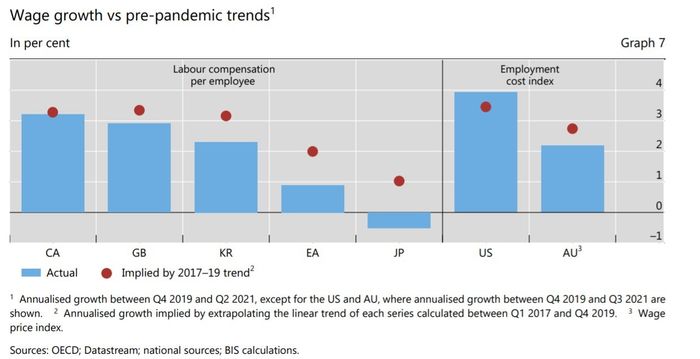
Hyun Song Shin, economic adviser and head of research at the Bank for International Settlements, finds that in some respects, the differing strategies got the jobs market back to similar places. Since the fourth quarter of 2019, the change in hours worked followed similar paths.

But the composition was far different. In the U.S., the rise in average hours worked was mostly due to lower unemployment, as well as a pickup in participation in the jobs market. In other developed markets, Shin found, the rise in average hours worked reflects workers taking on more hours at the same companies where they were previously employed.

Europe and Japan have not confronted the same issues the U.S. has found with a surge in job openings. “Preserving the employment relationship appears to have kept the economy on a path where the recovery is closer to bringing the economy to its pre-pandemic state, at least in terms of the Beveridge curve relationship,” said Shin, who previously was an economics professor at Princeton University. The Beveridge curve refers to the relationship between job openings and unemployment.

The U.K., he concedes, is one place that did rely on furlough programs but also has seen a rise in job vacancies. But in most advanced economies, average wage growth is more or less in line with pre-pandemic trends, or a little below. “It is notable, however, that in the United States, where labor market changes are most apparent, wage growth has picked up despite labor market conditions that appear weaker than before the pandemic,” he said.

And that’s why he suggests the U.S. might be facing an inflation problem longer than other economies.

“The key to gauging where global inflation is headed is in the labor market, and whether the reduced efficiency of matches exhibited in the Beveridge curves of some economies translates into a more sustained wage-price spiral. In this respect, longer-term structural issues are more important in understanding the current state of the global economy, especially when we consider future inflation developments,” he said.

London Markets: FTSE 100 slumps as airlines and travel stocks struggle in U.K., amid talk of COVID restrictions

London stocks were under pressure on Thursday, with investors weighing the potential cost of fresh restrictions in London, while the pound softened against rivals as Goldman Sachs pushed back expectations for interest-rate increases.

The FTSE 100 index
UKX,
-0.39%

fell around 0.4% to 7,310.01. The pound
GBPUSD,
-0.04%

was unchanged at $1.3208, and is down about 0.2% this week.

British Prime Minister Boris Johnson on Wednesday announced COVID-19 passes would be mandatory for entry into nightclubs or large venues and urged individuals to once again work from home. The government has warned of cases doubling every two or three days.

Sven Jari Stehn, economist at Goldman Sachs, said in a note on Wednesday that given that new information on the omicron variant is trickling out slowly right now, “it is difficult to have strong conviction for the outcome of the upcoming MPC meeting.” The Bank of England’s Monetary Policy meeting is scheduled for Dec. 16.

“Previously, we had thought a 15[basis point] hike in December was more likely than not, but this was a close call. We now think risk management considerations will dominate in next week’s [monetary policy committee] deliberations,” said Stehn, in a note.

Meanwhile travel-related stocks were trading lower in London. Expectations of more restrictions around the globe were weighing on the sector, despite, Pfizer’s
PFE,
+1.86%

assessment that three vaccines can “neutralize” the omicron variant — based on an early, lab study, said Chris Beauchamp, chief market analyst at IG.

“The U.K.’s move to new restrictions points toward the expected playbook for the weeks to come, and could well put some pressure on equity markets in what is normally a fairly positive time,” Beauchamp wrote in a note.

Shares of International Consolidated Airlines
IAG,
-3.42%

fell 3.7%, InterContinental Hotels
IHG,
-1.41%

IHG,
-1.21%

shares were down 2%. Wizz Air
WIZZ,
-3.15%

shares fell 3.7%. Rolls-Royce
RR,
-4.21%

shares also declined top decliner, despite a trading update from the aeroengine manufacturing company.

Rolls-Royce said it restored positive free cash flow in the third quarter and a gradual recovery international flying, alongside a market recovery for its power systems were helping to drive that performance. The stock has lost 16% in the past month, noted Beauchamp.

On the move higher were shares of Moonpig
MOON,
+3.91%
,
up over 2% after the recently floated online greeting-card and gift platform said Thursday first-half 2022 pretax profit fell on lower revenue, but sees full-year revenue to be at the upper end of guidance.

The Ratings Game: GameStop stock falls after earnings, and Wall Street bear says ‘still no turnaround strategy in sight’

Shares of GameStop Corp. slumped Thursday, in the wake of the videogame retailer’s fiscal third-quarter report, and while analyst Michael Pachter at Wedbush expressed some optimism about the outlook for next year, he still believes valuations warrant a bearish rating.

The company reported late Wednesday a much wider-than-expected loss for the quarter to Oct. 30, as sales rose above forecasts but cost of sales outpaced sales growth to knock gross margins by nearly three percentage points.

GameStop also disclosed that the Securities and Exchange Commission issued a subpoena calling for additional documents related to an investigation into trading activity in the “meme stock” earlier this year.

Don’t miss: Opinion: If GameStop earnings looked weak to you, you’re not who GameStop really cares about.

The stock
GME,
-4.55%

dropped as much as 5.4% after the open, then pared losses to be down 2.4% in morning trading. The stock has now plunged 31.5% since it closed at a 5 1/2-month high of $247.55 on Nov. 22.

A stock selloff on the day after earnings shouldn’t be much of a surprise to investors, as the stock has fallen the day after 11 of the previous 13 quarterly reports.

Wedbush’s Pachter reiterated the underperform rating he’s had on the stock since March, and cut his price target to $45 from $50. His new target implies about 73% downside from current levels.

“Yet again, management failed to provide clarity around a long-awaited digital transformation plan that has been hinted at in the past but has yet to crystallize,” Pachter wrote in a note to clients, which he titled “Another quarter, still no turnaround strategy in sight.”

He did make some positive comments about the company, however, saying that with sales growth expected to be “flattish” in 2022, he remains “quite optimistic” that GameStop will return to profitability by then. Meanwhile, he reiterated that it’s not the company’s financial and business outlook that keeps him bearish.

“The high-profile short squeeze that emerged earlier this year and ongoing support from certain retail investors…have spiked the share price to levels that are completely disconnected from the fundamentals of the business,” Pachter wrote. “The current share price level coupled with management’s failure to clearly articulate a growth strategy leads us to believe that an underperform rating is warranted.”


FactSet, MarketWatch

The stock achieved its “meme” status after the stock rocketed 1,745% from the end of 2020 through Jan. 27, when it closed at a record $347.51. Although the stock has more than halved since then, it was still up 800% year to date, while the S&P 500 index
SPX,
-0.29%

has advanced 25%.

Read more: GameStop and AMC stocks soar on another day of wild trading in heavily shorted companies.

Also read: GameStop frenzy puts clearinghouses in spotlight as investors weight systemic risk fears.

Financial News

Daily News on Investing, Personal Finance, Markets, and more!

Financial News

Policy(Required)