How I’m trying to invest like billionaire Ray Dalio with this gold ETC

Ray Dalio, the American financier, has often mentioned holding gold as part of a diversified portfolio. This is a sentiment that the founder of Bridgewater Associates (the hedge fund behemoth) repeated again during a recent interview with CNBC.  

The case for gold

I’ve always been keen on allocating a small portion of my own portfolio to gold for two reasons.

5 Stocks For Trying To Build Wealth After 50

Markets around the world are reeling from the coronavirus pandemic… and with so many great companies trading at what look to be ‘discount-bin’ prices, now could be the time for savvy investors to snap up some potential bargains.

But whether you’re a newbie investor or a seasoned pro, deciding which stocks to add to your shopping list can be a daunting prospect during such unprecedented times.

Fortunately, The Motley Fool UK analyst team have short-listed five companies that they believe STILL boast significant long-term growth prospects despite the global upheaval…

We’re sharing the names in a special FREE investing report that you can download today. And if you’re 50 or over, we believe these stocks could be a great fit for any well-diversified portfolio.

Click here to claim your free copy now!

First, the precious metal is considered a hedge against inflation. This is because inflation decreases the purchasing power of a currency, so you need more currency to buy the same amount of gold.

Second, it can provide protection against a sudden market downturn. The price of gold is largely seen as negatively correlated with stock prices, as when the market collapses, investors flock to the asset as a safe haven.

However, gold is by no means perfect. Central banks can raise interest rates in response to inflation. In this case, an asset without any earnings such as gold may not be as good as investments that pay earnings, such as high-dividend shares.

Options for investing

There are a few options available for investing in gold. For example, it’s possible to buy physical gold from the Royal Mint or other precious metal brokers, but that opens up questions about storage, which can be costly.

In my opinion, one of the easiest ways for me to buy is through a gold ETC (exchange traded commodity). This is a fund tracking the spot price of gold, but it trades like a stock and can be bought and sold through most online brokers.

There are lots of gold ETCs available, but for my portfolio, I choose to use two factors. First the size of the fund and second, the expense ratio.

I prefer iShares Physical Gold ETC (LSE:SGLN), which tracks the gold spot price and scores well against my measures. It’s large in size (over £9bn) and has a low ongoing charge of 0.15%. I also draw comfort knowing that the fund has been going for over 10 years now.

Performance and opinion

The performance has been mixed. The fund is down around 6% year-to-date and 2% year-on-year. Over a five-year period, the return has been much better at over 50%.

Looking ahead, it’s difficult for me to see where the share price could go. The value of gold and therefore of this ETC will be largely determined by the macro environment, which at present is so uncertain. 

Despite this, I still consider this ETC as a sensible component for my portfolio. The hope is that iShares Physical Gold ETC will act as a kind of insurance policy against a stock market crash or inflation.

Therefore I’m comfortable following the advice of Ray Dalio and I’ve allocated a small portion of my holdings to it.

Is this little-known company the next ‘Monster’ IPO?

Right now, this ‘screaming BUY’ stock is trading at a steep discount from its IPO price, but it looks like the sky is the limit in the years ahead.

Because this North American company is the clear leader in its field which is estimated to be worth US$261 BILLION by 2025.

The Motley Fool UK analyst team has just published a comprehensive report that shows you exactly why we believe it has so much upside potential.

But I warn you, you’ll need to act quickly, given how fast this ‘Monster IPO’ is already moving.

Click here to see how you can get a copy of this report for yourself today

Niki Jerath owns shares in iShares Physical Gold ETC. The Motley Fool UK has no position in any of the shares mentioned. Views expressed on the companies mentioned in this article are those of the writer and therefore may differ from the official recommendations we make in our subscription services such as Share Advisor, Hidden Winners and Pro. Here at The Motley Fool we believe that considering a diverse range of insights makes us better investors.

With no savings at 30, I’d use 4 tricks from Warren Buffett to build wealth

When Warren Buffett was 30, he’d invested his way to a fortune worth about $1m. So, if I had no savings at 30, zero investments and nothing but a steady income, what chance would I have of building wealth?

Plenty, as it happens. After all, Buffett today has a personal net worth of around $100bn — about 100,000 times the fortune he had at 30. And that’s after giving lots away to charity over the past few years.

5 Stocks For Trying To Build Wealth After 50

Markets around the world are reeling from the coronavirus pandemic… and with so many great companies trading at what look to be ‘discount-bin’ prices, now could be the time for savvy investors to snap up some potential bargains.

But whether you’re a newbie investor or a seasoned pro, deciding which stocks to add to your shopping list can be a daunting prospect during such unprecedented times.

Fortunately, The Motley Fool UK analyst team have short-listed five companies that they believe STILL boast significant long-term growth prospects despite the global upheaval…

We’re sharing the names in a special FREE investing report that you can download today. And if you’re 50 or over, we believe these stocks could be a great fit for any well-diversified portfolio.

Click here to claim your free copy now!

Considering risks first

It’s true that he’s an extreme example, but the first trick I’d learn from Buffett is to never stop compounding the gains and advances in my investments. That’s what he’s done. He wasn’t content with the $1m he’d achieved at 30, so he kept going…

And at 30, I’d still have about 37 or-so years to invest and compound before my State retirement age — plenty of time to get the process of compounding working for me to build a retirement pot.

But one of the keys to Buffett’s success has been an understanding that permanent loss of capital is a very bad thing. A loss of money means the loss of the opportunity to compound. And even losing a lot of it, but not all of it, means I’d be in deep trouble. For example, if an investment loses 80% of its value, I’d need a gain of 400% just to break even.

It’s not for nothing that Buffett’s first rule of money management is “never lose money.” Or that his second rule is “never forget rule number one.” And so the second trick of Buffett’s I’d use to build wealth is to approach all investments by considering the risks before the potential gains.

To do that, I’d choose shares carefully. For example, profitless, ‘jam tomorrow’ stocks are out the window for me. And I’m also wary of stocks in cyclical sectors such as airlines, mining, banking, retail, and others.

The few, not the many

So what stocks are worth an investment if my aim is to compound? Buffett reckons there are only a few exceptional businesses available on the stock market. The great majority of the others are low-quality or mediocre at best — and he tends to avoid those.

Instead, Buffett shops for stocks representing what he calls “wonderful” businesses. And that’s the third trick I’m aiming to use to build wealth. But even focusing on the quality of an enterprise could lead to investment losses rather than compounding gains. And that’s because quality companies tend to attract expensive valuations. And valuations can decline, causing a falling share price, even as a business prospers.

Buffett has always been a value investor at heart, so a key piece of the investment puzzle for him is buying quality stocks when the price has been marked down by the market. And it’s the fourth trick I’m using as I aim to build wealth from stocks.

I’d aim to apply the four tricks to these investment opportunities…

Our 5 Top Shares for the New “Green Industrial Revolution”

It was released in November 2020, and make no mistake:

It’s happening.

The UK Government’s 10-point plan for a new “Green Industrial Revolution.”

PriceWaterhouse Coopers believes this trend will cost £400billion…

…That’s just here in Britain over the next 10 years.

Worldwide, the Green Industrial Revolution could be worth TRILLIONS.

It’s why I’m urging all investors to read this special presentation carefully, and learn how you can uncover the 5 companies that we believe are poised to profit from this gargantuan trend ahead!

Access this special “Green Industrial Revolution” presentation now


Kevin Godbold has no position in any of the shares mentioned. The Motley Fool UK has no position in any of the shares mentioned. Views expressed on the companies mentioned in this article are those of the writer and therefore may differ from the official recommendations we make in our subscription services such as Share Advisor, Hidden Winners and Pro. Here at The Motley Fool we believe that considering a diverse range of insights makes us better investors.

How I’d invest £20k in UK shares to aim for a million

Is it possible to invest a one-off lump sum of £20,000 in UK shares and grow it to £1m? That’s the question I’m asking myself today.

I’d say that the answer depends on two predominant factors. First is how much time I have before I want to access my investment pot. Time matters and a longer time frame should result in greater returns.

5 Stocks For Trying To Build Wealth After 50

Markets around the world are reeling from the coronavirus pandemic… and with so many great companies trading at what look to be ‘discount-bin’ prices, now could be the time for savvy investors to snap up some potential bargains.

But whether you’re a newbie investor or a seasoned pro, deciding which stocks to add to your shopping list can be a daunting prospect during such unprecedented times.

Fortunately, The Motley Fool UK analyst team have short-listed five companies that they believe STILL boast significant long-term growth prospects despite the global upheaval…

We’re sharing the names in a special FREE investing report that you can download today. And if you’re 50 or over, we believe these stocks could be a great fit for any well-diversified portfolio.

Click here to claim your free copy now!

Referring to Berkshire Hathaway, CEO Warren Buffett famously once said: “Our favourite holding period is forever.” My own holding period isn’t forever, but it is around 20-30 years. This should be plenty of time for my shares to grow, particularly if I reinvest my dividends. 

Aiming higher

Second, my £1m target relies on the total return of my shares. Total return includes both share price returns and dividends. On average, over the past 35 years, UK shares have returned around 10% per year. But more recently, over the past five years, the average is closer to 6% per year.  

For my own portfolios, I aim for more than the average. I reckon with some careful stock selection it’s possible to achieve at least 15% per year. I do this by weeding out the weaker companies. I also focus on the businesses with better prospects in growing markets and economies.

By my calculations, investing £20,000 today at an average annual return of 15% could result in a £1m portfolio in 28 years. Note that at 10% per year, it could take 41 years and at the average 6% of recent years, it would take a lot longer. So to achieve my target within 30 years, I’d really need to try and beat the average return. But I’m well aware that I might not achieve this.

Picking the best UK shares

There are many styles of investing, including growth, value, and momentum. For many years I’ve focused on quality growth and momentum factors. I like finding shares that offer good-quality earnings, a strong balance sheet and above-average profit margins. Companies that demonstrate durable competitive advantages are my favourite.

One UK share that continues to tick my boxes is Games Workshop. This fantasy miniatures business is one of my best investments of recent years. It’s currently trading at nine times my original outlay from four years ago. That’s over 75% per year, so far. Picking a few really big winners like this can do wonders for my Stocks and Shares ISA and will hopefully speed up my journey to £1m.

Swings and roundabouts

A word of warning, however. Picking individual shares generally involves more volatility than, for instance, picking a diversified fund. Individual share prices tend to bounce around more. I’d need to be prepared for the swings that inevitably occur. Whether in a fund or shares, I’d need a lot of patience. It can often take time to see results. Also, not all selections will be winners. I’m prepared for some losses, but I’d need to try to manage my risk.

Overall, I reckon it’s possible for me to grow £20k into £1m by investing in UK shares, but I reckon I’d achieve my target a lot faster if I add some additional funds to my investment every year. But that’s a story for another day.

Our 5 Top Shares for the New “Green Industrial Revolution”

It was released in November 2020, and make no mistake:

It’s happening.

The UK Government’s 10-point plan for a new “Green Industrial Revolution.”

PriceWaterhouse Coopers believes this trend will cost £400billion…

…That’s just here in Britain over the next 10 years.

Worldwide, the Green Industrial Revolution could be worth TRILLIONS.

It’s why I’m urging all investors to read this special presentation carefully, and learn how you can uncover the 5 companies that we believe are poised to profit from this gargantuan trend ahead!

Access this special “Green Industrial Revolution” presentation now


Harshil Patel owns Games Workshop. The Motley Fool UK has recommended Games Workshop. Views expressed on the companies mentioned in this article are those of the writer and therefore may differ from the official recommendations we make in our subscription services such as Share Advisor, Hidden Winners and Pro. Here at The Motley Fool we believe that considering a diverse range of insights makes us better investors.

Brits spend a whopping £4,116 on house moves over their lifetime

Image source: Getty Images


The average Brit moves house 5.5 times over the course of their lifetime. And while moves come with their own stresses related to organising mortgages, arranging surveys, packing and unpacking, there is also an additional type of stress many ignore: high costs. Here’s a look at the costs involved and what you can do to reduce them.

Moving isn’t cheap

According to MoneySuperMarket, Brits spend an average of £748 each time they move house. For those moving the average 5.5 times, that means £4,116 in costs that include buying new furniture (55%), purchasing new household items, such as bedding and kitchen utensils (53%), paying for the post to be re-directed (42%), and changing bill providers (36%). This is 12% more expensive than it was last year when lifetime moving costs averaged £3,417. 

The research also shows that there could be costs to consider when moving house than many people realise. Jo Thornhill, money expert at MoneySuperMarket, explains, “If you are considering moving, factor in things like cleaning, new household items, temporary storage space, and professional movers.  

“It’s also important that you have contents insurance before transporting your items to their new home. Most policies will provide cover for your belongings against damage or loss while they’re in transit from one property to the next,” Thornhill adds.

Moving costs vary greatly between cities

Some cities are more expensive than others when it comes to moving costs. Moving house in and around Aberdeen will set you back about £1,020 in 2021. That’s more expensive than moving within London, where the average cost of a move is around £854. In cities like Leicester and Portsmouth, moving comes out much cheaper to around £600.

Reducing the cost of moving 

You can’t make your moving experience completely free, but you can certainly cut costs here and there. Here are five ways to keep moving costs under control:

  • Purge like crazy. The more stuff you have to move, the pricier it will be. It’s never too soon to get rid of excess clothes, furniture that needs to be replaced anyway, books and anything you don’t have a real use for. Consider selling things before you move to save money and put that money towards your moving costs.
  • Hire a man with a van rather than a big moving company. Larger companies tend to outsource the work anyway, and you end up paying for a middle man you don’t need. That said, more established moving companies might be a good idea if you have very expensive, valuable items (like crystal lamps or a piano) as these companies tend to be insured.
  • Try to negotiate a discount. Some movers will charge you less if you book well in advance (think two months, not two weeks) or if you pack everything yourself.
  • Drive yourself to your new home if you can. This way, you could take valuables and fragile items with you and you won’t have to worry about paying extra to insure them.
  • Be flexible with your moving plans. It’s usually more expensive to move during the summer or on the weekends. If you’re using a removal service, ask if they offer discounts for off-peak moving times.

Products from our partners*

Top-rated credit card pays up to 1% cashback

With this top-rated cashback card cardholders can earn up to 1% on all purchases with no annual fee. Plus, there’s a sweet 5% welcome cashback bonus (worth up to £100) available during the first three months!

Those are just a few reasons why our experts rate this card as a top pick for those who spend regularly and clear their balance each month. Learn more here and check your eligibility before you apply in just 2 minutes.

*This is an offer from one of our affiliate partners. Click here for more information on why and how The Motley Fool UK works with affiliate partners.Terms and conditions apply.

Was this article helpful?

YesNo


Some offers on The Motley Fool UK site are from our partners — it’s how we make money and keep this site going. But does that impact our ratings? Nope. Our commitment is to you. If a product isn’t any good, our rating will reflect that, or we won’t list it at all. Also, while we aim to feature the best products available, we do not review every product on the market. Learn more here. The statements above are The Motley Fool’s alone and have not been provided or endorsed by bank advertisers. John Mackey, CEO of Whole Foods Market, an Amazon subsidiary, is a member of The Motley Fool’s board of directors. The Motley Fool UK has recommended Barclays, Hargreaves Lansdown, HSBC Holdings, Lloyds Banking Group, Mastercard, and Tesco.


SBA Form 413: How to Fill out the Personal Financial Statement

Of the many forms you can expect to complete when applying for an SBA loan, SBA Form 413—also referred to as the “SBA personal financial statement”—is one of the most essential. This form factors into how the SBA determines your ability to repay an additional debt and, by extension, your eligibility for an SBA loan.

Although at first glance, SBA Form 413 may seem intimidating, it becomes much more manageable when you break it up into individual steps.

In this guide, we’ll walk you through the SBA personal financial statement—explaining what is needed for each section and ultimately, how to complete the form for your SBA loan application.

What is SBA Form 413?

SBA Form 413, also called the “personal financial statement,” is a required document in applying for most of the SBA loan programs. In short, the SBA uses this form to evaluate your personal finances and determine your ability to repay a potential loan.

At the top of Form 413, the SBA writes: “SBA uses the information required by this Form 413 as one of a number of data sources in analyzing the repayment ability and creditworthiness of an application for an SBA guaranteed 7(a) or 504 loan or, with respect to a surety bond, to assist in recovery in the event that the contractor defaults on the contract.”

So, if you’re applying for a business loan, you might be wondering why the SBA is interested in your personal finances.

According to Alex Goldklang, a strategic sales lead at Fundera, “The SBA needs to look at your business’s debt service coverage ratio (DSCR) as well as your global DSCR, and your personal finances factor into your global DSCR. To be approved for an SBA loan, you need to pass both.”

Put simply, these metrics indicate how well a business owner can service their debt. Goldklang says that the best way for the SBA to calculate that ability is by evaluating an applicant’s monthly debt obligations.

Along these lines, although it’s important to accurately report all of your liabilities and assets on your SBA personal financial statement, you’ll also want to take care in providing information on any installment accounts that you pay monthly—like car loans, student debt, and your rent or mortgage payments.

Who needs to fill out SBA Form 413?

Most SBA loan programs—including the 7(a) loan and 504/CDC loan, two of the agency’s most popular loan programs—require that you complete SBA Form 413 as part of your application.

Additionally, depending on your business entity, the following individuals will also need to fill out and submit their own versions of the SBA personal financial statement:

  • Each proprietor

  • Each limited partner with 20% or more interest and each general partner

  • Each stockholder owning 20% or more of voting stock

  • Any guarantor of the loan

It’s important to note that if you’re married and file a joint tax return, your spouse will need to be included on SBA Form 413. Similarly, any applicable spouse from the list above will also need to sign off on their versions of Form 413.

What information is needed to fill out SBA Form 413?

All in all, completing an SBA loan application is extremely time-consuming. Therefore, to help streamline the process, you’ll want to gather supplementary documentation and information ahead of time, especially when filling out SBA Form 413.

On the whole, the SBA won’t necessarily request photocopies of these documents, but you can consult these documents to accurately provide current valuations and additional details about all your relevant assets and liabilities. This being said, you’ll want to ensure that any documents you consult—and will potentially need to provide—should be dated within 30 days of your listed “as of” date (which we’ll explain below).

With this in mind, here are some of the documents you’ll want to gather ahead of time to help you fill out the SBA personal financial statement:

  • Personal checking and savings account statements

  • IRA statements and statements from other retirement accounts

  • Life insurance documents

  • Documents concerning any personal investments such as stocks or bonds

  • Pay stubs showing your annual salary

  • Documents showing any additional income information

  • General market data about your cars, homes, and other personally owned property

  • Mortgage statements, auto loan statements, credit card statements, and documentation of any other personal debt

As we’ll do in our steps below, you’ll want to review SBA Form 413 before you start filling it out. This way, you’ll know exactly what information you’ll need to provide, and the supporting documents you might need to consult to fill in this personal financial statement.

How to fill out SBA Form 413

With all of this background information in mind, let’s start breaking down exactly how to complete SBA Form 413.

Step 1: Fill in basic business information.

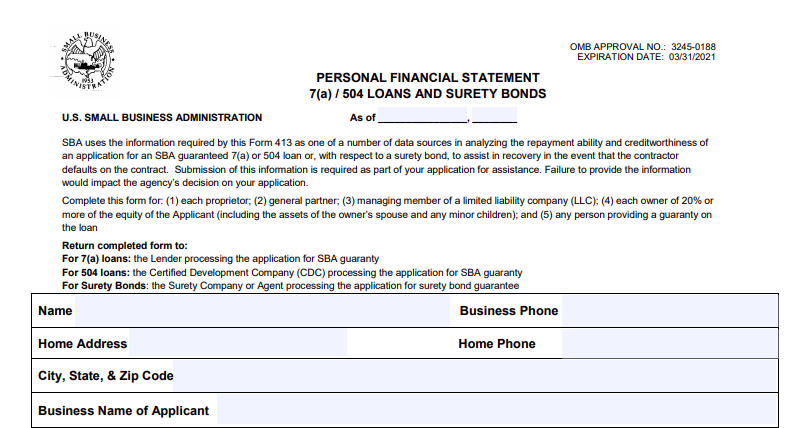
The first step to complete SBA Form 413 (shown below) is the most straightforward—you’ll just need to provide your personal contact information. If you’re married and will be providing information about your spouse’s personal financial information, you’ll want to include their name in this field as well.

In the middle of this part of the form, toward the top, you’ll see a field called “As of.” This field does not necessarily refer to the current date—rather, this conveys to the SBA the date up to which your provided information is accurate. The “As of” field is especially important with regard to valuations, which need to be as up-to-date as possible.

Therefore, it’s best practice to enter the last day of the month preceding the month in which you’re applying (e.g. September 30 if you’re applying in October). You’ll also want to keep in mind that your SBA Form 413 needs to be dated within 90 days of your business loan application.

Step 2: Add information about your assets.

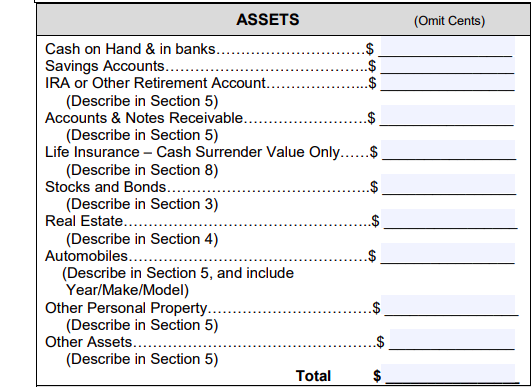
After you’ve completed the basic information at the top of your SBA personal financial statement, you’ll move along to the “Assets” section, shown below.

sba form 413 assets

In filling in this section, you’ll add the following pieces of information, rounding your valuations to the nearest dollar amount.

  • Cash on hand and in banks: The amount in your and your spouse’s checking accounts.

  • Savings accounts: Include the amount in any money market and CD accounts too.

  • Retirement accounts: The value of your IRA or any other retirement accounts in your name, as well as your spouse’s name (if applicable).

  • Accounts and notes receivable: You’ll only need to fill this out if you’ve personally loaned money and that amount is still owed to you.

  • Life insurance—cash surrender value only: If your life insurance has a cash payout, list the dollar amount you would receive if you canceled it. This only applies to whole life insurance policies, not term life insurance. You’ll describe this in detail in section 8.

  • Stocks and bonds: List the current value of all stocks and bonds owned by you and your spouse.

  • Real estate: List the current fair market value of all commercial or residential real estate you and your spouse own. You’ll describe this in detail in section 4.

  • Automobile: The current fair market value of all cars, boats, planes, or other automobiles you and your spouse own (not the automobiles you’re leasing).

  • Other personal property: Estimate the combined worth of all the valuable material items you own and could sell for cash but that don’t fall into any of the above categories. (Think your home, jewelry, electronics, and antiques.) You’ll describe this further in section 5.

  • Other assets: Estimate the value of any other assets you own that don’t fall into the above categories, including the value of your interest or equity in your business. It’s best to contract a professional valuation for this; but if that’s not possible, you’ll want to undervalue your estimate to avoid fraud charges. You’ll also describe this in detail in section 5.

  • Total: Add up the total value of your assets.

Step 3: Add information about your liabilities.

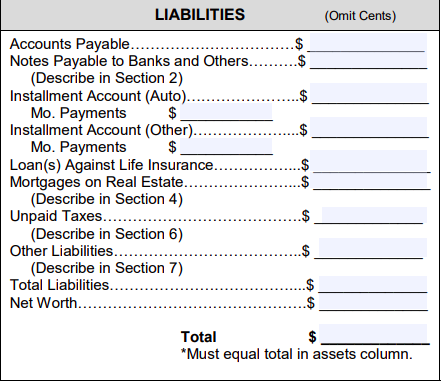
Next, on the right-hand side of the “assets” section, you’ll find the liabilities box. Here, the same rules apply as they do for your assets—you’ll list the liabilities on your books as an individual (separate from your business’s), and if you’re married, you’ll include the liabilities you hold jointly with your spouse.

sba form 413 liabilities

Again, in this section of SBA Form 413, you’ll round your valuations up to the nearest dollar amount.

  • Accounts payable: Essentially, this field refers to any debts you owe to another party other than banks, usually on a short-term basis (i.e. 30, 60, or 90 days). Most applicants can leave this section blank.

  • Notes payable to banks and others: This is where you’ll list all outstanding balances on your personal credit cards, lines of credit, and business installment loans. You’ll describe this information further in section 2.

  • Automobile installment account: Provide the total and monthly payment amount of your balance for any outstanding automobile loans.

  • Other installment accounts: List the total and monthly payment amount of any outstanding personal installment loans on your books, including student and personal loans.

  • Loan against life insurance: Provide the balance of any loans you’ve taken out for which you’ve pledged your life insurance policy as collateral (only if it was whole life insurance).

  • Mortgages on real estate: The balance of mortgages on your owned real estate. You’ll describe this in detail in section 4.

  • Unpaid taxes: List any due but unpaid taxes since your most recent filed tax return. You’ll describe this further in section 6.

  • Other liabilities: Provide the total amount of any other outstanding debt not listed in the previous sections. Most applicants don’t have any additional liabilities; but if you do, you can describe them in detail in section 7.

  • Total liabilities: Add up the total amount of your liabilities.

  • Net worth: Subtract your total liabilities from your total assets to determine your net worth.

  • Total: Add your “Total Liabilities” and your “Net Worth.” This value should be equal to your total assets.

Step 4: Complete section 1 for your source of income and contingent liabilities.

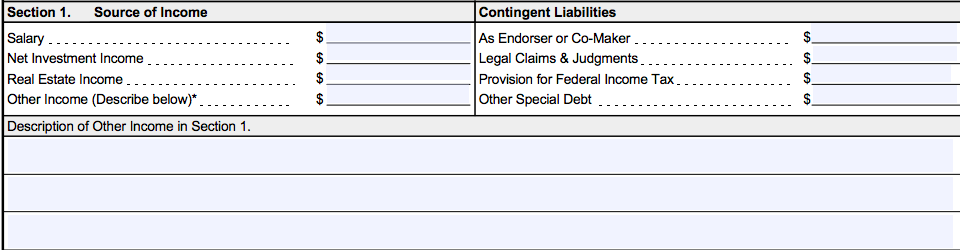
Once you’ve filled in the assets and the liabilities sections, you’ll move on to the final piece of page 1 of SBA Form 413. This part, called “section 1,” will ask for your source of income and contingent liabilities, as shown in the image below.

Source of Income

Here, you’ll fill in the following:

  • Salary: Provide your and your spouse’s total annual salaries, as reported on your tax return.

  • Net investment income: List any income you earn as dividends and interest from your investments.

  • Real estate income: Provide the net income you receive from any of your owned real estate properties, i.e. through sale, lease, or rental. Be sure to list your net income, or the income you earn after expenses.

  • Other income: Provide the total amount of any income received through venues not listed above. This can include alimony, child support, pension, social security, etc. It’s important to note, however, that you should not include alimony or child support payments if you don’t want to have it counted toward total income. You’ll describe the sources of this income in the box below labeled “description of other income in section 1.”

Contingent Liabilities

Contingent liabilities refer to the debts you’re responsible for if certain conditions occur. You’ll estimate the amounts of your contingent liabilities if those conditions are likely to occur.

  • As endorser or co-maker: The total balance of any outstanding debts for which you or your spouse acted as guarantor or co-signer.

  • Legal claims and judgments: The total amount you might owe for any pending legal claims or judgments.

  • Provision for federal income tax: The amount of money you’re setting aside to pay federal taxes for an expected increase in income due to pending litigation, dispute, or asset sale.

  • Other special debt: The total amount of any other outstanding contingent debts not listed above.

sba form 413 section 1

Step 5: Complete section 2 with your notes payable to banks and others.

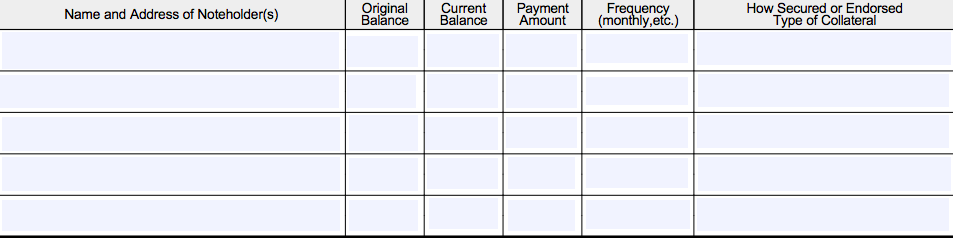
Next, you’ll fill in section 2 by further explaining all the debts listed as your Notes Payable, as you entered in the Liabilities column above. You should use the table provided (as shown below), and include a separate sheet if you need more space. If you include attachments, you’ll want to make sure they’re identified as part of your SBA personal financial statement and signed.

This being said, you’ll include the following details per debt for this section:

  • Name and address of the noteholder: The name and address of your creditor.

  • Original balance: The balance owed when the credit was first established. This will be $0 for credit cards and lines of credit or the total amount of the loan for installment loans.

  • Current balance: The amount you currently owe.

  • Payment amount: The amount you pay for this debt each month. If it’s an installment loan, list your monthly repayment amount. If it’s a credit card or line of credit, you’ll list “varies.”

  • Frequency: How often you pay your loan bills, i.e. monthly or weekly.

  • How secured or endorsed/type of collateral: Explain the type of collateral you pledged to secure your loan. If it was unsecured (as most credit cards are), list “unsecured.”

sba-form-413

Step 6: Complete section 3 with your stocks and bonds.

After you’ve completed section 2, you’ll move on to section 3. Just as you did for your Notes Payable, in section 3 you’ll provide more detail on every stock and bond you and your spouse own, as listed in the Assets column. Again, you can attach as many additional sheets as you need as long as they’re identified as part of SBA Form 413 and are signed.

As shown in the table below, you’ll include the following details for every stock and bond you own:

  • Number of shares: The number you own.

  • Name of securities: The name of this security.

  • Cost: Its original cost.

  • Market value quotation/exchange: Its current market value.

  • Date of quotation/exchange: The date you calculated its current value.

  • Total value: Your number of shares multiplied by its current value.

sba-form-413

Step 7: Fill in section 4 with the real estate you own.

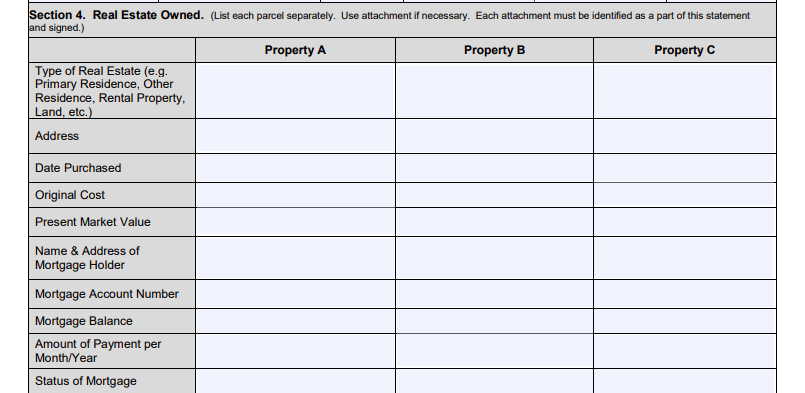
Once you’ve finished section 3, you’ll continue to section 4 (shown below), which asks for your real estate owned. Here, you’ll explain in greater detail all the property you own, as listed in your Assets and Liabilities.

  • Type of real estate: This may be your primary residence, an investment property, or an undeveloped lot.

  • Address: The property’s address.

  • Date purchased: The date listed on your mortgage.

  • Original cost: The property’s purchase price.

  • Present market value: Ask your broker for a current valuation of the property.

  • Name and address of mortgage holder: The name and address of the bank that holds your mortgage.

  • Mortgage account number: Find this number on your mortgage statement.

  • Mortgage balance: The amount you still owe on your mortgage.

  • Amount of payment per month or year: The amount of your monthly or yearly mortgage bill. If you’ve paid off your mortgage, list “N/A.”

  • Status of mortgage: Write “current,” “foreclosure,” or “paid in full.”

sba form 413 section 4

Step 8: Fill out sections 5 through 8 with personal property, unpaid taxes, other liabilities, and life insurance.

Next, you’ll complete sections 5 through 8 on this essential SBA form. As you’ll see below, these sections are all description-based.

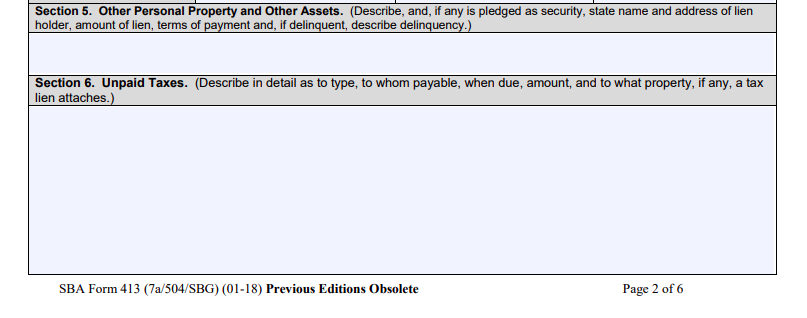
Section 5: Description of Personal Property and Assets

Here, you have the opportunity to go into greater detail about the “Other Personal Property” and “Other Assets” you listed in the Assets column, which will include the value of your stake in the business.

You’ll want to provide as much detail as possible about these items, and you should be prepared to provide documentation to prove their value, if possible. This being said, you may not have a receipt for every piece of property that applies here, like your grandmother’s diamond necklace, for example, and that’s OK. You should just try to make an educated guess as to how much you’d get if you sold your valuables—you shouldn’t, of course, intentionally undervalue or overvalue anything.

If you’ve pledged any of these assets as collateral to secure another type of loan, you’ll need to provide details about that loan, as well. You can use the Notes Payable section as a guide for what information to include. Additionally, if there’s a lien on any of these assets, you’ll need to provide the name and address of the lienholder, the amount of the lien, and the terms and payment. If the loan is delinquent, you’ll need to explain the circumstances of that delinquency.

Section 6: Description of Unpaid Taxes

In section 6, you’ll provide additional information about any unpaid taxes you have, as you specified in the Liabilities section. If you still owe taxes to your state or local government, you can still be eligible for an SBA loan—you just need to prove that you’re on a repayment plan. Here, therefore, you’ll explain to whom you owe taxes, when they’re due, the amount you owe, and whether any of your assets have a tax lien attached.

sba form 413 section 5 anad 6

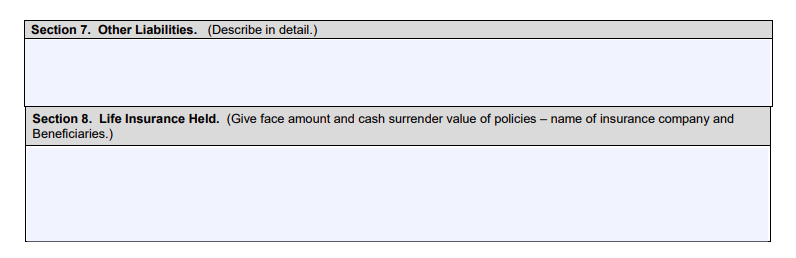
Section 7: Description of Other Liabilities

Once you’ve completed section 6, you’ll move on to the third page of SBA Form 413, starting with section 7. In this section, you’ll explain any “Other Liabilities” you listed in the Liabilities column, if you have them. These are the liabilities that don’t quite fit into the provided categories, such as debts owed to foreign governments or as a result of private agreements. Here, you should provide details such as the type of debt it is, to whom you owe payments, how much you owe, and your repayment plan.

Section 8: Description of Life Insurance

Finally, section 8 will be the last section you need to fill in to complete the main portions of the SBA personal financial statement. In this section, you’ll explain all life insurance policies you hold, including the death benefit, cash surrender value (if applicable), the names of your beneficiaries, and the name of your life insurance company.

sba 413 section 7 and 8

Step 9: Review the completed form.

At this point, the hardest pieces of SBA Form 413 are complete. Now, you’ll want to thoroughly review all of the information you’ve provided on this form.

You’ll want to make sure, to the best of your ability, that all of the information you’ve completed is accurate—after all, this statement will be used to determine your loan eligibility. Plus, if you knowingly make false statements on this form, you could be subject to criminal prosecution.

This being said, it may be helpful to ask a third party—like your business attorney, accountant, or loan specialist—to review the form before you complete the final steps. Having a second, or even third, pair of eyes on this document will help you ensure that everything is filled in completely and correctly and, hopefully, will allow you to catch mistakes (if there are any) ahead of time.

Step 10: Sign and date.

Once you’ve reviewed the information included in your SBA personal financial statement, you’ve reached the last step. Before completing the “certification,” however, you’ll want to make sure you read through the information provided by the SBA on pages three through six of the form.

On these pages, the SBA outlines the penalty for knowingly false statements, as well as statements required by law. If you have any questions about what’s written on these pages, you’ll want to consult your business attorney for clarification.

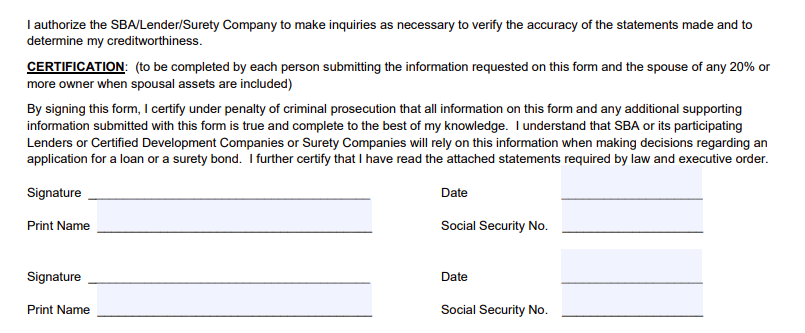
This being said, after reviewing this information, you’ll want to return to the certification section, where you’ll provide your signature, printed name, date, and social security number. Your spouse will also complete this information for themselves as well.

sba form 413 certification

The bottom line

Many business owners are intimidated by the prospect of filling out their SBA personal financial statements. It can be hard to know which of your assets and debts you should include, which you should leave out, how best to reach their values, and exactly how granular to get in your descriptions.

But Goldklang insists that the process isn’t as intense as it might seem:

“I tell people not to drive themselves crazy here. A lot of people think of their businesses as an extension of themselves or vice versa, and I admire that. But what I tell business owners when I hear their anxiety about the PFS is that this is your opportunity to tell us about your personal assets and liabilities—not your business’s.

So, that car you told me about—is the business paying that off, or are you? Put simply, that’s how you should fill out this form. If you think about it as your item, then put it on the form. If you think of it as the business’s debt, then leave it off.”

This being said, when in doubt, you should be transparent. Ultimately, the SBA needs accurate information to make an informed lending decision. If you’re concerned about a particular debt, you should try to provide as many details as possible to back up the numbers.

One of the greatest advantages of working with a loan specialist on your SBA application, therefore, is that they can advocate for you and help your lender look past those cut-and-dry numbers to understand aspects of your application that need additional explanation.

Plus, if this doesn’t work, then your loan expert can help you come up with an alternative plan if excessive personal debts are precluding your loan eligibility right now, so you can increase your chances of approval in the future.

This article originally appeared on Fundera, a subsidiary of NerdWallet.

Revealed! The three most popular assets for beginner investors in 2021

Revealed! The three most popular assets for beginner investors in 2021
Image source: Getty Images


Beginner investors piled in to invest their wealth last year, and new research reveals that newbies have as much confidence as ever in the stock market.

So what were the most popular assets among beginner investors in 2021? And what else can we learn from the research? Let’s take a look.

What were the most popular assets for beginner investors?

According to BrokerChooser, beginner investors ‘flooded’ the markets last year and are ‘here to stay’. In light of this, here are the most popular assets among beginner investors in 2021 (so far):

1. Stocks

A stock represents a fractional claim to ownership of a company. In other words, if you hold a stock in a company, then you get to stake a claim on its assets.

2. Exchange-traded funds (ETFs)

An ETF tracks the price of an index, sector or commodity. ETFs are sold on an exchange, such as the stock market, and are often favoured by passive investors.

3. Cryptocurrency

Cryptocurrency refers to digital, decentralised currency, with ‘Bitcoin’ being the best-known. While the concept of cryptocurrency has become mainstream in recent years, the sector remains widely unregulated in the UK.

What does the data reveal about the number of beginner investors?

According to BrokerChooser’s data, there are more beginner investors in the US than in Europe. That being said, there is roughly the same number of retail traders in Europe as there is across the pond.

One statistic of note is that day trading is a more common pursuit in the US than in Europe. This suggests that Americans have a riskier attitude to investing than their European counterparts. That’s because day trading is favoured by those chasing high returns in the short term. While it may seem like a decent approach, day trading is essentially a zero-sum game, and it can lead to substantial losses compared to a longer-term investing horizon.

Interestingly, 9% of those included in the data say they are interested in cryptocurrencies. This compares to less than 5% last year, revealing that digital currency is a growing sector of interest among those new to investing.

What else can we learn from the data?

Aside from beginner investors, the analysis reveals that investing remains a male-dominated activity. That’s because male investors outnumbered female users in every country in the world. In 2021, male investors accounted for 76% of traders, while females made up 24%. 

With regards to age groups, 39% of BrokerChooser traders are aged 25-34. Just 5% of traders are aged over 65. Interestingly, the number of investors using desktop computers and mobile devices was almost an even split, with 49% using fixed computers and 51% preferring mobile devices.

How did the report suggest stock markets will perform in 2022?

The report suggests that the performance of global stock markets may be impacted by rising interest rates, as well as any new or existing Covid-19 variants coming into play.

The report also suggests that rising inflation, higher energy prices, and the ‘ballooning’ Chinese housing bubble may be responsible for impacting global stock markets next year.

Krisztian Gatonyi, senior broker expert at BrokerChooser, suggests that interest rates may also be an issue next year. He explains, “As a result of the ongoing inflationary pressures, rising interest rates can be expected in 2022.”

Gatonyi also highlights the ongoing impact of Covid-19, stating, “The effect of the omicron Covid-19 variant could cause high volatility on the financial markets next year.”

While both of these events may cause concern among cautious investors, the report outlines that uncertain markets can provide ‘trading opportunities’. That’s because in volatile markets big swings can provide investors with more opportunities to make big gains. That said, volatile markets also make it easier to lose money!

As with any investing, it’s important to understand that stock markets can fall as well as rise. If you’re new to investing and want to learn more, then take a look at our investing basics.

Are you looking to invest? Take a look that The Motley Fool’s top-rated share dealing accounts.

Was this article helpful?

YesNo


Some offers on The Motley Fool UK site are from our partners — it’s how we make money and keep this site going. But does that impact our ratings? Nope. Our commitment is to you. If a product isn’t any good, our rating will reflect that, or we won’t list it at all. Also, while we aim to feature the best products available, we do not review every product on the market. Learn more here. The statements above are The Motley Fool’s alone and have not been provided or endorsed by bank advertisers. John Mackey, CEO of Whole Foods Market, an Amazon subsidiary, is a member of The Motley Fool’s board of directors. The Motley Fool UK has recommended Barclays, Hargreaves Lansdown, HSBC Holdings, Lloyds Banking Group, Mastercard, and Tesco.


Dow Jones Newswires: CANbridge Pharmaceuticals shares slump in Hong Kong debut

Shares of Chinese biopharmaceutical company CANbridge Pharmaceuticals Inc. fell as much as 29% in their Hong Kong trading debut after the company staged an initial public offering to fund research into rare diseases.

Shares of the Beijing-based company dropped from their offering price of 12.18 Hong Kong dollars and were recently 27% lower at HK$8.90 in Friday mid-morning trade.

CANbridge Pharmaceuticals, which focuses on researching rare diseases, raised net proceeds of around HK$604 million (US$77.5 million) in its offering, including from cornerstone investors such as Wuxi Biologics and asset-management firm Janus Henderson. The company intends to use proceeds to fund research and development for rare diseases including brain cancer, as well as for product launches.

CANbridge operates in China, Hong Kong, Taiwan and the U.S. and has products and a pipeline focused on rare oncology, rare diseases, gene therapy and others. It was founded in 2012.

Chinese companies are rushing to wrap up deals in Hong Kong before the end of the year, with those in industries ranging from healthcare to real estate raising billions of dollars in combined proceeds.

: With latest sale, Elon Musk has sold nearly $12 billion of Tesla stock in past month

Elon Musk resumed his Tesla Inc. stock selloff Thursday, cashing in nearly $1 billion.

In fillings with the Securities and Exchange Commission, the Tesla chief executive disclosed he sold another 934,091 Tesla shares, for about $963.2 million. He also exercised options to buy 2.17 million shares at a price of $6.24.

After a flurry of stock sales in November, Musk has sold just two tranches of stock since Nov. 23 — the previous one on Dec. 2.

Read: It’s not just Elon Musk: Corporate insiders sell stocks at historic levels as market soars

In total, Musk has sold about 11.03 million shares worth about $11.82 billion since Nov. 8,  a day after he said he would abide by a Twitter poll he posted in which users declared he should sell 10% of his Tesla stake. Some of the stock sales had been put into motion well before the poll was posted.

Assuming Musk intends to sell 10% of his shares, he’s almost there. Before the sales began, his 10% stake amounted to about 17 million shares — so after Thursday’s sales, he has about 5.97 million shares to go.

Also see: So after all the hype. what did happen on 12/9? Tesla stock dropped.

Musk, the world’s wealthiest man, has millions of stock options that he needs to exercise by August 2022, and he said in September that he intended on selling a large chunk of stock in the fourth quarter. CNBC reported last month that Musk faces about a $15 billion tax bill on those options.

Tesla shares 
TSLA,
-6.10%

 sank Thursday and are down 6% over the past 30 days. Still. the stock is up 42% year to date, and up 60% over the past 12 months.

Dow Jones Newswires: Shares of Chinese medicine firm Gushengtang jump in Hong Kong debut

Shares of Gushengtang Holdings Ltd. jumped in their trading debut in Hong Kong, after the Chinese traditional medicine healthcare provider raised 808.5 million Hong Kong dollars ($103.7 million).

The Guangzhou-based company’s shares gained as much as 18%, and were last up 3.6% at HK$30.05.

Gushengtang, which secured cornerstone investors including Boyu and Sage Partners for its share sale, plans to use the offering’s proceeds for business expansion.

The deal came as Beijing stepped up its push for greater use of Chinese traditional medicine.

In August, a new national-level policy called for more investment in public specialty hospitals. Authorities have also encouraged the use of traditional medicines during the pandemic.

8 Best Business Grants for Black Women Entrepreneurs

The most recent wave of the Black Lives Matter movement has amplified what Black people in America have known for centuries: Systemic racism is alive and well in America. That deep-seated, foundational racism touches every aspect of this country’s inner workings, including when it comes to business funding.

Despite the fact that Black women are starting businesses at the fastest rate among any racial group and that the number of Black female-owned businesses in America has increased by 164% since 2007, they remain chronically underfunded. As Fundera’s own report on the racial funding gap details, lending institutions consistently practice racial and gender-based biases against otherwise qualified applicants.

Seeking business grants for Black women specifically (or grants for women, minority, or Black entrepreneurs more broadly) can help you secure the business funding that a traditional, typically discriminatory lending institution may have denied you previously. With that in mind, we’ve gathered a list of some of the best business grants, investment opportunities, and resource hubs for Black women business owners.

8 grant resources and business grants for black women

While there aren’t a ton of grants intended specifically for Black women, you will find grant opportunities targeted more generally toward women, minorities, or Black business owners—all of which you might be eligible for—so we’ve listed a few of those below.

Another caveat to keep in mind: deadlines. Application windows can be fairly short, and lots of grant programs that are designed for Black women business owners or Black entrepreneurs of any gender identity (like the PayPal Empowerment Grant for Black-Owned Businesses) are currently closed to applications.

Still, it’s worth being aware of these grant opportunities if and when they reopen for the next round of applicants. And you can always run a search for financing opportunities through a general grant portal or resource center. A couple of those are included here too.

1. SBA 8(a) Business Development Program

Technically, the SBA 8(a) Business Development Program isn’t a grant program, and it’s also not one of the several (and highly coveted) loan programs for which the SBA is best known. Rather, it’s a business assistance program that aids “economically and socially disadvantaged business owners” in securing government contracts.

Each year, the federal government aims to set aside 5% of its annual contracting budget to small businesses that are owned and operated by marginalized entrepreneurs. The SBA 8(a) program provides such entrepreneurs the support they need to win those contracts, without competition. Participating entrepreneurs can receive assistance and training to help them navigate their businesses beyond securing government contracts too.

To be eligible for this nine-year program, applicants must fall under the SBA’s definitions of “economically disadvantaged” and “socially disadvantaged” individuals, among other factors. Briefly, the SBA defines “economically disadvantaged” individuals as those entrepreneurs “whose ability to compete in the free enterprise system has been impaired due to diminished capital and credit opportunities.” And “socially disadvantaged” individuals are defined, in part, as “those who have been subjected to racial or ethnic prejudice or cultural bias within American society because of their identities as members of groups and without regard to their individual qualities.”

2. IFundWomen

Another incredible resource is IFundWomen (IFW), which helps female and female-identified founders of any race or ethnicity seek capital (specifically through crowdfunding), coaching, networking, and grant opportunities. But for today’s purposes, we direct you to IFW’s grants hub where they’ve aggregated a collection of the most exciting grant opportunities for women (crucially, with up-to-date application deadlines).

In addition to grant programs offered by corporations and private sponsors, this hub includes information and application links for IFW’s three in-house grant programs, including a relief fund for business owners who have been impacted by the COVID-19 pandemic. Two grant programs within the IFW network are designed for Black women entrepreneurs in particular: the Visa Grant Program and the IFW Brokered Grant for Black-Owned Businesses.

Helpfully, too, they’ve gathered information about grant programs that are not within the IFW network, some of which are targeted specifically toward Black entrepreneurs.

3. NASE Growth Grants

Founded in 1981, The National Association for the Self-Employed (NASE) is the nation’s “largest nonprofit, non-partisan association” dedicated to supporting entrepreneurs and micro-businesses. One way the organization supports these smallest of small business owners is through their grant program. This program awards NASE Members up to $4,000 to finance a particular need, whether that’s purchasing equipment, hiring staff, launching a marketing plan, or another approved purpose.

Do note that NASE Growth Grants aren’t awarded solely to Black and/or female entrepreneurs. But based on the frequency with which grants are awarded, Black women entrepreneurs have several opportunities to secure one: Applications are reviewed on a rolling basis throughout the year, and the organization awards one grant per month.

To apply for an NASE Growth Grant, you’ll first need to join NASE and remain in good standing with the organization for at least three months. After that, you can apply online.

4. Minority Business Development Agency (MBDA)

The Minority Business Development Agency (MDBA) is a federal agency that supports the establishment and growth of minority-owned businesses in the U.S. Much like the SBA, the MBDA has over 40 physical locations across the country where minority entrepreneurs can seek financial assistance and business consulting.

While this isn’t necessarily a grant program in and of itself, the MDBA is a valuable resource for Black women entrepreneurs. You can find more information about grant and loan opportunities on the MDBA website.

5. Grants.gov

The be-all and end-all of federal grant resources, Grants.gov is a portal where federal agencies offering grant programs—both specifically for minority-owned businesses and otherwise—post information about their offerings, including eligibility requirements, funding amounts, and application deadlines. You can look for a grant according to several search criteria, including your industry and the sponsoring federal agency.

6. The Amber Grant Foundation

Like the NASE Growth Grant, the Amber Grant Foundation awards one $10,000 grant to a small business owner per month. In this case, however, grants are offered only to female entrepreneurs, and they’re intended specifically to help new entrepreneurs launch their businesses. If you’re awarded one of the $10,000 monthly grants, you will also be in the running to win the Amber Grant’s yearly $25,000 grant.

The application process is simple too: You’ll fill out a short form right on the Amber Grant website, where you’ll tell the organization a little bit about your business idea and how you would spend your grant funds. Note that you’ll have to pay a $15 application fee.

7. Female Founders Fund

If you’re a tech entrepreneur seeking early-stage funding opportunities, consider pitching the Female Founders Fund (FFF). Launched by “serial entrepreneur” Anu Duggal in 2014 and powered by a team of female investors, the fund is dedicated to “investing in the next generation of transformational technology companies founded by women.” Their portfolio boasts some of the “buzziest” female-owned companies out there, like Co-Star, Zola, Billie, Minibar, and Rent the Runway.

FFF invests in B2B, consumer, fintech, and health care businesses that have at least one female founding member, and they primarily focus on investing in seed-stage businesses. That said, they’re open to reviewing pitches from businesses in a variety of industries, and occasionally even before those businesses are ready for a formal funding round. They average between six to eight investments per year, with investments ranging from $500,000 to $750,000.

You can learn much more about FFF, their eligibility criteria, the investment process, and how to pitch them on their FAQ page.

8. Black Girl Ventures

Lastly, Black Girl Ventures (BGV) provides coaching, development, and community resources for Black and Brown female-identified entrepreneurs.

BGV’s marquee offering is their crowdfunded pitch competition program, in which participating entrepreneurs have three minutes to pitch their business idea, followed by a three-minute Q&A session with a panel of professionals in front of an audience. Then, the audience votes “with their dollars” on the crowdfunding platform SheRaise. First, second, and third place winners are announced, but everyone participating in the BGV Pitch has the opportunity to raise capital. Winners receive additional perks, as well, like free business coaching and a discount on graphic design services.

The bottom line

Being a Black, female-identified business owner can be incredibly challenging, but you’re not alone in your journey. In addition to some of the community, networking, and support organizations we’ve listed above, there are tons of additional resources to consider. Visiting your local SBA or SCORE office, either in person or online, can also be a great way to receive free resources and advice.

We’d also encourage you to apply for a business loan if you think you’re well-positioned to secure one. And if that’s the case, we’d love to help you sort through your options for a loan package.

This article originally appeared on Fundera, a subsidiary of NerdWallet.

Financial News

Daily News on Investing, Personal Finance, Markets, and more!

Financial News

Policy(Required)