
This FTSE stock has announced a major acquisition! Here’s what I’m doing now

Whenever a FTSE stock announces an acquisition, I am interested to learn more. What’s the reason behind the acquisition and how will it help the company in question? Halfords (LSE:HFD) announced a major acquisition last week that I believe will boost its profile, growth, and performance in the short and long term. Should I add add the shares to my portfolio at current levels? Let’s take a look.

FTSE retail giant

Halfords is the UK’s leading retailer of cycling products as well as automotive products and services. It employs over 10,000 people and has more than 750 locations throughout the country. Halfords claims that 90% of the UK is never more than 20 minutes away from a Halfords shop or one of its auto centres.

5 Stocks For Trying To Build Wealth After 50

Markets around the world are reeling from the coronavirus pandemic… and with so many great companies trading at what look to be ‘discount-bin’ prices, now could be the time for savvy investors to snap up some potential bargains.

But whether you’re a newbie investor or a seasoned pro, deciding which stocks to add to your shopping list can be a daunting prospect during such unprecedented times.

Fortunately, The Motley Fool UK analyst team have short-listed five companies that they believe STILL boast significant long-term growth prospects despite the global upheaval…

We’re sharing the names in a special FREE investing report that you can download today. And if you’re 50 or over, we believe these stocks could be a great fit for any well-diversified portfolio.

Click here to claim your free copy now!

As I write, Halfords shares are trading for 352p. A year ago, the shares were trading for 260p which is a 35% return over a 12-month period. In recent weeks, positive interim results and the acquisition deal  have boosted the shares. In December to date, Halfords shares are up 10%.

Acquisition and positive performance

On 1 December, Halfords announced it signed a sale and purchase agreement to purchase Axle Group Holdings Ltd for £62m. Axle owns the National Tyres and Autocare, Viking Wholesale Tyres, and Tyre Shopper brands.

This acquisition is a great move in my opinion. Halfords already has its own auto centres where it offers MOTs and services for motorists. Upon completion, Halfords will have approximately 604 garages, 234 consumer vans, and 190 commercial vans. This number will mean it has comfortably surpassed its target of 550 garages. Halfords places a great emphasis on motoring revenue and the National Tyres and Auto Care centres will help grow its motoring revenue stream. 

In November, Halfords also reported positive interim results for FY 2022. It confirmed that revenue, profit, sales growth, and cash generation had increased compared to 2021 levels. Many FTSE stocks in the retail sector have suffered due to supply chain issues. Halfords pointed towards the same problems but was able to leverage its competitive advantage and huge profile to record excellent results.

Risks of investing

Buying Halfords shares does come with risks, however. As mentioned, the current supply chain crisis has meant many businesses are unable to fulfil the demand for some of their products. Halfords has faced this issue in its burgeoning cycling department. If these issues persist, performance could be affected. Rising inflation and costs are a worry too. If these costs are passed on to customers, Halfords could lose customers and market share. This could affect performance and investor returns as well.

Overall, I believe this recent acquisition and the recent positive results will boost Halfords growth trajectory upwards. In addition, Halfords has a good track record of performance which fills me with confidence too. I understand past performance is not a guarantee of the future but I use it as a gauge when reviewing assessment viability. Halfords currently sports a price-to-earnings ratio of just 12, which I consider cheap. At current levels I would happily add Halfords shares to my portfolio.

FREE REPORT: Why this £5 stock could be set to surge

Are you on the lookout for UK growth stocks?

If so, get this FREE no-strings report now.

While it’s available: you’ll discover what we think is a top growth stock for the decade ahead.

And the performance of this company really is stunning.

In 2019, it returned £150million to shareholders through buybacks and dividends.

We believe its financial position is about as solid as anything we’ve seen.

  • Since 2016, annual revenues increased 31%
  • In March 2020, one of its senior directors LOADED UP on 25,000 shares – a position worth £90,259
  • Operating cash flow is up 47%. (Even its operating margins are rising every year!)

Quite simply, we believe it’s a fantastic Foolish growth pick.

What’s more, it deserves your attention today.

So please don’t wait another moment.

Get the full details on this £5 stock now – while your report is free.


Jabran Khan has no position in any of the shares mentioned. Views expressed on the companies mentioned in this article are those of the writer and therefore may differ from the official recommendations we make in our subscription services such as Share Advisor, Hidden Winners and Pro. Here at The Motley Fool we believe that considering a diverse range of insights makes us better investors.
Outside the Box: Who will have unmet long-term care needs?

We have just completed the third study in our three-part series on the needs and resources available for long-term care. This issue is really important because many late-career workers and retirees are very worried about the possibility of needing costly care later in life.  

Read: Prescription-drug savings vanish in the Medicare shuffle

Fear of dependency may make them reluctant to spend their 401(k) balances, depriving themselves of necessities as they age.

Read: Call it virtual assisted living: seniors can stay in their own homes longer thanks to these pandemic hacks

To recap. The first study examined the odds of a 65-year-old developing minimal, moderate, and severe needs, considering both the intensity and duration of the required care. The results show that roughly one-fifth of 65-year-olds never require long-term care and about one-quarter will have severe needs, with the rest falling somewhere in between (see first stacked bar in Figure 1).

The second study estimated the share of retirees who have the resources — either informal care from family or financial means — to cover any potential minimal, moderate, or severe care needs. The results determined that more than one-third of retirees will not have the resources for even the most minimal level of care, while one-fifth can afford care for severe needs if necessary (see second stacked bar in Figure 1).

Read: Want to share your life experiences and help others? How to do it well

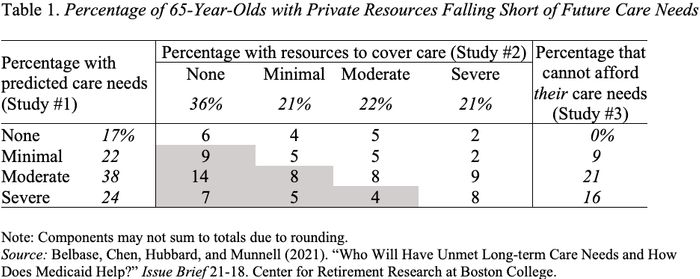
The final study combines the findings from the two earlier analyses to determine the share of individuals projected to have inadequate resources for their specific care needs. The left-hand column in Table 1 shows the distribution of 65-year-olds by their predicted lifetime maximum level of care needs (Study No. 1). The topmost row shows the distribution of 65-year-olds based on the highest level of care they can afford using their private resources (Study No. 2). The last column shows the percentage of individuals with inadequate resources to cover their specific level of care — the sum of the shaded numbers in each row (Study No. 3).

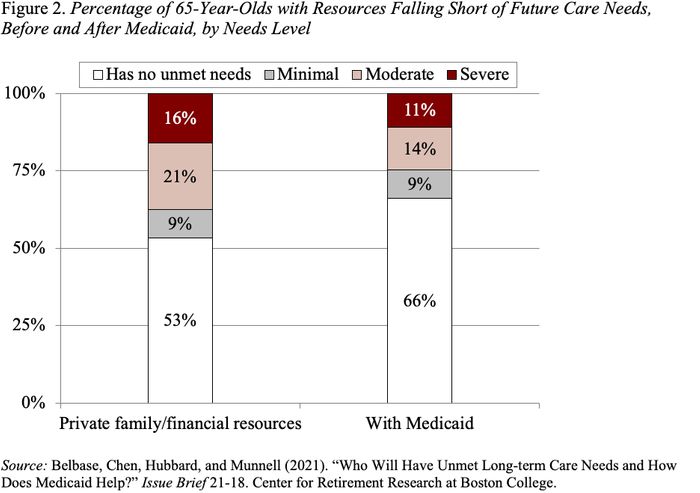
Overall, the results show that about 60% of those with moderate or severe needs will not have the family or financial resources to meet those needs. Fortunately, Medicaid — a joint federal-state program — offers some support for these individuals (see Figure 2). Without Medicaid, 16% of 65-year-olds will have severe care needs that they will not be able to fully cover using private resources. After accounting for Medicaid (for both those who qualify directly and those who spend down), this share declines to 11%. Similarly, 21% of 65-year-olds will have moderate care needs that they cannot fully afford; however, Medicaid reduces this share to 14%. 

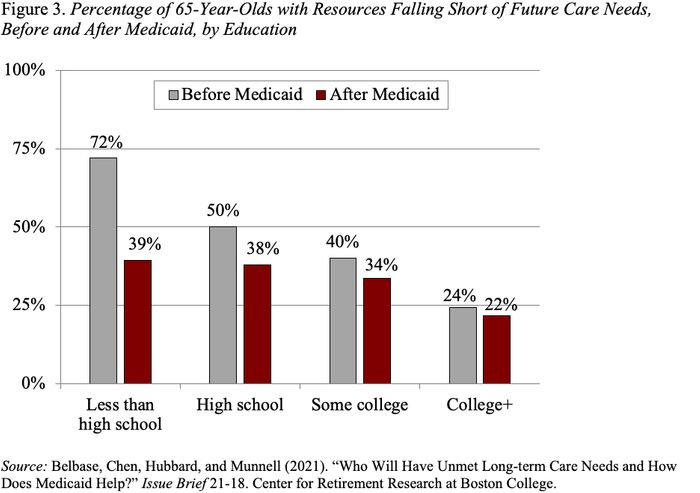
Not surprisingly, Medicaid helps those with fewer resources the most. For those with less than a high school education, Medicaid cuts the percentage falling short almost in half, while for those with college degrees — many of whom will not qualify for benefits — it has only a slight effect (see Figure 3). 

The bottom line is that when Medicaid is added to family and financial resources, most Americans can meet most of their needs for long-term care. Participants in 401(k) plans should be somewhat more sanguine than they are about using their balances to support their consumption in retirement. 

The Ratings Game: GoPro is a ‘standout’ as supply crunch plagues other tech names, analyst says in upgrade

Shares of GoPro Inc. are surging in Monday morning trading after an analyst upgraded the stock, calling the maker of action cameras a “standout” in the world of consumer electronics.

Wedbush analyst Alicia Reese boosted her rating on GoPro shares
GPRO,
+4.22%

to outperform from neutral Monday, while raising her price target to $13.50 from $11. The stock is up nearly 6% in morning trading.

One reason for Reese’s optimism is that the company “got ahead of supply-chain issues and component shortages,” allowing GoPro to avoid showing “any material negative impact” with its third-quarter results. Reese expects that the company will show similar resilience in the holiday quarter.

“The bottom line, in our view, is that GoPro has found its groove, even amid current supply-chain tumult,” Reese wrote.

She also is upbeat about GoPro’s progress in driving more direct-to-consumer sales. The company’s DTC push “drove profitability in 2020 in spite of significantly reduced marketability during lockdowns” and continues to help GoPro’s margin performance. Reese expects that the growing importance of DTC sales could allow GoPro to further expand gross margins going forward.

Subscribe: Want intel on all the news moving markets? Sign up for our daily Need to Know newsletter.

The company also stands to benefit from a travel rebound. GoPro “still managed to profitably expand its user base” during the stretch of lockdowns, and the company has exciting opportunities ahead once travel trends start to normalize, according to Reese.

“We see this as an important upcoming catalyst, and also think that GoPro is poised to expand its hardware into derivative products with specialized use cases to expand its user base, with only marginal R&D and manufacturing costs,” she wrote.

Reese joins analysts from Morgan Stanley and J.P. Morgan, who both upgraded the stock last month.

Shares of GoPro have rallied roughly 20% over the past three months as the S&P 500
SPX,
-0.72%

has risen about 5%.

2 FTSE 100 stocks I wish I had bought early in 2021

The late great investor, John Bogle, once said that timing the market is a loser’s game. Bogle, being the creator of the very first index fund, likely knew a thing or two on the subject. His advice is why I don’t worry much about timing the market. I’m more concerned about buying great stocks that I think are trading at a discount to their intrinsic value.

However, I can’t help but look back at what has been an interesting year in the markets and imaging what could have been. Since hindsight is 20/20, here are two top-performing FTSE 100 stocks I would have bought earlier this year if I knew then, what I know now. 

5 Stocks For Trying To Build Wealth After 50

Markets around the world are reeling from the coronavirus pandemic… and with so many great companies trading at what look to be ‘discount-bin’ prices, now could be the time for savvy investors to snap up some potential bargains.

But whether you’re a newbie investor or a seasoned pro, deciding which stocks to add to your shopping list can be a daunting prospect during such unprecedented times.

Fortunately, The Motley Fool UK analyst team have short-listed five companies that they believe STILL boast significant long-term growth prospects despite the global upheaval…

We’re sharing the names in a special FREE investing report that you can download today. And if you’re 50 or over, we believe these stocks could be a great fit for any well-diversified portfolio.

Click here to claim your free copy now!

The FTSE 100 leader in 2021 (so far)

Ashtead Group Plc (LSE: AHT) has had quite the run, racking up 94.6% in share price appreciation, year to date. If I had known, I would have bought this stock in early January, when it was trading closer to 3,500p. This company is widely known as the parent company of Sunbelt Rentals, the equipment rental giant in North America and the UK. Sunbelt is a leader in this field with over 800,000 individual assets available for hire to a massive customer base.

In its latest quarterly report, Ashtead updated its expected revenue growth by 2%-5% by the end of the fiscal year. This bodes well for the stock, which has consistently created good returns for investors over the past five years. As a dividend stock, there’s not much to be made here as its current dividend yield is a miserly 0.68%. If I depended on a steady flow of dividend income, this would be concerning. But as an investor with a value orientation, I can appreciate reinvesting earnings. Ashtead has seen free cash flows quadruple over the past three years to almost $2bn.

Betting on the future 

I wrote an article earlier this year about the success of Entain (LSE: ENT), which has flown right in the face of the pandemic. The past year has seen this stock shoot up by 54.97%, and I wish I had been along for the ride. Entain is one of the world’s prime gambling stocks. It benefits from massive brands such as Ladbrokes, Bwin, Party Casino, and a 50% stake in BetMGM. The FTSE 100 company has actually been so successful that it has attracted the attention of the US gambling group, Draftkings. Even though the $20.4bn offer by Draftkings to purchase Entain fell through, it was evidence that many in the market believe Entain is not only a great business but also currently undervalued.

Again, if I were a dividend driven investor, I would be wary about the mere 2.8% dividend yield on this stock. Also noteworthy is the tiny bottom line this company generates considering it consistently has gross profits of over 60%. It did well nonetheless this year, and I expect it to continue to do so in 2022.

FREE REPORT: Why this £5 stock could be set to surge

Are you on the lookout for UK growth stocks?

If so, get this FREE no-strings report now.

While it’s available: you’ll discover what we think is a top growth stock for the decade ahead.

And the performance of this company really is stunning.

In 2019, it returned £150million to shareholders through buybacks and dividends.

We believe its financial position is about as solid as anything we’ve seen.

  • Since 2016, annual revenues increased 31%
  • In March 2020, one of its senior directors LOADED UP on 25,000 shares – a position worth £90,259
  • Operating cash flow is up 47%. (Even its operating margins are rising every year!)

Quite simply, we believe it’s a fantastic Foolish growth pick.

What’s more, it deserves your attention today.

So please don’t wait another moment.

Get the full details on this £5 stock now – while your report is free.


Stephen Bhasera has no position in any of the shares mentioned. The Motley Fool UK has no position in any of the shares mentioned. Views expressed on the companies mentioned in this article are those of the writer and therefore may differ from the official recommendations we make in our subscription services such as Share Advisor, Hidden Winners and Pro. Here at The Motley Fool we believe that considering a diverse range of insights makes us better investors.
How Missing a Credit Card Payment Could Hurt Your Points Earnings

Earning points or miles is one of the primary reasons many consumers use a credit card. However, you may not realize how critical it is to keep up to date on your payments — and not just for increasing your credit score. Slipping up on a credit card payment could be bad news for earning and redeeming points.

Depending on the card issuer, if you miss a payment, you may end up forfeiting the points earned on a statement. Falling behind on payments could also mean losing the ability to earn or use your points. So, let’s review the different policies for major card issuers and see how missing a credit card payment could hurt your ability to earn points.

How major card issuers handle missing a payment

American Express Membership Rewards

American Express is the most punitive of the major U.S. card issuers when it comes to withholding points from cardmembers for missing a payment. You may forfeit all points earned during the period covered by a statement if you don’t make timely payment of the minimum amount due.

Say you spent $2,300 on the American Express® Gold Card — $600 on restaurants and groceries, $700 on airfare purchased from an airline and $1,000 in non-bonus categories. Your Membership Rewards points earnings on that statement would be 5,500 Membership Rewards points. However, if you don’t make timely payment of the minimum amount due on the statement, you won’t earn any points on these purchases. Terms apply.

Effective June 1, 2021, American Express tightened this policy for small business cards. Now, AmEx business cardmembers need to make payments by the payment due date — rather than the closing date of the next billing period — to avoid forfeiting points.

All is not lost if you find yourself in these types of situations. AmEx will let you reinstate forfeited points by paying a $35 fee for each month of points you want to reinstate. You have until 12 months after the billing period to exercise this option.

Chase Ultimate Rewards®

Compared with AmEx, Chase has a much more forgiving policy on missed payments with its Ultimate Rewards®-earning cards. Chase will only suspend cardholders from earning or using points if they don’t make the minimum payment on their account within 30 days of the due date. That means you won’t have to forfeit any rewards you’ve already earned on purchases.

Instead, Chase prohibits you from earning or redeeming points temporarily. You’ll be able to start earning and using points again in the next billing cycle once your account becomes current. But you’ll want to act quickly to catch up on your payments. If you don’t make at least the minimum payment on your account within 60 days of the due date, you risk losing all of the Ultimate Rewards® points in your account.

Citi ThankYou Points

While AmEx and Chase may limit a cardholder’s ability to earn points, Citi’s late payment policy restricts point redemptions. If you miss a payment on your Citi ThankYou Points credit card account, Citi may suspend your ability to redeem points earned through that account.

Once your account is current, you’ll need to request Citi reinstate your points. You can do so on the ThankYou website or by calling the ThankYou Service Center at 1-800-THANKYOU.

Capital One Rewards

Your account needs to be in good standing to earn or redeem Capital One miles. That means you’ll need to make at least the minimum payment by your due date to continue earning and redeeming rewards.

Capital One doesn’t detail what happens if you don’t make the minimum payment. However, Capital One does state that you’ll lose any unredeemed rewards still in your account if your account is closed.

How to avoid missing a credit card payment

Set up autopay on all of your accounts

The easiest way to avoid losing the ability to earn or redeem points is to not miss a payment in the first place. And one of the easiest ways to avoid missing a payment is to set up autopay on your card accounts.

If you aren’t sure you will pay the full balance each month, you can set up autopay for the minimum balance. Then, you can manually pay the remaining balance on your own time. At least that way, you can be sure that you won’t miss a credit card payment and hurt your ability to earn or redeem points.

Carefully read the terms when setting up autopay

You may assume that a benefit of autopay is that it takes effect immediately after you set it up. But, unfortunately, this is not always the case.

For example, when setting up AmEx AutoPay, the first automatic payment may not occur until after your next statement closes. That means, depending on where you are in your payment cycle, you may still need to make a manual payment before autopay kicks in — whether you’re setting up AmEx AutoPay for the first time or changing payment banks.

Since AmEx has the harshest consequences for missing payments, you’ll want to exercise extra caution when setting up or changing an AmEx AutoPay. In particular, pay close attention to the effective date whenever you’re creating a new autopay or changing a current one.

Synchronize your card payments

Many card issuers allow you to choose what date you want your statement to close and when to make any automatic payment. In addition, if you have multiple cards and want to ensure you don’t miss a payment, you can synchronize dates across all your accounts.

Once you do, you only need to check if all of your payments have been posted once per month. And, in case there are any issues, you can set up the payment dates so you have enough time to take corrective action before any consequences.

Avoid losing points from missing a credit card payment

Policies vary between major card issuers. However, to protect your credit score and points earnings, ensure that you don’t miss a credit card payment. Doing so could hurt your credit score and mean losing points or the ability to earn or redeem points.

Now that you have a better idea of how missing a credit card payment could hurt your efforts to accumulate points, consider setting up autopay for at least the minimum balance due on your cards. Remember to pay attention to the effective date of automatic payments and continue to make manual payments according to that date. If you want to be extra careful, you can synchronize your payment dates for all your cards and confirm that they’ve been posted concurrently. Then, instead of worrying about losing points, you can focus more on earning and redeeming them.

How to maximize your rewards

You want a travel credit card that prioritizes what’s important to you. Here are our picks for the best travel credit cards of 2021, including those best for:

This dirt-cheap penny stock could be a great recovery play!

Penny stocks possess greater risks than more established stocks. Some of these picks can provide lucrative returns in the long term, however. I believe Esken (LSE:ESKN) could be a good recovery play for my portfolio. Should I add Esken shares to my holdings at current levels?

Aviation and energy

Esken is a UK infrastructure company. It has two divisions, which are aviation and energy. Its aviation division helps manage airports and run day to day operations. It currently manages London Southend Airport. Other aviation services include baggage, checking-in, and other logistics solutions. The energy division helps provide fuel to biomass plants.

5 Stocks For Trying To Build Wealth After 50

Markets around the world are reeling from the coronavirus pandemic… and with so many great companies trading at what look to be ‘discount-bin’ prices, now could be the time for savvy investors to snap up some potential bargains.

But whether you’re a newbie investor or a seasoned pro, deciding which stocks to add to your shopping list can be a daunting prospect during such unprecedented times.

Fortunately, The Motley Fool UK analyst team have short-listed five companies that they believe STILL boast significant long-term growth prospects despite the global upheaval…

We’re sharing the names in a special FREE investing report that you can download today. And if you’re 50 or over, we believe these stocks could be a great fit for any well-diversified portfolio.

Click here to claim your free copy now!

Penny stocks are those that trade for less than £1. As I write, Esken shares are trading for 14p. This means it is one of the cheapest shares on the FTSE index right now. A year ago shares were trading for 21p. The pandemic has affected the share price. Aviation and travel stocks have had a turbulent 18 months due to restrictions and the pandemic.

For and against investing

FOR: Despite the current issues in the aviation industry, I like that Esken’s business has a diversified offering. Aviation may eventually pick up if the pandemic eases but it continues to operate its energy division, which has seen growth recently. I especially like penny stocks that have a diversified offering and don’t rely on one form of revenue stream.

AGAINST: Aviation is the larger division. The well documented issues that the aviation industry has faced since the pandemic started put me off. With the threat of new variants, which could result in more restrictions and less travel, the aviation industry’s woes may continue for a long time. There is a school of thought that living with the pandemic is the new normal and there will be peaks and troughs of travel.

FOR: A half-year report announced in November for the six months ending 31 August showed me signs of recovery for Esken. It reported that revenues increased by close to 8% compared to the same period last year. This was mainly driven by its energy division and its growth. Furthermore, aviation losses had declined less than the same period last year. Esken also managed to make a profit based on an earnings before interest, taxes, depreciation, and amortisation (EBITDA) basis for the half-year period.

AGAINST: Esken shares are still way off pre-pandemic levels which is understandable but still an issue for me. Furthermore, it was reporting consistent losses prior to the pandemic which is usually a red flag. If aviation woes continue and energy cannot pick up the slack, Esken may not report a profit for some time.

Contrarian penny stock option

Every now and then I like to pick a contrarian stock for my portfolio. This is usually a stock that has potential and is currently dirt-cheap so I am not risking lots of my hard-earned cash.

I place Esken in this contrarian bracket. Despite some credible risks and issues, for 14p per share, I would be willing to buy a small amount of shares for my holdings and keep an eye on developments. I see some potential in Esken in the longer term. If this potential doesn’t materialise, I wouldn’t have lost a substantial amount of money buying this penny stock.

FREE REPORT: Why this £5 stock could be set to surge

Are you on the lookout for UK growth stocks?

If so, get this FREE no-strings report now.

While it’s available: you’ll discover what we think is a top growth stock for the decade ahead.

And the performance of this company really is stunning.

In 2019, it returned £150million to shareholders through buybacks and dividends.

We believe its financial position is about as solid as anything we’ve seen.

  • Since 2016, annual revenues increased 31%
  • In March 2020, one of its senior directors LOADED UP on 25,000 shares – a position worth £90,259
  • Operating cash flow is up 47%. (Even its operating margins are rising every year!)

Quite simply, we believe it’s a fantastic Foolish growth pick.

What’s more, it deserves your attention today.

So please don’t wait another moment.

Get the full details on this £5 stock now – while your report is free.


Jabran Khan has no position in any of the shares mentioned. Views expressed on the companies mentioned in this article are those of the writer and therefore may differ from the official recommendations we make in our subscription services such as Share Advisor, Hidden Winners and Pro. Here at The Motley Fool we believe that considering a diverse range of insights makes us better investors.

This FTSE 250 stock is up 7.5% today! Was I wrong in not buying it?

Today is not a great day for the FTSE 250 index, or a particularly bad one, for that matter. As I write, it is down by 0.7% from last week’s close, which is just not a big enough number to take note of. However, some stocks are trading very strong today in any case. One of them is the greeting cards e-retailer Moonpig (LSE: MOON). It is up some 7.2% as I write, an increase second only to Jupiter Fund Management, which is up by an even bigger 8%.

My latest article on Moonpig was published only this Saturday. And in that, I had said that I would refrain from buying the stock right now. My sense was that it was way too pricey for me. Yet, cut to Monday, and it is rallying. What is going on here? And more importantly, was I wrong in deciding not  to buy it?

5 Stocks For Trying To Build Wealth After 50

Markets around the world are reeling from the coronavirus pandemic… and with so many great companies trading at what look to be ‘discount-bin’ prices, now could be the time for savvy investors to snap up some potential bargains.

But whether you’re a newbie investor or a seasoned pro, deciding which stocks to add to your shopping list can be a daunting prospect during such unprecedented times.

Fortunately, The Motley Fool UK analyst team have short-listed five companies that they believe STILL boast significant long-term growth prospects despite the global upheaval…

We’re sharing the names in a special FREE investing report that you can download today. And if you’re 50 or over, we believe these stocks could be a great fit for any well-diversified portfolio.

Click here to claim your free copy now!

Why is the Moonpig stock rallying?

First, let us talk about why the FTSE 250 stock could be rallying. I reckon this is directly to the Omicron variant. From my own portfolio of FTSE 100 stocks, I can see the trend among gainers today. These include the likes of AstraZeneca, Ocado, and Rentokil Initial. All three are good defensives against a potential virus-induced market meltdown. 

For instance, AstraZeneca is the Covid-19 vaccine maker and healthcare stock, which is a good safe stock at anytime. The Ocado stock saw its most glorious times last year as we ordered groceries in during the pandemic, and Rentokil Initial, the pest controller and hygiene services provider, saw strong demand for the latter during Covid-19 as well. Similarly, Moonpig also saw a spurt in growth last year, as its bricks-and-mortar competitors were temporarily removed from the game. As virus fears rise again, it is little wonder that investors are betting on the stock again.

Robust fundamentals

Moreover, as I pointed out in my article, its performance is still pretty decent. It might have declined after the lockdown boom, but compared to 2019 it is strong. This could bode well for it in the future as well. This is especially since we are still quite hopeful of recovery next year, which is a good time for discretionary consumer spending.  

But even if the latest variant sends us back in to lockdown or makes us cautious about going out, I reckon that the Moonpig stock could stand to gain like it did last year. In other words, this is one stock that could be a winner either way. 

Should I have bought the FTSE 250 stock earlier?

So was I wrong in saying that I would not buy it?

The fact is, I still believe the stock is too pricey. In fact, the latest update price-to-earnings (P/E) number is 143 times. I think that is an eye-watering number, and I can think of multiple FTSE 100 stocks that could give me good returns at lower relative prices. Also, with rising inflation, I think consumers could cut back on discretionary purchases going forward. I maintain, that for now it is just too risky for me to buy the Moonpig stock.

FREE REPORT: Why this £5 stock could be set to surge

Are you on the lookout for UK growth stocks?

If so, get this FREE no-strings report now.

While it’s available: you’ll discover what we think is a top growth stock for the decade ahead.

And the performance of this company really is stunning.

In 2019, it returned £150million to shareholders through buybacks and dividends.

We believe its financial position is about as solid as anything we’ve seen.

  • Since 2016, annual revenues increased 31%
  • In March 2020, one of its senior directors LOADED UP on 25,000 shares – a position worth £90,259
  • Operating cash flow is up 47%. (Even its operating margins are rising every year!)

Quite simply, we believe it’s a fantastic Foolish growth pick.

What’s more, it deserves your attention today.

So please don’t wait another moment.

Get the full details on this £5 stock now – while your report is free.


Manika Premsingh owns AstraZeneca, Ocado Group, and Rentokil Initial. The Motley Fool UK has recommended Jupiter Fund Management and Ocado Group. Views expressed on the companies mentioned in this article are those of the writer and therefore may differ from the official recommendations we make in our subscription services such as Share Advisor, Hidden Winners and Pro. Here at The Motley Fool we believe that considering a diverse range of insights makes us better investors.

What Is Medigap Plan D? What You Need to Know

Medigap Plan D is one of 10 Medicare Supplement Insurance plans that cover some out-of-pocket expenses for individuals enrolled in Medicare Part A and Part B, also known as Original Medicare.

How it works

After Medicare pays its approved amount for services, Medigap plans help cover what would otherwise be your out-of-pocket costs: copayments, coinsurance and some deductibles. These plans are available only to individuals enrolled in Medicare Part A and Part B — not to Medicare Advantage members.

There are 10 standardized Medigap plans available in most states (except Massachusetts, Minnesota and Wisconsin, which use different standards). The plans differ in terms of coverage for services, out-of-pocket limits and premium costs.

What Medigap Plan D covers

Here’s what Medigap Plan D covers, according to Medicare.gov:

  • Part A deductible.

  • Part A coinsurance and hospital costs up to an additional 365 days after Medicare benefits are used up.

  • Part A hospice care coinsurance or copayment.

  • Part B coinsurance or copayment.

  • Skilled nursing facility care coinsurance.

  • Blood transfusion (first three pints).

  • Emergency health care service for the first 60 days when traveling outside the U.S.

What Medigap Plan D doesn’t cover

Medigap Plan D covers more than most Medigap plans, but it’s not the most comprehensive option. For example, Plan D doesn’t cover Medicare Part B excess charges (when a provider charges you more than Medicare’s approved amount). Medigap Plan G is an option to consider if you want excess charge coverage on top of everything included in Plan D.

There are also costs that, in general, Medigap plans sold to new Medicare enrollees don’t cover:

  • Part B deductible (starting in 2020, new Medicare members can’t buy any plan that covers the Part B deductible).

  • Prescription drugs.

  • Long-term care.

  • Dental care.

  • Vision care.

  • Private-duty nursing.

How much does Medigap Plan D cost?

Medigap Plan D is regulated by the government but sold by private insurers. Prices vary according to factors including age, location and tobacco use. In a representative California ZIP code (92589) in 2022, monthly premiums for a 65-year-old nonsmoker range from $124 to $230.

To find out what a Medigap Plan D plan would cost you, visit Medicare.gov.

To get the best price for Medigap Plan D coverage, enroll during your Medigap open enrollment period — which happens only once. It starts when you turn 65 and enroll in Medicare Part B, and lasts for six months.

Medigap policies are cheapest and easiest to get during this open enrollment period because companies aren’t allowed to factor your health or medical history into your price. After the period ends, the prices may go up or you may be denied coverage due to your health status or medical history.

If you have questions about Medicare, visit Medicare.gov or call 800-633-4227 (TTY: 877-486-2048).

How I’d use £35 a week to build passive income streams

It’s not always possible for people to put large amounts of money into setting up passive income streams. But I think the good news is that even with a relatively modest amount, I could aim to start earning extra money without having to work for it. Here is how I would do that by investing in dividend shares, in three simple steps.

1. Putting aside a regular amount

Putting aside £5 a day would give me £35 a week in investment capital with which I could start to try generating passive income. And £5 a day is what many people spend on a fancy drink, or a couple of coffees. It’s not a negligible amount, but with financial awareness I would be able to put it aside each day without thinking too much about it.

5 Stocks For Trying To Build Wealth After 50

Markets around the world are reeling from the coronavirus pandemic… and with so many great companies trading at what look to be ‘discount-bin’ prices, now could be the time for savvy investors to snap up some potential bargains.

But whether you’re a newbie investor or a seasoned pro, deciding which stocks to add to your shopping list can be a daunting prospect during such unprecedented times.

Fortunately, The Motley Fool UK analyst team have short-listed five companies that they believe STILL boast significant long-term growth prospects despite the global upheaval…

We’re sharing the names in a special FREE investing report that you can download today. And if you’re 50 or over, we believe these stocks could be a great fit for any well-diversified portfolio.

Click here to claim your free copy now!

What is critical is that I actually start, rather than just thinking about doing it. If I set up a regular bank transfer, or had a savings jar at home into which I put a £5 note each day, I would actually start to see the money add up. That is something I don’t need to wait to start doing.

That £35 a week would add up to over £900 in just six months. My patient regular saving would mean I soon had some capital I could invest in dividend shares.

2. Choosing the shares

But on its own, the money wouldn’t earn me much, if any, income. That’s why I’d want to put it into dividend shares.

But I wouldn’t do that from day one, for a couple of reasons. First, most share-dealing accounts have some charges. So saving up my daily fiver until I had more funds to invest could help me reduce the percentage of my money eaten up by such charges.

Secondly, in order to reduce my risk, I would want to diversify across shares in different companies. That would be easier to do after a few months, when my money had grown. The good news is that I could make good use of this period of waiting before investing. It could allow me to research different shares and companies and find out which might be most suitable for my personal investment objectives.

To start with, I’d try to focus on large, established companies. Then I’d zoom in on their prospects of future free cash flow. I think that’s an important thing to look at in this situation as it is cash flow that is used to fund dividends. From Unilever to National Grid and Legal & General to BP, there is no shortage of such companies I would consider. But each faces specific risks as well as having its own business prospects. So I would look carefully into the company before making my first investment.

3. Setting up the passive income streams

After that I’d be ready to start buying shares.

I would buy them with an intended holding period of years. My passive income plan is about long-term investment, not speculation. After that, I would sit back and wait for dividends to be paid. They are never guaranteed. But by carefully selecting companies and diversifying across a few, over time I would be confident my passive income streams could start generating some extra cash for me.

5 Stocks For Trying To Build Wealth After 50

Markets around the world are reeling from the coronavirus pandemic…

And with so many great companies still trading at what look to be ‘discount-bin’ prices, now could be the time for savvy investors to snap up some potential bargains.

But whether you’re a newbie investor or a seasoned pro, deciding which stocks to add to your shopping list can be a daunting prospect during such unprecedented times.

Fortunately, The Motley Fool is here to help: our UK Chief Investment Officer and his analyst team have short-listed five companies that they believe STILL boast significant long-term growth prospects despite the global lock-down…

You see, here at The Motley Fool we don’t believe “over-trading” is the right path to financial freedom in retirement; instead, we advocate buying and holding (for AT LEAST three to five years) 15 or more quality companies, with shareholder-focused management teams at the helm.

That’s why we’re sharing the names of all five of these companies in a special investing report that you can download today for FREE. If you’re 50 or over, we believe these stocks could be a great fit for any well-diversified portfolio, and that you can consider building a position in all five right away.

Click here to claim your free copy of this special investing report now!


Christopher Ruane has no position in any of the shares mentioned. The Motley Fool UK has recommended Unilever. Views expressed on the companies mentioned in this article are those of the writer and therefore may differ from the official recommendations we make in our subscription services such as Share Advisor, Hidden Winners and Pro. Here at The Motley Fool we believe that considering a diverse range of insights makes us better investors.

Coronavirus Update: U.S. edges toward 50 million confirmed COVID-19 cases and 800,000 fatalities, as New York starts week with new face mask mandate

The tally of confirmed cases of COVID-19 in the U.S. was headed toward 50 million on Monday, and the number of deaths was close to 800,000, as New Yorkers kicked off the week with a new face mask mandate for all indoor public places.

Gov. Kathy Hochul announced the mandate on Friday, amid a winter surge in new cases, and said the move was based on the state’s weekly seven-day case rate, as well as increasing hospitalizations, as the Associated Press reported. New York enacted a mask mandate at the beginning of the pandemic in April 2020 that lasted more than a year.

The new mask mandate applies to both patrons and staff of businesses and venues and will be in effect from Monday to Jan. 15, after which the state will re-evaluate.

“We’re entering a time of uncertainty and we could either plateau here or our cases could get out of control,” Hochul warned at a public appearance in New York City.

New York joins several states with similar indoor mask mandates, including Washington, Oregon, Illinois, New Mexico, Nevada and Hawaii.

The U.S. is still averaging more than 120,000 new cases a day, according to a New York Times tracker, and more than 1,200 deaths. And while those numbers are well below the levels seen during the summer months — and the peak last winter — they are rising at an undesirably fast rate, especially in the Northeast and Great Lakes regions.

New Hampshire is now leading the nation in new cases, measured on a per capita basis, and has more patients in hospitals with COVID than at any time since the start of the pandemic.

See: Fauci says omicron-specific vaccines may not be needed, while new research indicates T-cell protection may hold up against the variant

Dr. Anthony Fauci, head of the National Institute of Allergy and Infectious Diseases and President Joe Biden’s chief medical adviser, took to the airwaves over the weekend to encourage Americans to get their booster vaccine shots.

Boosters are the “best and optimal protection” against the omicron variant, he said on ABC’s “This Week.” So far, data suggests omicron is more infectious than other variants and that it may evade some of the protection offered by primary vaccine doses. However, it is still not certain that omicron is more lethal than other variants and boosters appear to raise the level of antibodies in the human body to overcome it.

“It looks like it has a high level of transmissibility,” said Fauci, adding “the somewhat encouraging news is that preliminary data show that when you get a booster of an mRNA, it raises the level of protection high enough that it does do well against omicron.”

Fauci again urged the unvaccinated to get their primary shots as soon as possible. The Centers for Disease Control and Prevention’s vaccine tracker shows that almost 202 million people living in the U.S. are fully vaccinated, equal to 60.8% of the overall population.

Some 53.8 million people have received a booster shot.

UK Prime Minister Boris Johnson said Monday that at least one patient has died with the omicron variant, Sky News reported, and also urged Britons to get their boosters. The UK is planning to offer all eligible adults a booster by year-end as omicron appears set to become the dominant strain in the capital London.

Early data already suggest that the Omicron variant may be better at evading vaccine-generated antibodies, and a lot of that has to do with what’s happening at a molecular level. WSJ’s Daniela Hernandez explains.

Elsewhere, South African President President Cyril Ramaphosa is receiving treatment for mild COVID-19 symptoms after testing positive for the disease Sunday, his office said, the AP reported.

Ramaphosa, who is 69 years old and fully vaccinated, started feeling unwell and a test confirmed COVID-19, a statement from the presidency announced.

Read: ‘The days you were considered fully vaccinated with two shots are going to be a thing of the past’

China has reported its first omicron case in the northern city of Tianjin, the Guardian reported. The Chinese authorities on Sunday reported that the Omicron case was detected from a traveler from overseas. They said that the patient is now being quarantined and treated in a designated hospital.

The government of Western Australia said that state will reopen its borders on Feb. 5, 2022, the point at which 90% of its population is expected to be fully vaccinated. In a release, it said new testing requirements for arrivals would be introduced to assist with the safe transition.

Norway, an early success in reining in COVID, is planning to tighten restrictions again to stave off omicron, Reuters reported. Norway is setting record highs both in terms of new COVID-19 infections and hospitalizations. The government on Dec. 7 introduced a cap on the number of visitors allowed in private homes and shortened the hours bars and restaurants can serve alcohol.

See: Will we ever move past the age of COVID? With the latest variant threat, it seems like we’ll forever be on guard

After Merck’s Covid-19 vaccine candidates failed, the drugmaker partnered with rival Johnson & Johnson. WSJ reporter Jared Hopkins takes us behind the scenes, as the first Merck-made shots are released for distribution. Photo: Hannah Yoon/WSJ

Latest tallies

The global tally for the coronavirus-borne illness climbed above 270.2 million on Monday, while the death toll edged above 5.30 million, according to data aggregated by Johns Hopkins University.

The U.S. continues to lead the world with a total of 49.9 million cases and 797,350 deaths. 

 India is second by cases after the U.S. at 34.7 million and has suffered 475,636 deaths. Brazil has second highest death toll at 615,457 and 22.1 million cases.

In Europe, Russia has the most fatalities at 284,909 deaths, followed by the U.K. at 146,896.

China, where the virus was first discovered late in 2019, has had 112,345 confirmed cases and 4,809 deaths, according to its official numbers, which are widely held to be massively understated.

Financial News

Daily News on Investing, Personal Finance, Markets, and more!

Financial News

Policy(Required)