
: Samsara IPO: 5 things about the cloud-based operations company

Samsara Inc. is expected to price shares of its initial public offering late Tuesday and trade the following day as it hopes to grab a share of an estimated $55 billion market to digitize the operations of non-tech companies.

The stock will begin trading under the ticker “IOT” on the New York Stock Exchange on Wednesday. Morgan Stanley, Goldman Sachs, JPMorgan and Allen & Co. are among the underwriters.

Last week, the company estimated pricing its shares between $20 and $23 apiece, which would value it at up to about $11.5 billion.

Founded in 2015, Samsara offers a cloud-based platform that allows businesses to use Internet-of-Things connected devices that can range from video cameras to data-collecting equipment to help run operations. Here are five things to look for:

It targets industries not already swept up in ‘digital transformation’

“Unlike retail, advertising, media, and information technology, which have already undergone digital transformation, industries with physical operations are still in the early stages of digital adoption,” the company said in its S-1 filing with the Securities and Exchange Commission.

The company estimates a total addressable market of about $54.6 billion by the end of 2021, and $96.9 billion by the end of 2024.

Just for telematics alone — or monitoring cars and trucks and other mobile equipment — Samsara estimates a market opportunity of $32.9 billion market in 2021, and $63.7 billion in 2024, based on Gartner estimates.

The company cited operational efficiencies from using their platform from “a large freight carrier,” “a large city government,” “a waste transportation company,” and “a crane, rigging and heavy transport company.”

“While connected devices are now everywhere in our personal lives, it may surprise you to learn how much pen-and-paper is still being used in the industries that keep our planet running,” said co-founder John Bicket and Sanjit Biswas, co-founder and chief executive, in a founders’ letter in the filing.

“The possibilities are practically endless: we estimate that the industries we serve account for over a third of the global economy, and it’s easy to imagine a future when every asset has a chip in it and is connected to the cloud,” they said.

ARR has grown 68% and while revenue is on track for 78% growth

Samsara reported annual recurring revenue, or ARR, of $492.8 million as of Oct. 30, compared with $293.1 million in the year previous. ARR is a metric often used by software-as-a-service companies to show how much revenue the company can expect based on subscriptions.

That comes from 13,000 core customers, which account for $5,000 or more ARR, as of Oct. 30. More importantly, Samsara said that the number of its customers that pay more than $100,000 for its services surged 83% to 715 compared with 390 a year ago.

The company reported annual revenue of $249.9 million for a loss of $210.2 million for the fiscal year ending Jan. 30, 2021, compared with $119.9 million and a loss of $225.2 million in the previous year.

So far, for the nine months ending Oct. 30, Samsara reported revenue of $302.6 million for a loss of $102.3 million, compared with $174 million in revenue and a loss of $174 million .

About 15% of proceeds go to restricted stock settlements

Samsara said in its filing that expected proceeds of about $819.9 million will go to generic things like operations and to create a public market for its stock, but a significant chunk of the IPO money is going to settle restricted stock units.

Specifically, about $124.2 million in proceeds will go to a restricted stock unit settlement based on a midpoint pricing estimate of $21.50 a share. The settlement involves anticipated tax withholding and remittance obligations and an assumed 33.6% tax withholding rate, the company said.

Competitors are not direct but offer specific services that Samsara offers via suite

Samsara said no specific company competes toe-to-toe with its connected operations cloud suite.

Vendors like Verizon Communications Inc.’s
VZ,
+0.18%

Verizon Connect and Geotab offer driver management and GPS tracking tools, and Motorola Solutions Inc.’s
MSI,
-0.62%

Avigilon specializes in video analytics, AI, and network video management software.

Samsara, however, also lists Amazon.com Inc.
AMZN,
-1.54%

as a potential rival and that could spell trouble.

“For example, we rely upon Amazon for AWS web hosting and we do not currently have an alternative provider,” Samsara said in the filing. “If Amazon decided to compete with us and did not allow us to renew our commercial agreement, this may have a significant impact on our solution and would require that we allocate time and expense to setting up our Connected Operations Cloud on an alternative hosting service.”

Founders retain stake just shy of majority

The offering is for shares of our Class A stock, which get one vote per share, unlike Class B shares that get 10 votes per share.

Many IPOs of late have had early backers of the company commanding a majority stake in the company, and therefore, majority voting power. That’s not the case with Samsara.

The company raised $930 million in funding prior to the IPO, according to Crunchbase data. Of those early investors, Andreessen Horowitz will have 17.5% of the votes after the offering, while General Catalyst has 9.7% of the votes.

On the other hand CEO Biswas will retain 24.8% of the votes, while co-founder Bicket retains 24.3%.

Personal Finance Daily: How to help tornado victims in Kentucky, and 8 simple rules to maximize wealth

Hi, MarketWatchers. Don’t miss these top stories.

Holy Cow! Colorado rancher bilked investors out of $5M in cattle ponzi scam

Prosecutors say Richard Sears told investors he was developing a new breed of cattle but never delivered on promised returns. Read More

Was the deadly Kentucky tornado due to climate change? It’s ‘complicated’

Warm weather on Friday was a crucial factor as tornados chewed up parts of at least five states, but whether the long-run impacts of climate change is a factor is not quite as clear, and research is still evolving. Read More

How to help tornado victims in Kentucky and elsewhere — ‘We’re going to grieve and then we’re going to rebuild’

Tips on where to donate to help disaster victims, who often need help for months and even years after the public has moved on. Read More

Americans expect higher prices for another year — with one big exception

Americans lowered their expectations for home prices in the year ahead, according to the New York Fed’s monthly Survey of Consumer Expectations. Read More

Want a faster car? Just download more horsepower

It’s not cheap, but if you’re willing to drop an additional four figures into your car, Polestar lets you download another 67 horsepower. Read More

Where is the Cybertruck?

On Twitter, Elon Musk says it is still on its way, and will launch with four electric motors driving each of the truck’s wheels independently. Read More

8 simple rules to maximize wealth—at any age

A few rules of thumb can cut through the confusion that often surrounds money decisions and help you build a solid financial foundation. Read More

MacKenzie Scott reverses course after criticism, says she’ll reveal who benefited from her latest round of billionaire philanthropy

Scott, the former wife of Amazon founder Jeff Bezos, says she plans to build a website with a searchable database of grants. Read More

Florida man pleads guilty in nationwide scam which falsely filed $40M in bogus tax refund claims

Prosecutors said the ring claimed giant tax refunds for 200 homeowners in exchange for $15K fees. Read More

Supermodel Irina Shayk Selling a Swanky NYC Condo for $8.2M

The model Irina Shayk is cat-walking away from her apartment in New York City. Her snazzy pad in the West Village is listed for a head-turning $8.2 million. Read More

: This isn’t ‘Squid Game’ — it’s South Dakota teachers actually crawling on ice to grab money for their schools

Ten men and women in matching outfits are seen on their hands and knees in the middle of an ice rink, fighting each other for dollar bills, which they desperately stuff down their shirts and into their pockets while spectators cheer them on. 

What looks and sounds like a scene out of dystopian stories like “Squid Game” or “The Hunger Games” was actually a fundraiser set during a junior hockey game last weekend. And a clip of the episode has gone viral, with many critics condemning it for dehumanizing and demeaning the people involved — who were public school teachers looking to raise money for their schools. 

The 10 Sioux Falls area teachers were competing in the first-ever “Dash for Cash” fundraiser during intermission at the Sioux Falls Stampede hockey game on Saturday night, according to local paper the Argus Leader. CU Mortgage Direct donated $5,000 in single dollar bills, and the teachers were given five minutes to collect as much cash as they could, which is meant to be put toward either their classrooms or their schools. 

“With everything that has gone on for the last couple of years with teachers and everything, we thought it was an awesome group thing to do for the teachers,” Ryan Knudson, director of business development and marketing for CU Mortgage Direct, told the paper. “The teachers in this area, and any teacher, they deserve whatever the heck they get.”

This was the area’s first-ever “Dash for Cash” event, so perhaps the organizers didn’t realize that the optics on the well-intentioned charity stunt might not look great — especially during a year when “Squid Game” resonated so strongly with viewers in part because many people have been desperate to make ends meet throughout the pandemic. And U.S. public school teachers have been historically overworked and underpaid.

Many people who viewed the video online complained that it was in poor taste, leading the clip to go viral on Twitter
TWTR,
-2.11%

and Reddit throughout Monday. One 13-second clip in particular posted by podcast host Brian Tyler Cohen had been viewed about 15 million times by late Monday afternoon. 

“It’s bad enough teachers have to beg for the most basic class resources or buy them with their own money, but to have them be humiliated like this for ‘fun’ is sickening,” tweeted one viewer.

And there were plenty of comparisons to the Netflix
NFLX,
-1.16%

hit “Squid Game,” which featured desperate men and women playing deadly schoolyard games for the chance to win roughly $38 million in cash to get out of debt.

The Sioux Falls Stampede hockey team later apologized for the Dash for Cash event: “Although our intent was to provide a positive and fun experience for teachers, we can see how it appears to be degrading and insulting towards the participating teachers and the teaching profession as a whole.”

The team and the mortgage company that put up the $5,000 will also donate another $500 to each of the participating teachers, the Argus Leader reported, as well as $500 to the other 21 teachers who had applied to the event. So a total of $15,500 will be donated to area teachers.

And they could certainly use it. South Dakotan teachers earned $49,000 on average in 2020, making it the state with the second lowest-paid teachers in the country.

And an op-ed in the Argus Leader following the “Dash for Cash” event noted that the spectacle “provided a strong metaphor for chronic education underfunding, teacher pay.” 

“Even though the teachers took the unique opportunity to make some dough and CU Mortgage Direct gave money for the worthy cause, it was a bad look – to say the least,” wrote columnist Morgan Matzen. “South Dakota has a history of ranking last, or near the bottom, for teacher pay. And that’s despite the estimated fiscal year 2022 state aid totaled just under $500 million to all 149 school districts, a number that has increased regularly in the last five years.” 

So how much money did these teachers grab before scoring the extra $500? Barry Longden of Harrisburg High School managed to take away the most, with $616. Tasha Davis of Dell Rapids Public walked way with the least: $378. 

Check out the full list below.

How much did each teacher get?

  • Melissa Cole- Centerville Public School: $409

  • Tasha Davis- Dell Rapids Public: $378

  • Patrick Heyen- Memorial Middle School: $478

  • Barry Longden- Harrisburg High School: $616

  • Jill Kratovil- Madison Central: $569

  • Alexandria Kuyper- Discovery Elementary School: $592

  • Sawyer Schmitz- Webster Elementary School: $513

  • Stephanie Sparks- Brandon Valley Middle School: $574

  • Amy Staples- Oscar Howe Elementary School: $473

  • Leah Van Tol- LifeScape Specialty School: $379

: This $69 little black dress is made out of carbon emissions collected from steel mills

Could this party dress be a solution for pollution?

Inditex’s
ITX,
-0.56%

Zara brand launched a limited line of little black dresses made partly from carbon emissions on Monday.

And while it’s just one little test for an industry known to spew a lot of emissions into the air as it swaps out retail trends at increasing speed, via so-called fast fashion, the technology represents a rethinking of consumerism. Beyond the supply chain footprint, a makeover for materials is part of what some say will be necessary to stop Earth from heating up too fast and landfills from overflowing.

McKinsey research shows that the global fashion sector was responsible for some 2.1 billion metric tons of greenhouse gas (GHG) emissions in 2018, about 4% of the global total. That’s roughly the same quantity of GHGs per year as the economies of France, Germany and the U.K. combined.

The technology behind these LBDs comes from Lanzatech. It produces ethanol from carbon emissions through a process of fermentation, similar to how yeast converts sugar into alcohol. The carbon set aside for ethanol can be collected from industry, farming or households, and its use certainly isn’t exclusive to fashion. But in the case of Zara’s line, carbon emissions were collected from steel mills and the resulting ethanol was used to make the fibers that create polyester yarn.

Read: Good Company: Apparel Brand Prana, a Role Model For Sustainability

The four dress styles, which retail for $69, will be sold online only.

“We have found a new pathway to recycle carbon emissions to make fabric,” said Jennifer Holmgren, CEO of LanzaTech.

The next challenge is scaling the technology to keep the cost of materials down and spread its use to more products. The dresses are the first clothing to come to market using LanzaTech’s technology. Earlier this year, the company announced a collaboration with Lululemon
LULU,
-1.42%

and a partnership with On for running shoes, although those products have yet to hit shelves.

It’s also true that reused waste only makes up a portion of the garments. LanzaTech makes monoethylene glycol, or MEG, from ethanol (converting it to ethylene oxide and then MEG). MEG, together with purified terephthalic acid (PTA), makes polyester. Today PTA comes from fossil fuel
CL00,
-0.75%

byproducts, while 100% of the MEG can be created from recycled carbon. The final polyester contains 20% MEG and 80% PTA, so the garment has polyester made of 20% carbon emissions.

Illinois-based LanzaTech’s first commercial-scale gas fermentation plant has produced over 20 million gallons of ethanol, which is the equivalent of keeping over 120,000 metric tons of CO2 from the atmosphere.

Opinion: ESG gives a tailwind to clothing ‘re-commerce’ companies

Holmgren spoke with MarketWatch recently to discuss a partnership with an Indian client. That campaign converted CO2 emissions and renewable electricity from plants in India into lipids and Omega-3 rich fatty acids, a nutritional food component that was part of an effort to curb food shortages. LanzaTech also says it was the first to convert industrial waste into jet fuel, which was used by Virgin Airways.

“We have to learn to use carbon that’s not buried in the ground,” Holmgren said then. “Let’s bend the curve and see emissions drop 5%-8% every year, whether with our technology or anyone else’s. If we’re going to use carbon, let’s use what’s above the ground.”

In One Chart: Highly valued S&P 500 index is ‘near the top of its 85-year trend channel,’ says Deutsche Bank

The S&P 500’s “extremely high” historical valuation puts the index near the upper bound of a “trend channel of price appreciation” that spans more than eight decades, but the broad equity benchmark still could go higher, according to Deutsche Bank Research.

The U.S. stock index is “near the top of its 85-year trend channel,” the bank’s strategists wrote in a research report dated Dec. 10. “It was only higher in the late 1930s and late 1990s, when it went above,” a chart in the report shows.


DEUTSCHE BANK RESEARCH REPORT DATED DEC. 10, 2021

The S&P 500
SPX,
-0.91%

closed Dec. 10 at a record high of 4,712.02 and is on track to gain more than 24% this year, according to FactSet data. 

Deutsche Bank’s strategists project the index will continue to climb next year, pointing to earnings growth and saying in their report that stock buybacks should help keep S&P 500 returns strong, particularly in the first half of 2022. They have a price target of 5,250 for the S&P 500 by the end of next year, according to their research note.

Deutsche Bank Research is part of the investment banking division. Separately, the chief investment office of the bank’s wealth-management division provided a 2022 outlook presentation on Dec. 6 that showed an S&P 500 target of 5,000.

“For the S&P 500, we see 10% earnings growth to $230 in 2022,” according to the Deutsche Bank Research note dated Dec. 10, with the strategists referring to their earnings-per-share forecast. 

“Inflation has historically been neutral for earnings, but negative for multiples,” they wrote, against the backdrop of a surge in the cost of living during the pandemic.

Read: How far will ‘Powell’s new hawkish tilt’ go? Here’s what investors will be looking for from the Fed’s meeting this week

Valuations for the S&P 500 index are “extremely high,” according to the Deutsche Bank Research report. “Equity valuations are in the 97-100th percentile on almost any metric excluding the 1990s tech bubble period and well into the 90s in percentile terms even including it,” the strategists wrote.

Their 2022 forecast for the S&P 500 implies a trailing 12-month price-to earnings ratio of 22.8, the research report from Dec. 10 shows. 

“With earnings having already recovered to levels above trend that often marked cycle peaks and equity valuations historically high, the outlook for equities looks subject to a larger degree of uncertainty and a wider range of possible outcomes than is typical,” the strategists cautioned.

U.S. stock indexes closed lower Monday, with S&P 500 ending 0.9% lower, FactSet data show. 

For People With a Disability, Credit Is Key in a Crisis

From the time Erin Noon Kay was little, her mom taught her how to manage money. This is a good thing for every parent to do, but for Noon Kay, it was essential. She was born with cerebral palsy. And in addition to general budgeting, she needed to know how to navigate the confusing government benefits system.

Noon Kay — who founded Claiming Disability, a company that advocates for people with disabilities through outreach activities and media representation — explained that many people who are disabled don’t handle their own finances. Instead, their finances will be managed by a nonprofit or their parents, meaning they don’t learn the skills themselves.

“I don’t think we’re doing disabled people a service when we try to shelter [them] from the reality of their own life,” says Noon Kay, 33. “Like if my mom would have sheltered me from all of these realities, it would have been a huge shock.”

An often-overlooked area of financial management is credit. Having good credit (FICO scores of at least 690) means having access to options in an emergency — if, say, you lose your job or are unable to work.

But people with disabilities are already less likely to work full time and tend to earn less on average than those without disabilities, says Tom Foley, executive director of the National Disability Institute, or NDI. And he speculates that the disability community is one of the most credit-invisible groups, making emergencies harder to manage.

For some, going into debt is the only option

After all, the solution is not always as simple as spending less money: If you have a disability, some expenses that are often seen as luxuries are absolute necessities.

Foley gave the example of someone’s air conditioning going out in the middle of summer. If you have a disability and you live in Georgia, getting that fixed is not a luxury; it’s probably necessary for survival. Unfortunately, if you also have poor credit (FICO scores of 629 or lower), your options for covering such emergency expenses are limited.

“It’s all of these things kind of conspiring to put someone in a really vulnerable economic situation, which makes it a lot harder to manage any debt,” says Foley.

A 2017 NDI analysis of survey data from the Financial Industry Regulatory Authority, or FINRA, found that people with disabilities are much less likely to use credit cards than the general population and are much more likely to struggle with debt and to use “alternative credit services” like pawnshops and payday loans. Payday loans can come with APRs upward of 300%.

If you have bad credit, or no credit at all, there are alternatives to payday loans that will be easier to pay off. But those with good credit have even better options, including low-interest loans and 0% intro APR credit cards.

How to start building your credit

Building your credit can be a challenge if you’re struggling financially. But it’s not impossible. Mostly, it comes down to learning how to manage any debt you acquire. In fact, Noon Kay credits her mom’s financial lessons with the good credit she has today.

Here’s how you can get started:

Open an account that gets reported to the credit bureaus

Most credit scoring models don’t keep track of rent or utility payments, but credit cards and loans are generally reported to the three major credit bureaus. Getting a credit card is one of the easiest ways you can be sure that your account will actually help your credit, and there are options for those with poor or thin credit. (More on that below.)

Make on-time payments

Once you have an account that’s reported to the credit bureaus, make every payment on time because that’s among the most important factors in your credit scores. If you have a credit card, you don’t even have to pay off your entire balance. As long as you pay your minimum payment, you’ll be able to protect your credit.

But remember: Merely paying your minimum balance isn’t a great long-term solution. Credit card interest is likely to be much lower than a payday loan, but the APR will still typically sit in the double digits.

If you’re struggling to pay your minimum payment, be proactive and contact your credit card issuer first. The issuer might have a hardship program to help lower your monthly payments and keep your account in good standing.

Credit cards that can help

If your credit is less than ideal, you might have some trouble getting approved for many credit cards, including most rewards cards. But you do still have some options:

Secured credit cards

Unlike other credit cards, secured cards require a cash deposit upfront. Once you close the account in good standing — or are able to upgrade it to a traditional unsecured card through responsible use over time — you’ll be able to get that deposit back. Major issuers like Capital One and Discover offer secured credit cards.

Since the deposit reduces card issuers’ risk, it’s easier for applicants with poor or no credit to get approved. In fact, it’s possible to find secured cards that don’t require a credit check at all, or even a bank account — although such products may have other drawbacks, like annual fees or no upgrade paths to higher-tier cards.

‘Alternative’ credit cards

Depending on your credit scores, you might be able to qualify for an unsecured alternative credit card that can use nontraditional underwriting standards to make approval decisions. These cards might still look at your credit history, but they’ll also consider other factors like income, employment and banking information.

This isn’t going to be the best option for everyone. If you’re on a limited or fixed income, you might have some trouble getting approved. But it’s an option to consider if your credit history is weaker than the rest of your financial history.

Become an authorized user

You can also build credit by becoming an authorized user on someone else’s credit card account. You’ll want to ask someone who has good financial habits and makes every payment on time, since you’re building your credit by piggybacking off of theirs.

As an authorized user, you can get your own physical card and make purchases with it, although that’s not required; your credit could see a benefit without you ever having to use the card.

But authorized users generally don’t have the ability to make changes to the account, nor are they responsible for making payments on it. That liability falls to the primary account holder, meaning it’s wise for the two of you to set rules and expectations in advance. If you rack up charges that the primary account holder cannot pay back, each of you may suffer negative impacts to your credit.

The Tell: Here are the ‘key underpriced risks’ for junk bonds following a year for the record books

Credit conditions haven’t been this loose for U.S. companies in many years, helping fuel the roughly $500 billion record borrowing spree this year in the “junk” or high-yield bond market, according to BofA Global.

But easy borrowing conditions also can make the “market vulnerable to a risk reset,” warned Oleg Melentyev’s high-yield credit team in its 2022 outlook, particularly if an “overtightening” of central bank policy takes hold or other “key underpriced risks” jolt the roughly $1.6 trillion high-yield bond market.

While Melentyev’s team sees “no shortage of concerns” like inflation, energy shortages and potential woes tied to China’s real-estate market that could rattle investors, it also said those risks are likely understood by junk-bond investors and priced into the market.

See: Corporate debt investors brace for tighter financial conditions in 2022

Risks lurking under the radar would be a bigger worry, they said, with a central bank policy error topping their list of underpriced “managed” risks, or those stemming from a deliberate action by a government (see chart).

Central Bank policy error is a top underpriced risk


BofA Global

A new coronavirus variant tops their underpriced “exogenous” risks, or factors largely outside of the control of governments or corporations.

Fears around the omicron variant of the virus have been partly blamed for stoking market volatility in the past two weeks, with U.S. stocks ending Monday lower but the S&P 500 index
SPX,
-0.91%

still less than 1% away from record territory.

Another concern for investors has been whether the Federal Reserve might be nudged into outlining sharper cuts to pandemic-era support for markets than earlier anticipated as it battles inflation running at a nearly 40-year high.

Read: 5 things to watch for when the Federal Reserve announces its policy decision Wednesday

So far, funds that track high-yield bonds have been relatively resilient. The SPDR Bloomberg High Yield Bond ETF
JNK,
+0.02%
,
one of two main U.S. high-yield bond market exchange-traded funds, and the iShares iBoxx $ High Yield Corporate Bond ETF
HYG,

both were up about 1.2% on the month through Monday, according to FactSet data.

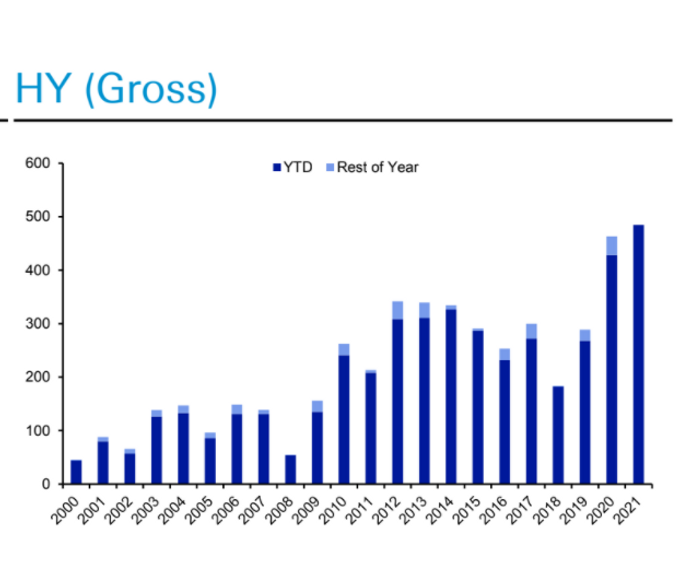
Despite their list of worries, BofA Global analysts still also have a largely rosy outlook for U.S. junk bonds, including with issuance forecast at a robust $425 billion for 2022.

That compares with annual issuance that only began to regularly top $200 billion in the U.S. in the past decade, according to Deutsche Bank.

Booming U.S. junk-bond supply


Deutsche Bank

: Tesla slides into bear market territory as valuation falls below $1 trillion

Tesla Inc.’s valuation fell under $1 trillion on Monday, with a loss of more than 4% sending the stock flirting with bear market territory.

Tesla shares
TSLA,
-4.98%

were down 4.7%, bringing December losses to more than 14%, which is shaping up to be the stock’s worst monthly performance since March 2020.

A close around current levels would be the lowest since Oct. 22, when the stock closed at $909.68.

It would also be down 21.35% from its record closing high of $1,229.91 on Nov. 4, signaling a bear market, which, as many on Wall Street define it, is marked as a decline of at least 20% from a peak. It would be Tesla’s third bear market of the year.

Tesla’s valuation shot past $1 trillion in October, on the heels of news that Hertz Global Holdings Inc. planned to order 100,000 Tesla vehicles.

The Fed: 5 things to watch for when the Federal Reserve announces its policy decision Wednesday

A pivot is defined as a turn or a twist. Its safe to say there will be twists and turns on Wednesday as Fed Chairman Jerome Powell is widely expected to adopt a more hawkish stance in his postmeeting news conference Wednesday.

On display will be “the limits of Fed hawkishness,” said David Kelly, chief global strategist at JPMorgan Funds. Central bankers are often described as either inflation-wary hawks, eager to tighten monetary policy, or more growth-focused doves.

“Fed members have displayed their dovish feathers too often at this stage for us to mistake them for a flock of hawks,” Kelly said.

It is widely assumed the Fed will double the pace at which it is tapering its bond purchases at the end of the December Federal Open Market Committee meeting. The Fed is also expected to pencil in more rate hikes over the next three years.

Beyond those important headlines, here’s a look at open-ended questions whose answers will be key for economists and investors to understand the Fed’s true colors when policy makers conclude their two-day meeting Wednesday.

Stocks
DJIA,
-0.54%

SPX,
-0.53%

were lower on Monday ahead of the Fed’s decision. The yield on the 10-year Treasury note
TMUBMUSD10Y,
1.428%

was well below 1.5%.

Could there be a dovish taper?

Steve Englander, head of North American macro strategy at Standard Chartered Bank, sees the possibility of a dovish taper that ends in mid-April. At the moment, economists expect the Fed to reduce bond purchases by $30 billion a month, rather than the current $15 billion a month pace. Doubling the pace of the taper would end purchases altogether by mid-March. Englander argued that reducing purchases by $25 billion a month would gain the most support. The resulting mid-April end to purchases would be dovish because “the faster the taper, the faster investors are likely to expect subsequent [rate] hikes,” said Englander, in a note to clients.

What’s the forecast for next year?

Markets will key on what the Fed projects for the economy in 2022, according to Steven Ricchiuto, chief economist at Mizuho Securities USA. The Fed now sees the economy expanding at a 3.8% rate next year, and this could be revised lower. Inflation is forecast to drop to 2.2% in 2022. This should be raised. The Fed’s forecast for the unemployment rate — also at 3.8% — should hold steady, he said. Ricchiuto said that how much the Fed revises inflation up next year will be key for what the market will discount for rate hikes next year. At the moment, markets are discounting about 2½ rate hikes next year. How these projections are revised “will lead to a lot of conclusions about whether or not, in the market’s mind-set, two [rate hikes] becomes three or three [rate hikes] becomes four.”

Goodbye ‘transitory,’ hello…?

Powell has signaled that the Fed is going to delete the word “transitory.” How will the Fed describe the inflation outlook? Neil Dutta, head of economics at Renaissance Macro, believes the Fed will simply say inflation is “elevated” but not try to explain it away. Ricchiuto thinks Powell will try to describe inflation as a “one-time permanent adjustment in prices that doesn’t become an annual event.” Michael Gapen, chief U.S. economist at Barclays, thinks the Fed will settle on “persistent.” At the November Fed press conference, Powell said: “certainly we should see inflation moving down by the second or third quarter.”

See: El-Erian says Fed use of ‘transitory’ to describe inflation was its worst call ever

How many rate hikes exactly?

In September, the Fed’s so-called dot plot, which tracks individual policy makers’ expectations for future rate moves, penciled in a total of six hikes by the end of 2024, bringing its benchmark rate up to 1.8%. Analysts now expect the Fed to boost the number of rate hikes up to a total of nine over the same period. That would place the median dot close to the Fed’s assessment of the neutral rate of 2.5% — where Fed policy is neither helping the economy expand or trying to slow it down.

Any change in the forward guidance about rate hikes?

An open question is whether the Fed will feel the need to change the language that set out conditions for the first rate increase. Ricchiuto thinks it is too soon for the Fed to change the guidance. Currently, the Fed has said benchmark rates will remain near zero until labor market conditions have reached full employment and inflation has risen to 2% and is on track to exceed 2% for some time. Fed officials have said the latter two conditions are satisfied. “If the FOMC feels the need to update this language, it will probably do so by putting more emphasis on the labor market as a catalyst for liftoff,” said Roberto Perli, head of global policy at Cornerstone Macro.

What to do about the balance sheet?

Economists will be listening to whether Powell gives any guidance on how much benchmark short term rates need to be raised before officials start tightening by allowing the balance sheet to shrink. “We don’t expect a clear signal yet,” said Jim O’Sullivan, chief U.S. macro strategist at TD Securities. In the last cycle, the Fed started shrinking the balance sheet when short-term rates reached the 1%-1.25% range.

Financial News

Daily News on Investing, Personal Finance, Markets, and more!

Financial News

Policy(Required)