Futures Movers: Oil dips after IEA says omicron will slow recovery in demand

Oil futures were higher Tuesday, but remained off earlier highs, after the International Energy Agency said the omicron variant of the coronavirus that causes COVID-19 would slow a recovery in demand for crude.

West Texas Intermediate crude for January delivery
CL00,
+0.06%

CLF22,
+0.06%

rose 9 cents, or 0.1%, to $71.38 a barrel on the New York Mercantile Exchange. February Brent crude
BRN00,
+0.05%

BRNG22,
+0.05%
,
the global benchmark, edged up 12 cents, or 0.2%, to $74.51 a barrel on ICE Futures Europe.

Both benchmarks dipped into negative territory after the Paris-based IEA, in its monthly report, cut its 2022 supply forecast from non-OPEC producers by 100,000 barrels a day and reduced its demand forecast by the same amount, saying it expects the surge in coronavirus cases to stymie the recovery in global demand.

Read: IEA cuts 2022 oil demand outlook citing omicron hit on global growth

Analysts said traders would remain attuned to reports around the severity of the omicron variant.

Central banks are also in focus, with the Federal Reserve expected to move Wednesday to more quickly wind-down its monthly asset purchases, setting the stage for rate increases by next spring.

See: 5 things to watch for when the Federal Reserve announces its policy decision Wednesday

“If risk appetite is given a boost by central banks this week we could see [oil] push on higher but ultimately, the omicron data is going to be key,” said Craig Erlam, analyst at Oanda, in a note. “Politicians are clearly concerned and the rate of transmission is worrying. Further restrictions could weigh but traders will be all too aware that any drop in the price on this could trigger a sudden adjustment from OPEC+.”

Can’t Buy the House You Want? Consider Moving Out of the City

If you’re a city dweller and have found yourself frustrated with the local real estate market, relocating to a smaller town might seem like an attractive possibility in the near future.

Maybe you’re reaching a different stage of your life — such as growing your family or approaching retirement — and you’re dreaming of a backyard garden or a more laid-back pace. Maybe, as for many others, a permanent transition to remote work has allowed for more flexibility and opened up new ZIP code options for you. Or maybe you simply want more square footage for your homebuying dollar.

Whatever your motivation, suburbs and small towns can offer a more affordable, and surprisingly appealing, alternative to the city.

Changes in life lead to changes in residence

“Being an elected official in town, you meet a lot of new residents,” says Rob Lewandowski, commissioner for the borough of Collingswood, New Jersey, a suburb 5 miles outside of Philadelphia. “Invariably, I would say 60% of the people I meet are coming from Philadelphia. They’re coming from Fishtown, Center City and South Philly, oftentimes because they’ve had a child or they have one on the way. And they’re trying to find that sweet spot of urbanity while also getting those quality-of-life advantages.”

An analysis by Harvard’s Joint Center for Housing Studies found that about 13% of Americans moved each year and that about 40% of moves were motivated by housing reasons. Those reasons included wanting to transition from renting to homeownership, wanting a better property and pursuing more affordable housing, according to 2019 Current Population Survey data from the U.S. Census Bureau. Nearly a third of movers did so for family-related reasons, including marriage and a desire to establish an independent household.

Movers are “looking for housing options they want at prices that they can afford,” Lewandowski says, “but they also want a connection to people, local businesses and a lifestyle.”

If you’re one of the many people considering a move out of the city to get more space for your budget, you can narrow your search and start getting a realistic picture of what you can afford by comparing the median price per square foot of homes in your desired area. For example, data from Realtor.com shows that the median home listing price per square foot was $370 in Center City Philadelphia, while it was $213 just a few miles away in Collingswood. For some families, that kind of move could add another bedroom within their budget, or space for a dedicated home office.

Leaving a city doesn’t have to mean leaving amenities

If you’re hesitant to move out of the city because of lifestyle trade-offs, you may be surprised by the availability of appealing options in the suburbs.

“People still want the experience of commerce, of dining, of entertainment,” says Lewandowski. “So to have a place where people don’t need to get in a car and go into a sea of parking lots, where they can bring their stroller or their cart and walk to the local farmer’s market, that’s really important. It brings it to a scale that you would find in a city.”

Many towns have developed more walkable downtowns in recent years, mixing homes with commercial spaces like restaurants and shops. If it’s important to you to continue to be able to get around easily without a car, consider making a list of towns that you’re targeting and look up their Walk Score. Collingswood, for instance, has a walk score of 74. This is considered “very walkable,” as residents can walk or bike to local resources like dining, schools and parks.

If you prioritize a great restaurant scene or school district, local “best-of” lists can give you greater insight into your potential options. If you’re concerned with the diversity or commitment to equity in a community, then you’ll want to look at local news sources and try to meet some people in organizations that connect to your interests.

For city expats, priorities are changing

“People in general are reevaluating what home means to them,” explains Jessica Hoff, broker-owner of Century 21 JRS Realty in Clark, New Jersey, a suburb about an hour outside of New York City. Remote work has made it so that clients that come to her have much more freedom, no longer having to choose a home based on proximity to an office. Meanwhile, other factors like room for a home workspace have become more important.

Priorities outside of the home itself are evolving, as well, as Hoff says that clients have expressed more interest in the local offerings of the communities where they’re looking at properties. This phenomenon has even changed the way that she and other local agents are promoting homes.

“Close proximity to the Garden State Parkway and bus lines” may no longer be the hot selling feature it once was, Hoff explains, to people who are less concerned with the hassle of a daily commute. Instead, more property listings use “vital advertising space” to spotlight attractions like “minutes away from amazing hiking trails” or “plenty of recreation opportunities and county parks,” she says.

How to move out of the city

Moving out of the city may feel daunting, but having a plan in place can help ensure that you find a better value for your money without fully compromising your lifestyle or sense of identity.

  • Know the areas you’d like to research. Most moves are local, with many home buyers choosing to stay relatively close to family and jobs; 82% of moves were within the same county or state in 2019, according to the Current Population Survey. If you don’t want to go very far, you can determine a radius that you’re comfortable with. If you’re looking to move farther away, consider your priorities. Would you prefer warmer weather? More accessibility to nature? Thinking through your must-haves can help narrow your options.

  • Determine what you want to keep about city living. If there are elements of city life that you don’t want to lose, narrow your search to an area that provides the features you want, such as nightlife, walkability and diversity.

  • Decide what you can afford. Suburban homeownership can come with its own unique range of new costs, such as buying and maintaining a car, property taxes and HOA fees, to name a few. When calculating your budget for your new home, make sure that you account for your new monthly expenses outside of the mortgage itself.

  • Consider how much space you’ll need. If you plan on growing your family, this is an important factor in deciding how many bedrooms you should look for. If your job has transitioned permanently to remote work, think about your needs long-term. Will you need your own private office space? Do you have kids that will need dedicated play space away from other areas of the home?

  • Find a real estate agent in your desired area. Once you’ve narrowed down your options, real estate agents can be great resources for learning more about a place. Come with a list of questions, and be clear about your needs and what you want out of your new residence.

You can also learn more about your target towns by visiting and seeing for yourself what they have to offer. Local calendars of events will let you know about upcoming occasions like restaurant weeks, farmers markets, carnivals and other happenings that can give you a better sense of what it feels like to be part of the community.

How I’d build a passive income by investing just £30 a week

I often hear people say that they just do not have enough savings to start buying stocks yet. And this is more likely to be true when we are young and have not built a pool of investible funds yet. I do think, however, that we should start investing wherever we are, with what we have. And over time, we could see the benefits of starting early. 

What can I buy for £30?

In fact, if I were to start investing today with very little money to spare, I could technically buy one of the best dividend yielding FTSE 100 stock for just £6. I am talking about the FTSE 100 industrial metals miner and steel manufacturer Evraz, which pays me a yield of 13.2%. The stock has an eye-watering dividend yield of 13.2%! This means, that for every stock I buy, I earn almost 80p in dividends per year.

5 Stocks For Trying To Build Wealth After 50

Markets around the world are reeling from the coronavirus pandemic… and with so many great companies trading at what look to be ‘discount-bin’ prices, now could be the time for savvy investors to snap up some potential bargains.

But whether you’re a newbie investor or a seasoned pro, deciding which stocks to add to your shopping list can be a daunting prospect during such unprecedented times.

Fortunately, The Motley Fool UK analyst team have short-listed five companies that they believe STILL boast significant long-term growth prospects despite the global upheaval…

We’re sharing the names in a special FREE investing report that you can download today. And if you’re 50 or over, we believe these stocks could be a great fit for any well-diversified portfolio.

Click here to claim your free copy now!

To make the most of  my investments, ideally I should aim for as low a trading fee as possible. We at The Motley Fool like to recommend it to be no more than 2% of the total value of investment.  There are trading platforms that offer a fee of less than £2 a trade, so if I am going to start investing, I could consider those. Also, the stamp duty on any electronic transactions is 0.5% of the trading value, which I should take into consideration. Based on this, I would invest £120 in a month in the stock or just £30 per week. 

What happens in a year

This would amount to an ownership of 20 Evraz shares every month and 240 in one year. At the current share price, this could result in a dividend payout of £190 in a year. Even if I deduct the transaction costs and stamp duty from this return, I still earn a double-digit yield of 11%. Now, this is not exactly a life-changing amount. But it is indicative of how even the smallest amount of money could really amount to something in a relatively short period of time if invested right. 

Of course, not all shares have a yield of 11% — many are much lower — and high-yield shares often come with risks.

But it is still possible that my income could grow over time. This would allow me to increase my level of investments. And if I keep ploughing any dividends back into more investments as well, it might just be a matter of time before I have a pretty substantial base of savings

How to keep generating passive income

There is of course always the possibility that the stock’s dividend yield could change over time. For instance, in the case of Evraz, next year could be a weaker one. The commodity boom is expected to slow down a bit and it is facing higher taxes in its home country of Russia as well. But going by its past dividend history, the yield could still be substantial. Also, there is nothing that stops me from moving my money around to other opportunities to generate a passive income over time either. 

5 Stocks For Trying To Build Wealth After 50

Markets around the world are reeling from the coronavirus pandemic…

And with so many great companies still trading at what look to be ‘discount-bin’ prices, now could be the time for savvy investors to snap up some potential bargains.

But whether you’re a newbie investor or a seasoned pro, deciding which stocks to add to your shopping list can be a daunting prospect during such unprecedented times.

Fortunately, The Motley Fool is here to help: our UK Chief Investment Officer and his analyst team have short-listed five companies that they believe STILL boast significant long-term growth prospects despite the global lock-down…

You see, here at The Motley Fool we don’t believe “over-trading” is the right path to financial freedom in retirement; instead, we advocate buying and holding (for AT LEAST three to five years) 15 or more quality companies, with shareholder-focused management teams at the helm.

That’s why we’re sharing the names of all five of these companies in a special investing report that you can download today for FREE. If you’re 50 or over, we believe these stocks could be a great fit for any well-diversified portfolio, and that you can consider building a position in all five right away.

Click here to claim your free copy of this special investing report now!


Manika Premsingh owns shares of Evraz. The Motley Fool UK has no position in any of the shares mentioned. Views expressed on the companies mentioned in this article are those of the writer and therefore may differ from the official recommendations we make in our subscription services such as Share Advisor, Hidden Winners and Pro. Here at The Motley Fool we believe that considering a diverse range of insights makes us better investors.

Bond Report: Treasury yields edge higher ahead of Fed meeting, PPI reading

Treasury yields edged higher Tuesday ahead of the kickoff of a pivotal, two-day meeting of Federal Reserve policy makers and the latest read on U.S. wholesale inflation.

What are yields doing?
  • The yield on the 10-year Treasury note
    TMUBMUSD10Y,
    1.436%

    rose to 1.429%, edging up from 1.423% at 3 p.m. Eastern on Monday.

  • The 2-year Treasury note yield
    TMUBMUSD02Y,
    0.656%

    was at 0.645%, compared with 0.642% Monday afternoon.

  • The yield on the 30-year Treasury bond
    TMUBMUSD30Y,
    1.821%

    was 1.818%, up from 1.811% late Monday.

What’s driving the market?

The focus for investors remains on the Federal Reserve and a host of other major central banks, including the European Central Bank, Bank of England and Bank of Japan, which are holding policy meetings this week.

Fed policy makers are expected on Wednesday to announce they will accelerate the wind-down of monthly asset purchases in response to inflation that continues to run hot and has proven more persistent than had been expected. The move is expected to put the Fed on track to end asset purchases by next spring, clearing the way for potential interest rate increases earlier than had been previously anticipated.

See: 5 things to watch for when the Federal Reserve announces its policy decision Wednesday

In other U.S. economic news, the National Federation of Independent Business on Wednesday said its small-business optimism index rose 0.2 point in November to 98.4.

The November Producers Price Index is due at 8:30 a.m. Eastern. Economists, on average, look for a rise of 0.5%.

Investors also remain attuned to the spread of the omicron variant of the coronavirus that causes COVID-19. Pfizer Inc.
PFE,
+4.59%

said trials of its COVID antiviral treatment showed it held off severe disease, while lab results showed it was effective against the omicron variant.

What are analysts saying?

“Apart from an accelerated taper, [Fed Chairman Jerome Powell’s] message on policy tightening going forward will be important,” said Rubeela Farooqi, chief U.S. economist at High Frequency Economics, in a note. “In the past, Mr. Powell has said that tapering does not send a signal about tightening. But a relatively quick change in thinking on tapering — the initial taper was announced following the Nov. 2-3 FOMC meeting, and Chair Powell signaled an acceleration in the pace at the end of the month — will also have implications about how quickly policy will be normalized going forward.”

: Fund managers dash for cash ahead of Fed decision

Fund managers dashed for cash in anticipation of more aggressive Federal Reserve policy, according to the latest survey conducted by Bank of America.

The allocation to cash rose to 5.1% in December from 4.4% in November, the survey of 371 panellists running $1.1 trillion in assets under management found. The survey was conducted between Dec. 3 and 9.

Bank of America said that was the highest allocation to cash since May 2020, as holdings in real estate investment trusts reached a seven-year high and the allocation to stocks was the lowest since 2020.

The Fed’s two-day meeting on interest rates starts Tuesday, and is expected to conclude with a faster pace of bond purchase tapering.

The dash for cash triggered a tactical buy signal as a contrarian indicator, Bank of America said. The typical global equity return three months out is a 4% gain, rising to 6.5% over six months.

The fund managers are expecting the Fed’s taper to end in April, the first rate hike to come in July, with two increases for all of 2022, the survey found.

The S&P 500
SPX,
-0.91%

has gained 24% this year and has set 67 record highs.

Outside the Box: What the U.S. economy needs is for people to work longer and take Social Security later

Elderly workers have become an increasingly critical driver of U.S. economic growth, accounting for almost 60% of all gains in U.S. employment during the 2010s. But since the onset of the COVID-19 pandemic in February 2020, more than one in 15 elderly workers have dropped out of the country’s labor force.

Near term, the decline in elderly labor-force participation is slowing the current economic recovery. Long term, if the decline proves permanent, it could worsen the already challenging economic, fiscal and retirement security outlook for an aging America.

Everyone knows that the pandemic caused a huge spike in unemployment. What is less well-known is that it also caused a large drop in labor-force participation — that is, the number of people who are either working or actively seeking work. While the unemployment rate has fallen as the recovery has progressed and is beginning to approach its pre-pandemic level, the labor-force participation rate is not much different from what it was a year ago at the height of the pandemic.

There are a number of reasons why labor-force participation has been slow to rebound. Many women were compelled to exit the labor market due to pandemic-related caregiving responsibilities, and some may have decided not to return. Government stimulus checks, together with rising asset prices, may also have enabled some workers to exit the labor market, at least temporarily, while the health effects of long COVID may be keeping others at home.

But the most important reason is the surge in early retirements. As of November 2021, the labor-force participation rate of U.S. adults aged 65 and over was 7.2% lower than in February 2020, while that of “prime age” adults aged 25- to 54 declined by 1.3%. 

The Federal Reserve Bank of St. Louis estimates that around 3 million more workers have retired since the start of the pandemic than would have been expected to retire based on prior-year trends. More than straightforward concerns about health and safety may be driving the exodus. Although a large share of these extra pandemic-era retirees are lower-income workers, which is to say workers who are least likely to be able to work remotely, higher-income workers have also been retiring in much greater-than-expected numbers.

While the reasons for this are not entirely clear, it is possible that the widespread death and disruption caused by the pandemic is prompting a “life is short” reevaluation of the trade-offs between continued work and retirement. If so, the decline in elderly labor-force participation could turn out to be more than a one-time shock.

The extra tax revenue that longer work lives generate could help to alleviate the rising cost of old-age benefit spending. 

Let’s hope not, since longer work lives would have many benefits for an aging America.  In economic terms, they could substantially offset the drag that slower growth in the population in the traditional working years would otherwise have on economic growth. As things stand, the Congressional Budget Office projects that U.S. employment will be growing at a rate of just 0.3% per year by the 2030s and 2040s, slowing GDP growth to 1.5% per year — barely one-half of its postwar average. Meanwhile, in fiscal terms, the extra tax revenue that longer work lives generate could help to alleviate the rising cost of old-age benefit spending. 

There would also be substantial benefits for individuals. For one thing, retirement security would improve. All else being equal, if workers contribute for five more years to a 401(k) or other defined-contribution retirement plan, and thereby collect benefits for five fewer years, the plan’s income-replacement rate would be roughly one-third greater. Moreover, studies show that continued productive engagement has a highly positive effect on the physical health, cognitive function, and emotional well-being of older adults. 

Working longer as America ages is both natural and necessary. It is natural because both life spans and health spans have risen dramatically since retirement institutions were first put in place. It’s also necessary because an equally dramatic slowdown in economic growth, itself largely the result of population aging, is rendering those same institutions unsustainable.  

Read: How will we make the most of an extra 30 years of life?

Getting back on track

Before the pandemic struck, older American workers were going the right direction. After falling steeply from the 1950s through the 1970s, the elderly labor-force participation rate bottomed out in the 1980s and 1990s, then began rising again. Once the pandemic is past, it is imperative that America get back on track. 

Several relatively modest policy changes could make it more attractive for those older workers who are able to do so to remain on the job longer, while at the same time protecting those who are not. These include:

1. Adjusting Social Security’s benefit formula to include workers’ entire wage histories, rather than just their 35 highest-earning years.

2. Applying Social Security’s delayed retirement credit, which currently stops at age 70, up to whatever age benefits are claimed.

3. Lowering FICA tax rates for older workers, who often earn no additional benefits for the extra taxes they pay.

4. Making Medicare the primary payer for all Medicare-eligible employees.

Employers could also help by expanding opportunities for partial retirement, phased retirement and “unretirement.”

The goal should not be to have people work for their entire lifetimes. Nor should it even be for them to work longer. Some people will not be able to, and some simply will prefer not to. But unless a significantly larger share of adult Americans remain productively engaged well into their later years, the economic and financial challenges the U.S. already faces will only worsen. Whether America succeeds in extending work lives may well determine whether it prospers while it ages.

Richard Jackson is president of the nonprofit Global Aging Institute (GAI). This article is based on “Rethinking Retirement in an Aging America,” a report jointly published by GAI and The Terry Group.

More: While many are looking for work, some older workers are jumping at the chance for a new start

Also read: This is why Congress needs to act on Social Security — right now

Mark Hulbert: Is the real earnings yield of the S&P 500 a reliable stock market predictor?

The S&P 500’s current inflation-adjusted earnings yield is significantly negative, but you don’t need to worry. I point this out in order to counter a fast-spreading narrative on Wall Street that the stock market’s prospects are poor when its earnings yield — the inverse of the P/E ratio — is lower than the inflation rate. Now is one of these times: With a trailing P/E of 28.65, the S&P 500’s
SPX,
-0.91%

earnings yield is 3.5% — more than 3 percentage points below the Consumer Price Index’s ’s 12-month rate of change.

It is rare for the real earnings yield to be this negative, but that doesn’t mean it is bad for the U.S. stock market. The last time the S&P 500’s real earnings yield was as low as it is now was between July 1946 to June 1947, when the U.S. was emerging from its war-economy footing and inflation spiked into the double digits. That actually turned out to be a good time to load up on equities: The S&P 500’s inflation-adjusted total return over the next decade was between 13.0% and 16.0% annualized — more than double its long-term average.

The stock market hasn’t always performed this well in the wake of a negative real earnings yield. But over the past 150 years, its average return in the wake of such occasions was no different than when yields were positive. That means the real earnings yield is not a helpful indicator for predicting the stock market’s longer-term direction.

A more helpful indicator is the raw, unadjusted, earnings yield — the inverse of the P/E ratio with no adjustment for inflation. Consider the extent to which it is able to explain or predict the stock market’s inflation-adjusted total return over the subsequent decade (as measured by a statistic known as the r-squared). Since 1871, the r-squared in the case of the unadjusted earnings yield is 24.7%. In the case of the real earnings yield, in contrast, the r-squared is an insignificant 0.4%.

Stocks are overvalued

It is curious that many on Wall Street have suddenly become concerned about the U.S. stock market’s overvaluation. According to almost all measures that have a statistically significant track record, equities have been extremely overvalued for several years running. Why become worried now, on the basis of an indicator that has no statistical validity?

Their concern is reminiscent of the shock that the Claude Rains character feigns in the movie Casablanca upon “discovering” that gambling goes on in the casino. 

Regardless, the market’s long-standing overvaluation makes it tricky to draw the correct lesson from the market’s low real earnings yield. Given the general overvaluation, it is entirely possible that the stock market in coming years will struggle, producing a below-average return. If it does so, however, it won’t be because the market’s current earnings yield is below the inflation rate.

Mark Hulbert is a regular contributor to MarketWatch. His Hulbert Ratings tracks investment newsletters that pay a flat fee to be audited. He can be reached at mark@hulbertratings.com

More: Americans expect higher prices for another year — with one big exception

Plus: A near-term pullback, then the third bubble in 100 years is coming, says strategist. Here’s how to get ready.

Need to Know: This major bank expects meme-stock madness and 99th percentile valuations to continue. Here’s why.

It was quite the Manic Monday, with not just the S&P 500 suffering its worst single-day performance in nearly two weeks, but retail favorites such as meme stocks GameStop and AMC Entertainment getting battered.

Thomas Lee of Fundstrat made three points. No investor wants to go risk-on into the Federal Open Market Committee meeting, equities reached an all-time high just last week, and the U.K. pushing COVID-19 vaccines is a reminder the U.S. still has to get through the omicron variant wave.

The 2022 outlooks are still pouring in, and a relatively optimistic outlook comes from the equities and derivatives strategy team at BNP Paribas, whose 5,100 call for the S&P 500
SPX,
-0.91%

next year matches Goldman Sachs, though it isn’t the highest on Wall Street. The team says valuations are “rationally exuberant.” The S&P 500 forward earnings yield premium to the U.S. 10-year Treasury
TMUBMUSD10Y,
1.440%

is in line with the five-year average, even if the Shiller price-to-earnings ratio is at a 99th percentile reading. And valuations, it notes, “have almost never been the sole cause of a market correction.”

BNP also details the exuberance elsewhere, such as in options. Call option volumes exploded at different times in 2021, and recently exchange-traded fund flows and market moves have been positively correlated, which it says is “consistent with a more momentum-driven regime, in which investors are chasing rallies rather than buying dips.”

From meme stocks to mega caps, there have been several instances of large dislocations and abnormal price moves. It expects more of these dislocations next year, but still of the “episodic and idiosyncratic” variety. While margin debt is at an all-time high, household balance sheets are also in excellent shape, and the labor market remains strong. “It could take either a significant economic or market downturn to change this behavior, neither of which we anticipate in 2022,” BNP says.

As for institutional investors, there’s a high bar to decrease allocations to equities while real returns for many assets are low or negative, the so-called there-is-no-alternative, or TINA, trade.

What about a Fed tightening cycle? Historically, the team says, it’s the end of the tightening cycle, not the start, that has been problematic for stocks. That isn’t to say there won’t be speed bumps, but BNP says there could be a rally afterward.

It is more worried about another topic du jour, supply chains, though it assumes disruptions will start to ease next year. Backlogs as measured by Institute of Supply Management polls of purchasing managers have already started to peak, and a gradual shift back into services demand from goods would also ease inflationary bottlenecks. But if these disruptions don’t ease, or get worse, there’s the risk of the Fed hiking into a weaker growth outlook, which could unwind the elevated valuations.

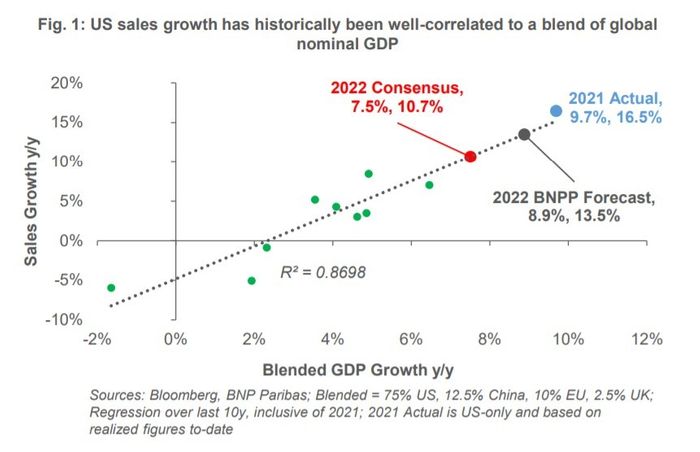
But the team is optimistic about corporate earnings. Historically, U.S. sales growth has been correlated to global nominal gross domestic product growth (that is, real growth plus inflation). BNP’s estimate of 4.8% real GDP growth, and 4.1% consumer-price index growth, translates into earnings per share growth of 12.4%, 5 percentage points above the consensus.

The buzz

The Fed’s two-day meeting starts Tuesday, with the announcement and press conference coming on Wednesday. There’s also a report due on producer prices.

California imposed a month-long mask mandate for indoor public places, as Philadelphia will require vaccine proof for bars, restaurants and indoor sporting events. Two doses of the vaccine made by Pfizer
PFE,
+4.59%

and BioNTech
BNTX,
+7.97%

offer 70% protection against hospitalization from the omicron variant, though just 33% protection against infection, according to a South African study.

Rentokil Initial
RTO,
-7.69%

struck a $7 billion deal to buy Terminix Global Holdings
TMX,
-0.19%
,
boosting its U.S. presence in pest control.

U.S.-listed Chinese social media provider Weibo
WB,
-5.59%

was fined by China’s internet regulator for violating a cybersecurity law.

Tesla
TSLA,
-4.98%

CEO Elon Musk continued his sale of shares while exercising options, taking the total stock sales to about $12 billion. The cryptocurrency Dogecoin
DOGEUSD,
+32.58%

jumped in value after Musk tweeted Tesla will start allowing merchandise purchases with it.

An initial examination by the U.K. Competition and Markets Authority found a “vice-like” grip by Apple
AAPL,
-2.07%

and Alphabet
GOOGL,
-1.47%

unit Google over mobile device ecosystems, ahead of a final report in June.

Need to Know starts early and is updated until the opening bell, but sign up here to get it delivered once to your email box. The emailed version will be sent out at about 7:30 a.m. Eastern.

The market

U.S. stock futures
ES00,
-0.19%

NQ00,
-0.55%

pointed to a second day of declines, particularly for the interest-rate sensitive technology sector.

Other assets weren’t faring as badly, with crude-oil futures
CL.1,
+0.06%

inching higher.

Top tickers

Here are the most active tickers on MarketWatch, as of 6 a.m. Eastern.

Ticker

Security name

TSLA,
-4.98%
Tesla

GME,
-13.92%
GameStop

AMC,
-15.31%
AMC Entertainment

DXY,
-0.19%
U.S. dollar index

TMUBMUSD10Y,
1.440%
U.S. 10-year Treasury note

DJIA,
-0.89%
Dow Jones Industrial Average

AAPL,
-2.07%
Apple

NIO,
-1.75%
NIO

ES00,
-0.19%
E-mini S&P 500 futures

NVDA,
-6.75%
Nvidia

Random reads

There’s a comet that if you don’t see this month, you never will.

This $6 hat with a picture of a bass is popular even among non-fishers.

Want more for the day ahead? Sign up for The Barron’s Daily, a morning briefing for investors, including exclusive commentary from Barron’s and MarketWatch writers.

FA Center: Odds of being a stock market winner in 2022 are in your favor for this one big reason

There’s a two-out-of-three chance the U.S. stock market will rise in 2022. A 66% probability of a rising market next year seems downright attractive, given that equities have more than doubled over the past 18 months. What many investors don’t realize is that these market odds stay the same from year to year, regardless of what’s come before.

Investors have a hard time accepting this because they believe the market exhibits trends. They assume that a good year makes it more likely the subsequent year will be rewarding, and a poor year sets up the probability of another disappointing year.

Contrarian investors make a conceptually similar mistake. They think the market regresses to the mean, which would mean that an above-average year would be more likely followed by a below-average year, and vice-versa.

Both investors and contrarians are wrong, because the stock market discounts the future, not the past. As market theoreticians teach us, an efficient market’s level at any given time should reflect all information that is publicly-available. According to Lawrence Tint, the former U.S. CEO of BGI, the organization that created iShares (now part of Blackrock), that means the market will rise or fall according to changes in anticipated future returns. It does “not include history in the calculation,” he said in an interview.

The accompanying chart provides a good illustration of market efficiency. The chart, which is based on the Dow Jones Industrial Average’s
DJIA,
-0.89%

return since its creation in 1896, plots the odds that the Dow will rise in any given year.

For starters, notice that across all calendar years, the stock market has risen 66% of the time. That’s the left-most column in the chart. Now focus on the column immediately to its right, which reflects the odds the market will rise in a given calendar year if it also rose in the immediately-preceding year. The odds in that case are — you guessed it — 66%.

The other columns of the chart likewise show that remarkably similar odds emerge when we slice and dice the data in different ways. For example, if the stock market falls in a given calendar year, the odds of stocks rising in the subsequent year are 67%. From a statistical perspective, this is no different than the odds that occur in other years.

The only precondition in which the market’s odds of rising in a given year appear to be well above the overall average occurs when the market has fallen more than 20% in the previous calendar year. In that case, as the right-most column in the chart shows, the odds are above 80%. Yet even in this case there may be less than meets the eye. That’s because there have been so few calendar years since 1896 in which the stock market fell by more than 20% — just 11, in fact. With such a small sample, it’s difficult to draw confident conclusions.

The bottom line: The odds the stock market will rise next year are the same as they would be in any other year.

Your reaction to these statistics will depend on whether you see the glass as half-full or half-empty. If you’re in the former camp, you will celebrate the two-out-of-three odds the market will rise next year, whereas if you’re in the glass-is-half-empty camp you will focus on the one-out-of-three odds of its falling. Regardless, what happens to stocks in 2022 will have nothing to do with how the market has performed this year.

Mark Hulbert is a regular contributor to MarketWatch. His Hulbert Ratings tracks investment newsletters that pay a flat fee to be audited. He can be reached at mark@hulbertratings.com

Become a smarter investor. Sign up here to get MarketWatch’s best mutual funds and ETF stories emailed to you weekly!

Also read: Highly valued S&P 500 index is ‘near the top of its 85-year trend channel,’ says Deutsche Bank

Plus: These 6 overvalued stocks are making the S&P 500 look more pricey than it really is

Dow Jones Newswires: Apple, Google have ‘vice-like grip’ over mobile devices, U.K. regulator says

The U.K. competition regulator said Tuesday that its interim report has found that a duopoly of Apple Inc. and Alphabet Inc.’s Google limits competition and choice, and that the firms are “exercising a vice-like grip” over mobile devices.

The Competition and Markets Authority said its report into mobile ecosystems suggests users are losing out because of the companies’ control. It had launched a probe in June over concerns that Apple
AAPL,
-2.07%

and Google
GOOGL,
-1.47%

have too much power over the iOS and Android operating systems, respectively, along with their app stores and web browsers.

The antitrust watchdog said it is concerned that this control is leading to less competition and meaningful choice for customers, as people appear to be missing out on innovative new products and services, along with higher prices.

“Apple and Google have developed a vice-like grip over how we use mobile phones and we’re concerned that it’s causing millions of people across the U.K. to lose out,” CMA Chief Executive Andrea Coscelli said.

The CMA said the best way for it to tackle the firms’ substantial market power was through a digital market unit once it receives powers from the government.

The report also set out a range of actions to address the issues, including making it easier for customers to switch ecosystems without losing functionality or data and making it easier to install apps through other methods than default app stores.

The CMA is consulting on its initial findings and said it will welcome responses by Feb. 7.

Representatives from Apple and Google weren’t immediately available for comment.

Write to Joe Hoppe at joseph.hoppe@wsj.com

Financial News

Daily News on Investing, Personal Finance, Markets, and more!

Financial News

Policy(Required)