
2 simple Warren Buffett habits anyone can apply

Legendary investor Warren Buffett is known for his outstanding investment track record. But unlike rivals at top investment firms, he doesn’t have hundreds of analysts working for him. Buffett doesn’t use complicated algorithms to identify shares to buy for his portfolio.

In fact, the investor uses a couple of techniques to find investments that I think anyone can use when looking for shares to buy. That includes me.

5 Stocks For Trying To Build Wealth After 50

Markets around the world are reeling from the coronavirus pandemic… and with so many great companies trading at what look to be ‘discount-bin’ prices, now could be the time for savvy investors to snap up some potential bargains.

But whether you’re a newbie investor or a seasoned pro, deciding which stocks to add to your shopping list can be a daunting prospect during such unprecedented times.

Fortunately, The Motley Fool UK analyst team have short-listed five companies that they believe STILL boast significant long-term growth prospects despite the global upheaval…

We’re sharing the names in a special FREE investing report that you can download today. And if you’re 50 or over, we believe these stocks could be a great fit for any well-diversified portfolio.

Click here to claim your free copy now!

Asking people for suggestions

Over the years, Buffett has repeatedly asked people for suggestions about shares or businesses he ought to buy.

That comes out in his annual shareholders’ letters, where he lays out specific criteria he considers when looking for businesses to buy. Buffett has even included a specific request for people to contact him if they are selling a business they think meets his criteria. It has also informed his approach when it comes to repurchasing shares in his company, Berkshire Hathaway. Again, Buffett has appealed directly to potential sellers of large stakes to contact his company directly.

In other words, Buffett is not too humble to ask for others’ help in finding things to buy. In fact, one might say that he actively encourages it.

As a private investor, how can I apply a similar approach? I can ask other people for suggestions on shares they think are worth looking at. Now, that doesn’t mean that they will be good for me. Other investors’ criteria and needs may be different to my own. But eliciting investment ideas from other people could help broaden my own thinking. Even if I don’t end up investing in any of them, it could help me deepen my knowledge of the market. That would enable me to keep re-examining my own investing ideas from a fresh perspective.

Warren Buffett reads a lot

One of the main ways Buffett has come across investment ideas over his long career is through reading. From investment articles to financial reports, Buffett reads – a lot. In fact, reading is the activity that takes up most of his working day.

How does that help him get investment ideas? It fills gaps in his knowledge and inspires him. Buffett sometimes reads about companies for decades without investing in them. That means that, if he does decide to buy their shares at some point, he is doing so with a very deep knowledge of the company’s historical performance. These days it is easier than ever to read a lot of financial information online, often for free. I am applying Warren Buffett’s approach to my own hunt for investment ideas, reading widely and regularly.

Applying the lessons

I may never have the investing success Warren Buffett has enjoyed. But that doesn’t mean I can’t benefit from applying some of the principles of his approach.

Looking for more information on investment, especially from a diverse range of viewpoints, could help me become a more considered investor. Whether it’s staying in touch with other investors about their ideas, or reading about companies in which I have some interest, I think Buffett’s approach could helpfully inform my own.


Christopher Ruane has no position in any of the shares mentioned. The Motley Fool UK has no position in any of the shares mentioned. Views expressed on the companies mentioned in this article are those of the writer and therefore may differ from the official recommendations we make in our subscription services such as Share Advisor, Hidden Winners and Pro. Here at The Motley Fool we believe that considering a diverse range of insights makes us better investors.

Washington Watch: As China’s digital yuan project gains steam, chances may rise for bipartisan embrace of digital dollar

The Chinese government’s stance on private cryptocurrencies has become a major point of focus for global investors in bitcoin and other digital assets, but its intensifying experiments with a digital form of its government-backed yuan could be even more consequential, experts say.

China has been experimenting with the digital yuan, or renminbi, since 2014, launched pilot projects in four major cities in 2019 and last November expanded to six additional cities including the financial hub of Shanghai, according to a white paper issued by the People’s Bank of China in July.

The Financial Times reported in October that the Chinese government is pressuring McDonald’s
MCD,
-0.32%

to expand the number of locations at which it accepts digital yuan for payment, beyond the 270 locations in Shanghai where it already does. The FT also cited a source familiar with the situation that Nike
NKE,
-1.30%

and Visa
V,
-0.52%

are being pressured by the government to integrate the digital yuan into their operations.

So far U.S. officials have remained sanguine about the digital yuan and its implications for the U.S. economy and its geopolitical standing, but recent successes may force them to reconsider, according to Robert Greene of the Carnegie Endowment for International Peace.

“The digital renminbi likely will become the backbone of a meaningful cross-border payments [system],” Greene, an expert on Chinese financial-sector trends, told MarketWatch. “There are Chinese officials calling for the renminbi to serve as the regional currency of Southeast Asia, and the digital renminbi could facilitate that.”

The Bank of International Settlements, an international financial organization owned by the world’s largest central banks, published research in September that said that central bank digital currencies could reduce the time needed to make cross-border payments from days to just seconds and cut associated costs by about half.

Last week, the BIS reported the “successful” results of an experiment using digital versions of the euro and the Swiss franc to settle international transactions between commercial banks in France and Switzerland as part of its ongoing experiments with central-bank digital currency called Project Jura.

“Project Jura confirms that a well designed wholesale CBDC can play a critical role as a safe and neutral settlement asset for international financial transactions,” said Benoît Cœuré, head of the BIS’s Innovation Hub, in a statement. “It also demonstrates how central banks and the private sector can work together across borders to foster innovation.”

Steve Pavlick, head of policy at Renaissance Macro Advisors, told MarketWatch that divergent views in Congress on whether and how it supports the Fed issuing a digital dollar will rest on developments abroad.

“Opposition and animosity to China is one of the few bipartisan forces there is right now,” he told MarketWatch. “There is a strong desire to preserve the dollar’s supremacy. If there’s a way to do that without the unintended consequences of hurting your domestic finance industry,” consensus could be built around the issue, he added.

Jonathan Dharmapalan, CEO of eCurrency, a California company that provides technology to central banks that plan to issue digital versions of their currencies, told MarketWatch in an interview that China’s ongoing deployment of its digital currency will soon make plain the advantages of offering access to digital yuan to buyers of Chinese-made products.

As it stands now, most foreign purchases of Chinese exports pay for those goods in U.S. dollars. “China wants to eliminate that process,” Dharmapalan told MarketWatch. “Retailers outside of China will be able to convert to digital renminbi without ever having to run to a bank to do it. With China being the supplier of the world, essentially, they’d love for everything to be bought and sold as soon as possible in renminbi.”

To be sure, there are major political hurdles a digital dollar faces before it advances beyond its current experimentation phase. The Federal Reserve Bank of Boston has been working with the Massachusetts Institute of Technology for the past 18 months to develop open-source code that would enable private parties to begin pilot projects that could demonstrate a digital dollar’s utility.

The Fed has promised a report that will examine the benefits and risks of issuing a central bank digital currency, but it remains unfinished despite Chairman Jerome Powell’s assurances in September that it would be released “soon.”

The delay could reflect internal disagreements at the central bank over the wisdom of a digital dollar or concern over creating a political firestorm amid a confirmation process for Powell and several forthcoming nominations from President Joe Biden to the Fed Board of Governors, Renaissance Macro’s Pavlick said.

Pavlick added that tension over Democrats’ desire to see the Fed and other financial regulators take on issues ranging from climate change to workforce diversity and Republicans’ fears that a digital dollar could destabilize the domestic banking industry could force digital-dollar policy to take a back seat.

Proponents of a digital dollar, therefore, will have to emphasize its importance in the face of geopolitical rivals, like China, using central bank digital currency to lower transaction costs and and draw its neighbors more tightly to its economic orbit.

“The most powerful tool we have against Russia and China are our economic sanctions,” Pavlick said. “So anything they can do to reduce their dependence on the dollar makes digital currencies more attractive.”

3 reasons I like dividend shares as passive income ideas

There are lots of passive income ideas. Not all are created equal – or even vaguely equal. One of my favourite passive income ideas is investing in dividend shares. But not everyone understands dividend shares, or their potential to generate extra money for their owners. Here are three reasons I like them.

1. World class businesses

If I put money into a bank account, I basically receive the payment the bank is getting from other customers to borrow it, minus the bank’s cut. In a competitive financial services market with low interest rates for now, that means that my likely passive income will be fairly meagre.

5 Stocks For Trying To Build Wealth After 50

Markets around the world are reeling from the coronavirus pandemic… and with so many great companies trading at what look to be ‘discount-bin’ prices, now could be the time for savvy investors to snap up some potential bargains.

But whether you’re a newbie investor or a seasoned pro, deciding which stocks to add to your shopping list can be a daunting prospect during such unprecedented times.

Fortunately, The Motley Fool UK analyst team have short-listed five companies that they believe STILL boast significant long-term growth prospects despite the global upheaval…

We’re sharing the names in a special FREE investing report that you can download today. And if you’re 50 or over, we believe these stocks could be a great fit for any well-diversified portfolio.

Click here to claim your free copy now!

By contrast, investing in dividend shares allows me to benefit from large, well-established businesses generating substantial profits. An example is British American Tobacco. One of the leading tobacco business globally, its shares currently yield 8%. In other words, if I invested £1,000 today, I would expect to receive £80 in dividend income annually.

Now, there’s a risk that won’t happen. Dividends aren’t guaranteed and as cigarette use falls, so might profits at British American Tobacco. But by diversifying my passive income streams across a number of shares, I seek to benefit from the business expertise of successful companies. I expect that to offer greater possible returns than bank interest.

2. In and out

I am an investor, not a speculator. So I don’t try to move in and out of shares quickly. Instead, I aim to choose companies I think have strong long-term potential. I then buy them in my portfolio to hold.

However, that doesn’t mean I never sell. Of course, circumstances can change and a company’s outlook can vary from one year to the next. If I set up my own business to generate passive income, moving in and out of it might not be so easy. Even if the idea was truly passive, it would likely take me time and effort to establish it. Then, if I wanted to exit it, I would need to find a buyer if I wanted to try and recoup my investment. 

With shares, by contrast, the start-up time is minimal — and that’s also true when I decide to end my investment. I can put funds into a share on the same day I decide I like it. Equally, when I think it’s time to sell, I can move to action immediately.

3. Passive income and business education

Owning dividend shares enables me to get income without working for it. But that doesn’t mean I never spend time developing my passive income ideas.

I tend to take time to read up on companies’ performance when assessing what the right opportunities for me as an investor might be. Over time, that reading can help me learn not just about the specific firm. It can also give me a growing education in business and finance generally. It’s not an MBA, that’s true. But it’s still a free, practical education based on real-life businesses. For my personal development, I think that can be very helpful.


Christopher Ruane owns shares in British American Tobacco. The Motley Fool UK has recommended British American Tobacco. Views expressed on the companies mentioned in this article are those of the writer and therefore may differ from the official recommendations we make in our subscription services such as Share Advisor, Hidden Winners and Pro. Here at The Motley Fool we believe that considering a diverse range of insights makes us better investors.

The Conversation: The great contradiction in the ‘Great Resignation’: Most people like their jobs

record share of American workers are quitting their jobs, thanks in part to a strong economy and a labor shortage.

Does that mean Americans are unhappy with where they work?

The answer would seem to be yes, according to many economists and other observers. That’s the narrative driving the Great Resignation, in which workers are simply fed up with their current jobs and demanding something better.

Read: ‘The Great Resignation’ slowed in October, but 4.2 million Americans still quit jobs

Survey data I’ve been collecting during the pandemic, along with social survey results from previous years, however, suggests this is far from the whole story. Rather than being motivated simply by dissatisfaction, it appears many of them are simply taking advantage of a strong economy to look around, while for others, the pandemic has prompted them to consider their options.

Are you satisfied?

The General Social Survey, a reputable national survey of American adults, has been asking workers questions about how they feel about the quality of their working life since 2002.

There are actually three key types of questions it asks that help us get at this idea: the level of dissatisfaction with current work, turnover intention and confidence in finding a new job.

Let’s start with dissatisfaction. The question is: “On the whole, how satisfied are you with the work you do – would you say you are very satisfied, moderately satisfied, a little dissatisfied or very dissatisfied?”

In 2002, about 12% of respondents said they were very dissatisfied or a little dissatisfied with their work, a figure that barely changed in subsequent surveys through 2018. In 2021, a tad over 16% said they weren’t satisfied – an increase, but not a big one. And on the flip side, a little over 83% said they were moderately or very satisfied.

This means that by and large the vast majority of Americans – at least according to this survey – express moderate to high satisfaction with their work.

Looking for a change

Turnover intention is another important indicator. The General Social Survey asks:

“Taking everything into consideration, how likely is it you will make a genuine effort to find a new job with another employer within the next year – would you say very likely, somewhat likely or not at all likely?”

My interpretation of a “very likely” response to this question is that it signals an immediate interest in leaving their present job. In 2002, about 19% said they were very likely to try to find a new job soon. Over the years, the share who said this rose and fell a little, but has remained very consistent.

A greater share of people say they are contemplating quitting than express dissatisfaction with their current job.

Unfortunately, the survey hasn’t posed the question since 2018, so I partnered with polling company Angus Reid Global to conduct two large national surveys of American workers in November 2020 and November 2021. One of the questions I asked was the one on turnover intentions, though I extended the period in which they expected to look for a new job to two years.

As you might expect given the rising quit rate, the share saying they were very likely to hunt for a new position jumped. It rose to 26% in 2020 and to 29% in November 2021.

While it’s likely that my number is a bit elevated just because of the extended time horizon – two years instead of one – the increase is consistent with the Great Resignation narrative that workers are keen to find a better workplace.

But these two figures – job satisfaction and turnover – reveal an interesting paradox: A greater share of people say they are contemplating quitting than express dissatisfaction with their current job. There are several possibilities for why a worker might be happy with their job, yet eyeing a move to another company. Perhaps they’re seeking more status or reconsidering their career, or maybe they’re worried about possible layoffs.

Confidence in the job search

An additional theme in the Great Resignation narrative is that workers feel more confident about finding alternative job prospects – and that’s one reason they have been quitting in droves.

Fortunately, the General Social Survey asks that very question:

“How easy would it be for you to find a job with another employer with approximately the same income and fringe benefits as you now have – not at all easy, somewhat easy or very easy?”

Two years before the COVID-19 pandemic, in 2018, about a quarter of respondents said finding another job would be very easy. I asked the same question in my 2021 survey and found that number had actually decreased to around 22%.

This means that worker confidence or optimism about finding a palatable alternative job has not climbed all that much, making it less likely to be a factor in driving the current wave of resignations.

What’s going on here?

While the data doesn’t show that Americans overwhelmingly love their jobs or anything like that, they do suggest most people like them enough to hold on to them.

Of course, this isn’t the end of the story. The data does show important differences depending on the type of job we’re talking about. For example, workers in the service sector were more dissatisfied with their jobs and much more likely to express an intent to quit than the average respondent.

But all in all, the survey data doesn’t support the common narrative that it’s a “take this job and shove it” economy, in which increasingly unhappy workers are finally sticking it to their managers.

Rather, when you dig down into the data, something different appears: A slice of workers are always considering leaving their jobs – and as the labor market looks brighter, the pent-up impulse to quit kicks in. But the shift in worker sentiment – or at least the way it has been portrayed – seems exaggerated.

Scott Schieman is a sociology professor at the University of Toronto. This was first published by The Conversation — “Vast majority of American workers like their jobs – even as a record number quit them“.

More on the ‘Great Resignation’

The ‘Great Resignation’: Heed these 8 tips from an employment lawyer before you quit

The panic over workers quitting? It’s more Great Stalemate than Great Resignation

This state has the biggest labor shortage — and one of the lowest unemployment rates

Hardship Loans: How to Borrow Money During a Financial Setback

A financial hardship can add stress to an already-difficult situation, like when your vehicle breaks down, someone in your household loses their job or a family member requires expensive medical care.

A hardship loan can be any money you borrow during such a difficult time. This can include a loan from a friend or family member, a personal loan or equity financing.

Here are some hardship loan options, plus alternatives to borrowing.

Hardship loan options

Friend and family loans

Borrowing money from a friend or family member may be the cheapest option, especially if the person who lends to you doesn’t charge interest. A friend or relative also won’t consider your credit score like a bank or online lender would. Asking someone you’re close with to lend you money may bruise your ego, but it can also be the fastest and simplest option.

To set expectations, draw up a contract detailing the loan amount and terms, including when and how often payments will be made and how much they’ll be.

Amount: You and the person you borrow from determine the loan amount, but note that there may be tax implications if the loan exceeds $15,000.

What it’s for: This option can be helpful if you’ve recently lost your job or main source of income, which may disqualify you from most traditional loan options. You can use this money for a car repair or to get back on track after a difficult time. You and the lender can decide whether to restrict how the funds are used.

Requirements: Typically no qualification requirements.

Costs: Your friend or family member can decide whether to charge interest. Beyond hard costs, a friend or family loan could cost you the relationship if something goes wrong, so tread carefully.

Payday alternative loans

Payday alternative loans, or PALs, are small-dollar loans available to members of some credit unions. If you have a low credit score and are a member of a credit union that offers PALs, it’s one of your cheapest borrowing options. You typically have between one and 12 months to repay this loan.

Amount: $200 to $2,000.

What it’s for: These are small, short-term loans that can help you pay for small emergencies or unexpected expenses.

Requirements: You may have to be a credit union member for at least a month to qualify, but some only require that you become a member. Your income and ability to repay the loan are key factors in determining whether you qualify.

Costs: PALs can have annual percentage rates of up to 28%. Some credit unions require a one-time membership fee.

Personal loans

Unsecured personal loans are offered by banks, credit unions and online lenders to borrowers with all types of credit. Some lenders offer secured personal loans, which require collateral like a vehicle or savings account and can help you qualify for a better rate.

Some personal loans are tailored to consumers with bad credit (629 or lower FICO), so a low credit score won’t necessarily prevent you from qualifying for a personal loan. If you’re borrowing for an emergency, a personal loan can be funded within a couple of days.

Amount: $1,000 to $100,000.

What it’s for: If your credit score has recently taken a hit but remains above 550, a personal loan can help you with urgent home repairs or medical emergencies.

Requirements: Each lender has different requirements. Some banks and credit unions require you to be an existing customer to get a loan. Borrowers with good or excellent credit (690 or higher FICO) typically get the lowest rates and many lenders like to see a debt-to-income ratio below 40%. Adding a co-signer with strong income and credit may improve your chances of qualifying.

Costs: APRs on personal loans range from about 6% to 36%. Some lenders charge an origination fee, which is calculated in the APR, and may reduce the loan amount you receive.

401(k) hardship withdrawals

If you’ve been contributing to a 401(k), you may qualify for a hardship withdrawal. Check your plan to determine if you qualify and what the specific conditions are.

Amount: This type of withdrawal lets you access money you — and maybe your employer — have contributed to the fund, but probably not any gains the money has made while it has been invested.

What it’s for: Generally, expenses such as medical bills, college tuition, money to avoid eviction, funeral expenses and some home repairs qualify for hardship withdrawal.

Requirements: Your plan’s administrator usually decides whether you qualify, and you may have to explain why you can’t get the money elsewhere.

Costs: If you’ve lost your job and are under age 55, you could face tax penalties for withdrawing money from your 401(k). You may still have to pay a 10% tax penalty if you withdraw the money before age 59 1/2. This option also leaves you with less in savings for retirement.

Home equity loans and lines of credit

With a home equity loan or line of credit, you borrow against the equity your home has gained. A home equity loan comes in a lump sum, while a HELOC is an open credit line you use as needed.

Tapping your equity to cover a hardship can be a risky option because you use your home as collateral. That means if you don’t repay the borrowed funds, you could lose the house. Also, if your home’s value drops, you could owe more than what it’s worth.

Amount: Up to about 85% of your home’s value.

What it’s for: Urgent home repairs are a good use of home equity financing, as long as you’re comfortable using your home as collateral.

Requirements: You usually need more than 20% equity in your home, a debt-to-income ratio of less than 40% and a 620 or higher credit score. A lender will also require employment and income verification.

Other hardship assistance

For help with rent or utilities: Contact your utility company, landlord or mortgage issuer for help deferring a payment. If you need long-term help, consider seeking other housing or contacting a housing counselor.

To clear unsecured debt: Debt relief can help if your debt has become overwhelming. Learn about the different types of debt relief and their consequences.

To pause student loan payments: If you meet certain criteria, you may be eligible for student loan deferment or forbearance.

Hardship financing to avoid

No-credit-check loans: A lender may offer a no-credit-check loan for borrowers with low or no credit scores, but beware of this option. These lenders may not review your ability to repay the loan and will charge triple-digit interest rates to account for the risk of you not paying.

Payday loans: Payday lenders may attract consumers in hardship because they have few qualification requirements, and some lend to you regardless of your employment status. They often require repayment of the entire loan amount in two weeks, which can lead to a cycle of debt if you’re unable to make the payment and have to borrow again.

How personal loans work in hardship

If you have a personal loan and need hardship assistance, contact your lender. Most lenders offer hardship assistance, often working out a plan on a case-by-case basis.

If your hardship plan involves pausing loan payments, ask your lender how that will be reported to the major credit bureaus. Payments reported as late or missed will hurt your credit.

How lenders are responding to COVID-19

Initially, personal loan lenders — including banks, online lenders and credit unions — responded to the pandemic by making hardship programs consistent and public. Many offered a month or more of deferred or reduced payments.

Toward the end of 2020, most lenders had taken the COVID-19 assistance information off their websites and returned to normal case-by-case hardship offerings.

If you’re experiencing a financial hardship related to the pandemic, call your lender and ask what assistance is available.

Robert Powell's Retirement Portfolio: Year-end moves to make with your retirement portfolio

It’s that time of year when you get to put a bow not just on gifts for loved ones but also your portfolio.

Here are some moves to consider making with your nest egg before the year ends.

Still working?

If you’re still working, consider maximizing how much you’re contributing to your employer-sponsored retirement plan, said Patrick Kuster, a wealth adviser with Buckingham Strategic Wealth.

According to the IRS, employees can defer up to $19,500 in 2021 in their 401(k), 403(b), 457 and Thrift Savings plans, and those age 50 and older can contribute an additional $6,500 for a total of $26,000.

Read: How to save on your 2021 taxes

For those with earned income above 2021 Roth contribution limits, Kuster said this may be the last year for “backdoor” Roth conversions due to proposals within the Build Back Better Act (BBB). “As such, the conversion of after-tax dollars may need to be completed by year-end,” he said. “For those evaluating this strategy, you may want to consider beginning the process sooner rather than later.”

A backdoor Roth IRA conversion is simply making a (typically nondeductible) IRA contribution, followed by a subsequent Roth conversion, according to Kitces.com.

IRA account owners – especially those in low-income tax years — might consider traditional partial or full Roth IRA conversions, Ashley Folkes, a senior financial adviser with Bridgeworth Wealth Management. Two reasons: As with backdoor Roth conversions, proposed tax law changes that could affect this opportunity in the future. Plus, you could leave a tax-free inheritance to your heirs, and it can create an account that can grow tax-free longer.

December is also a good time to revisit your portfolio’s target asset allocation (now’s a good time to draft one if you don’t have an investment policy statement) and consider how best to bring that allocation back into balance.

There are several approaches. You could sell those assets that are say 5 percentage points above your target asset allocation and buy those assets that are 5 percentage points below your target asset allocation. You could change how your contribution is allocated.

Or, instead of reinvesting your internal inflows such as dividends and interest income into the same overweighted holdings, you can allocate those into areas that are underweighted, said Folkes.

Another more dynamic way of rebalancing your portfolio, said Folkes, is moving money from passive to more active management or vice versa if you believe the market conditions present themselves one way or another.

For nonretirement accounts, Kuster said Uncle Sam doesn’t know that your investments are up or down until you sell. While you think about rebalancing to bring your allocation back into balance, Kuster said a strategy to consider is to generate a tax loss for any investment values (or lots) that are down and seek to purchase back a similar (same asset class) but different (not substantially identical, per wash sale rules) investment. “The value in realizing the losses is their use to offset this year’s or future year gains,” he said.

As this strategy is, essentially, a tax deferral, Kuster said it is especially beneficial when losses are generated at higher tax rates and offset by future gains at lower tax rates. “If you think that you might have a heavy capital gains burden this year, expect to stay at a similar tax rate, or that your rate may even go down in the future, talk with your financial and tax professionals,” he said. “They can help you identify whether loss harvesting may be a sound strategy for you.”

What’s more, Kuster said this may be the last year that wash sale rules don’t apply to cryptos, currencies and commodities. His suggestion: Consider selling any losses of these assets and repurchasing the investment a day or two later.

Get instant alerts on the biggest market-moving news: Sign up for MarketWatch bulletins

Not taking RMDs yet?

If you’re retired but not taking RMDs, these may just be the lowest income-tax years of your life, and potentially the years where you withdraw the largest portions of your portfolio, said Kuster.

“Review your financial goals within the next few years and consider how downturns in markets may impact these goals or the long-term success of your portfolio,” he said. “As timing markets during this important segment of your life is unwise, it’s probably worth revisiting your asset allocation and evaluating the impact of placing the funds you need within the next six months to a few years on the sidelines.”

Kuster also recommends working with your financial adviser and tax professional to evaluate if converting funds from your pretax retirement accounts to a Roth IRA illustrates tax savings and would be in line with your financial goals. “As an example, if you don’t rely on your RMDs to pay the bills or don’t think you will in the future, converting and prepaying the tax now before balances grow may lead to lower taxes down the road.”

Taking RMDs?

If you’re retired and now in that stage of life when you’re taking RMDs (age 72 and older) and no longer contributing to a 401(k) or IRA, you’ve got it easy when it comes to rebalancing your portfolio back to its target asset allocation. You could sell those assets that are above your target asset allocation and buy those assets that are below your target asset allocation.

Consider too, said Kuster, making qualified charitable distributions or QCDs from an IRA directly to a qualifying charity. “While the donation won’t count toward a charitable deduction, this strategy can be especially efficient for those who don’t itemize deductions, essentially bringing back tax efficiency for those who take the standard deduction,” he said.

While you just need to be 70½ to execute QCDs, those 72 and over can leverage them to manage Medicare costs when your projected modified adjusted gross income is over $182,000. That’s because QCDs count toward RMDs. “Therefore, they can be used to reduce ‘counted’ retirement distribution amounts,” said Kuster.

Of note, the maximum annual exclusion for QCDs is $100,000, according to the IRS.  

This is the minimum amount of savings we’ll need for a comfortable retirement

Image source: Getty Images.


Let’s face it – regardless of all the Instagram filters, none of us is getting any younger with time. The coronavirus crisis has proven yet again how hard it is to plan anything and especially what your life could look like down the line. However, if you follow the maxim that ‘time waits for no one’, you are probably already thinking about retirement.

The question comes down to money — exactly how much will you need in retirement? Simple to pose but for most people, it is very hard to answer, which makes planning for the later part of our lives quite challenging. With the hope of simplifying the planning process, the Pensions and Lifetime Savings Association (PLSA) published the Retirement Living Standard. Developed by the Centre for Research in Social Policy at Loughborough University, it captures the public attitude towards retirement in contemporary Britain. The standards consider three different baskets of goods and services and estimate the minimum amount of money that you will need for the respected lifestyle (minimum, moderate and comfortable). 

The minimum income in retirement that you will need is £10,900, rising to £13,200 if you are in London. If you are a couple then the minimum increases to £16,700 (or £21,100 for London). This should be enough to cover all your essentials, like household bills, and leave some for the occasional treat and entertainment. 

For a comfortable retirement, with more luxury like travelling abroad, the amount climbs to £33,600 (£36,700 – London) of annual income for a single retiree and £49,700 (£51,500 – London) for a couple. If you would like to be over the minimum standard but cannot afford to be in the top percentiles, you are striving for an annual income that will let you achieve a moderate living standard. For that extra financial security and more fun, around £20,800 is about right or £30,600 for a couple (£20,800 and £30,600 respectively if you are based in the capital).

Do you mean to tell me I can still have fun when I retire?

The simple answer is yes, but that doesn’t take away from the fact that you still need to contribute to your retirement pot before you can reap the benefits. Annoying, I know, but if you are a fraction as competitive as I am then it gives you a target to focus on. Yet we shouldn’t forget that these estimates involve a form of subjective judgement. For example, it is stated that the comfortable standard involves aspects like taking a yearly three-week holiday in Europe, replacing your car every five years or so, and spending around £1,200 on clothing each year. 

Of course, we all have a different lifestyle and some of us might consider this extravagant. However, the standards are not inclusive of all costs. For example, it doesn’t take into consideration paying your mortgage in retirement or the need for care support. So, if any of these apply to your circumstances, then the standards may not be as useful to you. 

Another thing to consider is the standards are only meant to act as guidance and not a final figure. Meaning, you might not end up having that lavish three-week getaway in Europe. However, the PLSA’s estimates provide a great starting point to gauge whether your savings will sustain your lifestyle in retirement. 

Another important point I’d like to raise is that not all your retirement income will have to come from your savings. Well, that is if you have made National Insurance contributions during your working life. Then you will be entitled to a state pension, which is worth £9,339 in the current financial year (so you can subtract that from your target income). 

For a single person in London, this translates to a deficit of just over £15,000 to hit the PLSA’s moderate level of income. The question then evolves to how big my pension pot should be to fill that gap. 

You can start by checking if your pension provider offers a free retirement income calculator. My current provider, Legal & General, offers a fairly simple one to use, in comparison to others I’ve seen. Assuming that I retire at age of 60 and I’m aiming for a moderate level of income, it reckons I will need £550,000 of pension savings to buy a guaranteed income for the rest of my life (also known as an annuity) of £15,190. This is also assuming that I take 25% of the pot as tax-free cash and will not expect the remaining to go up in value.  

Alternatively, you can decide to continue investing your retirement pot with the hope of it increasing in value. But the fact that you need more than £500,000 in savings (taking into account the state pension) would come as a shock to most people. 

Products from our partners*

Top-rated credit card pays up to 1% cashback

With this top-rated cashback card cardholders can earn up to 1% on all purchases with no annual fee. Plus, there’s a sweet 5% welcome cashback bonus (worth up to £100) available during the first three months!

Those are just a few reasons why our experts rate this card as a top pick for those who spend regularly and clear their balance each month. Learn more here and check your eligibility before you apply in just 2 minutes.

*This is an offer from one of our affiliate partners. Click here for more information on why and how The Motley Fool UK works with affiliate partners.Terms and conditions apply.

Was this article helpful?

YesNo


Some offers on The Motley Fool UK site are from our partners — it’s how we make money and keep this site going. But does that impact our ratings? Nope. Our commitment is to you. If a product isn’t any good, our rating will reflect that, or we won’t list it at all. Also, while we aim to feature the best products available, we do not review every product on the market. Learn more here. The statements above are The Motley Fool’s alone and have not been provided or endorsed by bank advertisers. John Mackey, CEO of Whole Foods Market, an Amazon subsidiary, is a member of The Motley Fool’s board of directors. The Motley Fool UK has recommended Barclays, Hargreaves Lansdown, HSBC Holdings, Lloyds Banking Group, Mastercard, and Tesco.


Oneworld Multi-Carrier Awards: What You Need To Know

American Airlines flies to an impressive 123 international destinations across 61 countries. However, American doesn’t fly to every international destination that travelers want to visit. So connecting between American Airlines and its Oneworld partner airlines is essential for flying to many international locations.

Not all airline loyalty programs let you combine multiple Oneworld airlines in the same award. However, some mileage programs have special Oneworld multi-carrier award charts.

The smartest way to book these awards is with American AAdvantage, British Airways Avios, Cathay Pacific Asia Miles and Japan Airlines Mileage Bank. Whether you want to visit Bali or Budapest — or both on the same trip — here’s what you need to know about booking Oneworld multi-carrier awards with these airline loyalty programs.

American AAdvantage Oneworld multi-carrier awards

The easiest way to book Oneworld multi-carrier awards is using American Airlines AAdvantage miles. That’s because American lets travelers combine awards from different airline partners in the same award without any limitation to the number of airline partners. You can also book awards on almost all of American’s partners on its website.

The only limitation you may hit is AAdvantage’s cap of three segments for award travel within the U.S. and Canada and four segments for all other travel. Besides that, the only limitation is your creativity.

Want to combine an American award with an Alaska award? That’s easy. This option can come in handy when using Alaska awards to connect to American’s new international flights out of Seattle — such as Seattle to Bangalore, India.

You don’t even need to fly a segment on American. For example, you can fly from San Jose, California, to Seattle on Alaska Airlines, then connect to a Qatar Airways award to Doha.

Or combine Alaska Airlines, American Airlines and British Airways to fly from Bozeman, Montana, to Budapest, Hungary. A saver economy award on this route will cost you 22,500 AAdvantage miles each way during off-peak dates.

Earning AAdvantage miles

To take advantage of one of these redemption options, you’ll need AAdvantage miles. Thankfully, there are plenty of ways to earn these miles.

One way to earn AAdvantage miles is to transfer points from Marriott Bonvoy. Bonvoy points transfer to American at a 3:1 rate with a 5,000-mile bonus for every 60,000 points you transfer.

British Airways Avios Oneworld multi-carrier awards

For most British Airways awards, awards are based on the distance of each flight segment. If you book a nonstop award from Denver to Miami, British Airways charges the price for the distance of the trip. However, if you connect in Dallas on the way, British Airways prices each flight separately and adds the two costs together — usually leading to a higher award price.

However, if you combine two or more Oneworld airlines on the same award ticket, British Airways uses a different award chart. Instead of basing the award cost on each flight segment, you’ll pay a flat rate based on the total distance of the trip.

British Airways multi-carrier award chart

Premium economy

Business class

Under 1,500

1,501 – 4,000 miles

4,001 – 9,000 miles

9,001 – 10,000 miles

10,001 – 14,000 miles

14,001 – 20,000 miles

20,001 – 25,000 miles

You may be able to save Avios by using this Oneworld multi-carrier award chart rather than the standard award pricing. For example, a business class award between 3,001 and 4,000 miles in distance costs 62,000 Avios in the standard award chart. However, you can fly up to 10,000 miles in distance — meaning potentially three flights in this distance band — for just 140,000 Avios.

There are a few downsides to using British Airways Oneworld multi-carrier awards. First, the rules are numerous, yet unpublished by British Airways. Some travel sites report successfully booking British multi-carrier award tickets with up to eight flight segments and multiple stopovers.

However, since you can’t book these awards online, you’ll need to call British Airways to price out and book these awards. And the agent might not be knowledgeable about the rules of this type of award.

Earning British Airways Avios

If you need more Avios to book a multi-carrier award, you’re in luck. You can earn British Airways Avios through a myriad of ways. In addition to flying and British Airways credit cards, you can transfer points to British Airways Executive Club from the following programs:

  • American Express Membership Rewards (1:1 transfer ratio).

  • Capital One Miles (1:1 transfer ratio).

  • Chase Ultimate Rewards® (1:1 transfer ratio).

  • Marriott Bonvoy (3:1 transfer ratio).

Cathay Pacific Asia Miles Oneworld multi-carrier awards

Like British Airways, Cathay Pacific’s Asia Miles program uses a separate Oneworld Multi-Carrier Award Chart for award bookings that combine two or more Oneworld airlines.

When using this award chart, you’re limited to only two Oneworld airlines in the same ticket if your itinerary doesn’t include Cathay Pacific. However, if your itinerary includes a Cathay Pacific flight, you can book three or more Oneworld airlines in the same booking.

Cathay Pacific Asia Miles Oneworld multi-carrier award chart

Business class

First class

0 – 1,000 miles

1,001 – 1,500 miles

1,501 – 2,000 miles

2,001 – 4,000 miles

4,001 – 7,500 miles

7,501 – 9,000 miles

9,001 – 10,000 miles

10,001 – 14,000 miles

14,001 – 18,000 miles

18,001 – 20,000 miles

20,001 – 25,000 miles

25,001 – 35,000 miles

35,001 – 50,000 miles

Maximize the Asia Miles Oneworld Multi-Carrier Awards chart by booking up to five stopovers, two transfers and two open jaws. The only limitations are that you can’t book premium economy awards and your itinerary can’t exceed 50,000 miles. Besides that, you can build as complex of an itinerary as you want.

Earning Cathay Pacific Asia Miles

Although Asia Miles is a foreign program for many travelers, it’s fairly easy to accumulate Asia Miles. You can transfer points to Asia Miles from four major transferable point programs:

  • American Express Membership Rewards (1:1 transfer ratio).

  • Capital One Miles (1:1 transfer ratio).

  • Citi ThankYou Points (1:1 transfer ratio).

  • Marriott Bonvoy (3:1 transfer ratio).

Japan Airlines Mileage Bank Oneworld multi-carrier awards

The Japan Airlines Mileage Bank program also lets members book a combination of Oneworld airlines in the same award ticket. Like British Airways and Cathay Pacific, Japan Airlines adds the total distance of the flights to determine the price of an award.

Japan Airlines Oneworld award chart

Business class

First class

1 – 4,000 miles

4,001 – 8,000 miles

8,001 – 10,000 miles

10,001 – 12,000 miles

12,001 – 14,000 miles

14,001 – 20,000 miles

20,001 – 25,000 miles

25,001 – 29,000 miles

29,001 – 34,000 miles

34,001 – 50,000 miles

Japan Airlines Oneworld multi-carrier awards are about as generous as they get. Members can book up to eight flight segments and seven stopovers on the same award ticket. If you can book nonstop flights throughout your journey, you can potentially visit seven different destinations on the same ticket.

Earning Japan Airlines Mileage Bank miles

With Marriott Bonvoy you can transfer to JAL at a 3:1 transfer ratio with a 5,000-mile bonus for transferring 60,000 points.

If you’re planning to book Oneworld multi-carrier awards

Many Oneworld programs let members book multi-carrier awards. However, the award pricing for these awards may be different from the airline’s standard award pricing. In many cases, this can open up the opportunity to book amazing multi-stop awards on several amazing airlines.

How to maximize your rewards

You want a travel credit card that prioritizes what’s important to you. Here are our picks for the best travel credit cards of 2021, including those best for:

The Ultimate Guide on Southwest Flights to Vegas 

If you plan to visit Sin City and like flying with Southwest Airlines, you’ll be happy to know that you have many options for Southwest flights to Las Vegas. Here’s what you need to know.

The Southwest route map from Las Vegas

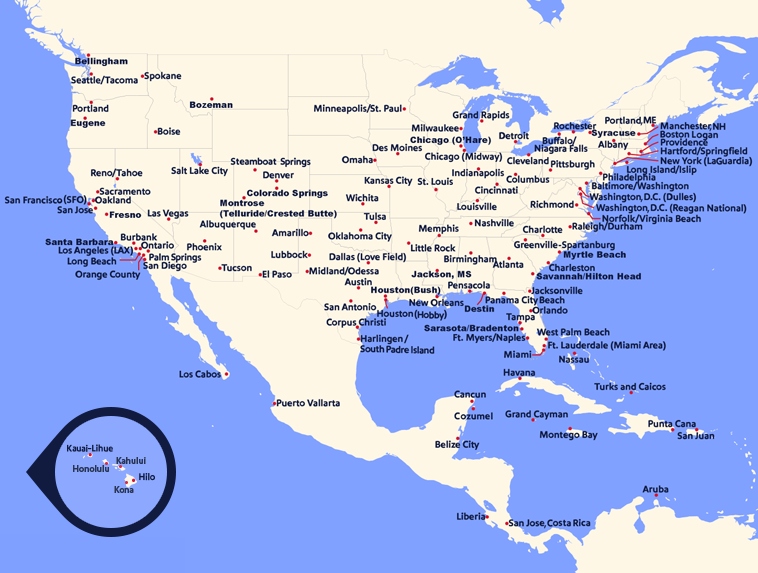
Southwest flies direct to Las Vegas from more than 60 U.S. cities, including Buffalo, New York; Cleveland; Denver; Houston; Milwaukee; and Tampa, Florida. If you don’t mind making a stop, you can find a Southwest flight to Las Vegas from almost anywhere the airline flies.

Flying Southwest into Harry Reid International Airport

You’ll fly into Harry Reid International Airport (LAS), formerly McCarran Airport. Before you book your Southwest Las Vegas flight, know what to expect for departure and your return trip.

  • Terminal: Las Vegas’ airport has two terminals — Terminal 1 and Terminal 3. All Southwest Airlines flights depart and arrive at Terminal 1 at the B and C concourses, where you’ll find a variety of shops, restaurants, eateries — and slot machines. Free Wi-Fi is available throughout the public areas of the airport.

  • Terminal 1 lounge: The Club LAS is past security in Concourse D, located near gate D33. If you have Priority Pass lounge access through a credit card, you can use this lounge. But because it’s in a different concourse than your Southwest flight, allow extra time to get to your gate.

The airline’s loyalty program, Rapid Rewards

Southwest loyalists are wise to become Rapid Rewards members, which makes it easy to earn and redeem Rapid Rewards points. Points are earned by flying the airline, spending on a co-branded credit card or spending with partners, such as specific hotels. Members can also buy points or transfer them from outside loyalty programs.

When flying, points are earned at varying rates depending on the ticket type. For non-elite flyers, the airline’s cheapest airfares, known as Wanna Get Away, earn 6 bonus points per dollar spent. This ends up being half of what’s earned for the most expensive ticket type (Business Select), which earns 12.

Elites are known as A-List or A-List Preferred members and get a further boost to points earnings, as well as priority boarding and other benefits.

If you plan to fly regularly to Vegas on Southwest, consider becoming a member and earning status to improve your overall flight experience.

The value of Southwest points

The value of Southwest Rapid Rewards points varies depending on how you use them. NerdWallet’s recent analysis determined Southwest points are worth an average of 1.4 cents each. This baseline value can help you determine if your redemption is worth it or if you should instead pay cash and save your points for a more valuable redemption. Learn more about the value of Southwest points.

When looking at flight options, consider the airline’s Wanna Get Away fares. Because these fares tend to be the cheapest cash option, they also get good value for your points compared to Anytime and Business Select fares.

If your travel dates are flexible, use the Low Fare Calendar, which lets you search by month to find the cheapest travel dates. You can view the lowest fares by cash and points price to decide when is optimal to fly.

Cheap cities to fly to Las Vegas from

Searching for Southwest cheap flights to Vegas? To get a snapshot of costs, we rounded up the following fares for one-way journeys from five popular departure cities. Some of these flights were nonstop, while others were not.

Departure city

Cost in points to book a ticket 90 days in advance

Cost in cash to book a ticket 90 days in advance

Value per point

1.5 cents.

San Francisco

1.7 cents.

Chicago-O’Hare

1.5 cents.

Washington-Dulles

1.5 cents.

1.6 cents.

We determined the value per point with a simple math equation: (Cost in cash / Cost in points) x 100. If the cost per point is more than our average value of 1.4 cents, you’re getting a good deal. If it’s below, you might consider holding onto those points for a future, more valuable redemption.

Other tips for booking cheap Southwest flights to Vegas

There are plenty of ways to book affordable Vegas flights with Rapid Rewards points. Follow these tips to get a better deal.

  • Earn a Companion Pass. If you can earn the Companion Pass, a companion of your choosing can join you on every flight that you take at no cost other than taxes and fees. This benefit is available whether you pay the cash rate or redeem points for your flight.

  • Transfer points from another rewards program. If you don’t have enough Southwest Rapid Rewards points but have Chase Ultimate Rewards® points, you can transfer your points at a 1:1 ratio. If you have Marriott Bonvoy points, you could convert those to Southwest Rapid Rewards points, but we don’t recommend this option as they transfer at a 3:1 ratio.

  • Fly on off-peak travel days and times. You’re bound to find a more affordable airfare on a Tuesday than a Friday, and departing early hours versus mid-morning.

If you want to fly Southwest to Las Vegas

This airline makes it easy to get to Sin City, as many Southwest flights to Vegas are nonstop. If you book your flight well in advance, you can find some nice mile redemption options, as well as affordable cash rates.

How to maximize your rewards

You want a travel credit card that prioritizes what’s important to you. Here are our picks for the best travel credit cards of 2021, including those best for:

Omicron variant: 3 cheap UK shares I’ll be buying to navigate the crisis

Share prices have inevitably had to weather a number of storms during the Covid-19 pandemic, and this has been particularly true whenever new variants have developed. In recent weeks, news stories have revolved around the new Omicron variant. While it is possible that this variant is milder, it does appear to be more transmissible and it has certainly dented share prices. As the Omicron variant progresses, I hope that these three cheap UK shares will help me weather the storm. 

Looking back to the Alpha and Delta variants and the impact on the market, however, I believe I can purchase shares that will limit downside risk to my portfolio. Just Eat Takeaway (LSE: JET), the food delivery company, is an option whenever there is a remote chance of tighter restrictions – because people will have to order food to the house instead of going out to dinner. This is reflected in the order growth from 2020 to 2021, increasing 66% in the UK and 41% overall. Technically, the JET share price benefits from lockdown news and retreats when lockdowns come to an end; JET stock dropped 12.8% when the first lockdown ended in June 2020. However, New York City has capped commissions since August 2021 and the share price has been continually trending down. For me, this company is not without its risks, but the low price is why I think this is a good addition to my portfolio.

5 Stocks For Trying To Build Wealth After 50

Markets around the world are reeling from the coronavirus pandemic… and with so many great companies trading at what look to be ‘discount-bin’ prices, now could be the time for savvy investors to snap up some potential bargains.

But whether you’re a newbie investor or a seasoned pro, deciding which stocks to add to your shopping list can be a daunting prospect during such unprecedented times.

Fortunately, The Motley Fool UK analyst team have short-listed five companies that they believe STILL boast significant long-term growth prospects despite the global upheaval…

We’re sharing the names in a special FREE investing report that you can download today. And if you’re 50 or over, we believe these stocks could be a great fit for any well-diversified portfolio.

Click here to claim your free copy now!

Another stock I’ll be watching closely is Fresnillo (LSE: FRES), the silver mining company operating in Mexico. The Q3 report showed lower silver and gold production and highlighted the possibility of mining being impacted by Covid-19, thus demonstrating that operations may be interrupted at certain times in the future. Nonetheless, interim earnings were up 59% and the dividend was increased in August 2021. I am also interested in this stock because silver can be a safe haven in times of crisis, reflected in the share price that has retraced 76.4% from its Autumn 2020 highs during arguably the toughest part of the pandemic. Recent price action shows a tentative uptrend support line, which will need to hold the price at a future point to be confirmed. 

Finally, Scottish Mortgage Investment Trust is an interesting stock to consider for wider exposure to tech companies. Its performance during pandemic times is nothing short of extraordinary, with around a 300% increase in share price since April 2020. This is a reflection of how well the tech sector has performed, but I will be looking in detail at its holdings before I make any purchases. While the holdings are geographically diverse, spanning the US and China, there are certain stocks included in the Scottish Mortgage Investment Trust that I will be checking out to make sure they do not negatively impact the share price, like Tesla and Meta.

Is this little-known company the next ‘Monster’ IPO?

Right now, this ‘screaming BUY’ stock is trading at a steep discount from its IPO price, but it looks like the sky is the limit in the years ahead.

Because this North American company is the clear leader in its field which is estimated to be worth US$261 BILLION by 2025.

The Motley Fool UK analyst team has just published a comprehensive report that shows you exactly why we believe it has so much upside potential.

But I warn you, you’ll need to act quickly, given how fast this ‘Monster IPO’ is already moving.

Click here to see how you can get a copy of this report for yourself today


Randi Zuckerberg, a former director of market development and spokeswoman for Facebook and sister to Meta Platforms CEO Mark Zuckerberg, is a member of The Motley Fool’s board of directors. Andrew Woods owns shares in Just Eat Takeaway. The Motley Fool UK has recommended Fresnillo and Just Eat Takeaway.com N.V. Views expressed on the companies mentioned in this article are those of the writer and therefore may differ from the official recommendations we make in our subscription services such as Share Advisor, Hidden Winners and Pro. Here at The Motley Fool we believe that considering a diverse range of insights makes us better investors.
Financial News

Daily News on Investing, Personal Finance, Markets, and more!

Financial News

Policy(Required)