BookWatch: Ray Dalio warns the Fed’s hands are tied and that higher U.S. inflation is sticking around. Democracy, maybe not.

As an investor, Ray Dailo eyes the rearview mirror to see what’s ahead. If this paradox makes sense, then you likely agree with the view of history that “those who cannot remember the past are condemned to repeat it.”

Put another way, it’s hard to know where you’re going if you don’t know where you’ve been. In his latest book, “Principles for Dealing with the Changing World Order: Why Nations Succeed and Fail,” Dalio, the founder and co-chairman of hedge fund Bridgewater Associates, shows investors their future by taking them back in time to study the rise and fall of great countries and powerful currencies. Because the question you never want to ask about either your money or your situation in life is “how did I get here?”

In almost 600 pages of narrative and charts, the book paints Dalio’s interpretation of the tectonic shifts now reshaping global politics and financial markets in ways that loudly echo the past but are yet to be determined — namely the competitive, complex relationship between the U.S. and China.

How the world’s two most-formidable nations coexist — or not — is affecting and will continue to impact not only your wealth and opportunities in the 21st century, but your children’s and their children’s as well. Says Dalio: “[Americans] have to do three things: We have to earn more than we spend by being productive and get our finances in order; we have to work well together economically and politically, and we have to avoid war with China.”

In this interview, which has been edited for clarity and length, Dalio offers insights about the similarities between the current economic and political cycle and previous ones, the disturbing external and internal threats to American democracy and influence, and how to and what to hold in your investment portfolio, including bitcoin, as history unfolds.

MarketWatch: Your new book is the latest in a series where you share your fundamental principles for investing in and living with the world as it is — essentially ways to accept and play the hand you’re dealt. What conditions and circumstances concern the United States right now that you want investors to understand, and why look to the past for answers?

Dalio: In my investing, I learned a lesson that many things that surprised me hadn’t happened in my lifetime but had happened before. The first time that happened was in August 1971 when the U.S. broke its promise to exchange dollars for gold so that it could print a lot of money, which led to the devaluation of the U.S. dollar. I was working on the floor of the New York Stock Exchange. I was surprised that the stock market rose a lot, so I looked into history and I found that same thing happened in March 1933. And I learned why.

As a result of that, I always study what drove major economic and market movements in history. My study of the Great Depression is the reason we anticipated the 2008 financial crisis.

Many people are interested in the news of the day but they’re not interested in the history and lessons of the past. But you won’t understand what’s going on if you just react to the news of the day. My approach has always been like a doctor, that if I haven’t seen many cases of it before, I want to go back and study all the cases in history so I can make decisions today. 

There are three things happening now that I needed to study:

  1. Zero interest rates with the creation of a lot of debt and a lot of money-printing to finance that debt.

  2. The internal conflict between left and right, rich and poor, Democrats and Republicans, which is producing a level of conflict in the U.S. that is the highest since 1900. This also has tax implications. There is an anti-capitalist swing under way that will affect U.S. tax policy, where people live, and how they are with each other.

  3. The rise of a great power to challenge an existing great power and the existing world order. The existing world order began in 1945 and it was the American world order. Now China is rising to challenge the United States.

These things are big. Almost every day we’re going to be talking about these three things and what’s happening with them. The last time that happened was in the 1930-1945 period. They happened many times in history basically for the same reasons in the same way. 

MarketWatch: The political and social divisions in the U.S. affect so much of what Americans take for granted, and maybe it’s because they’re taken for granted that they confront us now. Can this country move forward together?

Dalio: The fundamentals are clear. We have to do three things: We have to earn more than we spend by being productive and get our finances in order; we have to work well together economically and politically, and we have to avoid war with China. When I look at different countries, I judge them based on whether or they have good finances, internal order and external peace.  

‘If the causes people are behind are more important to them than the system, the system is in jeopardy. I worry that’s where the U.S. is now.’

We have the ability to do these things but I worry about us being our own worst enemy. History has shown that if the causes people are behind are more important to them than the system, the system is in jeopardy. I worry that’s where the U.S. is now. 

There is a great polarity, a fight-and-win-at-all-costs mentality. Looking ahead, in the 2022 election we will see the primary battle between the extremists and the moderates in both political parties and probably see moves to greater extremism. In the general election, there is a good chance that neither side will accept being the loser.

This type of fight-to-the-death mentality could lead to some form of “civil war.” What I mean by civil war is a series of battles not resolved by the law or the Constitution, in which power is used instead — including the failure of our democracy to work. 

Also, as I look ahead economically for the U.S. I see a worsening of the situation. Because of all the money that has been pumped out we’re now on a sugar high, but we are beginning to see that inflation will pick up, and the stimulus checks that came in won’t come in at the same rate, causing conditions to worsen. 

It all comes down to a couple of basics. To be successful we have to be financially strong and be good with each other. That’s it.  

MarketWatch: Easier said than done. There doesn’t seem to be much political will right now in Washington or among the U.S. states to work together.

Dalio: I know. In these cases — the French Revolution, the Russian Revolution, the Chinese Revolution, for example — the divides became greater and greater. And then you have to pick a side and fight for that side. We are starting to see this in the U.S. by the movement of Americans to different states. It’s not just a tax issue. It’s a values issue.

Most likely you’re going to see disagreements between the federal government and state governments on the matter of what is states’ rights that probably won’t be all settled legally, so they will be settled through tests of power. There will be places that people won’t want to be because it’ll be threatening. People will want to be with their own kind.

I want individuals to understand the mechanics of this, which is why I wrote the book. For example, I’d like them to see historical cases and fundamental cause-effect relationships to understand what it means to produce a lot of debt and a lot of money, so I wrote a chapter on the value of money.  

MarketWatch: What could this situation mean for U.S. investors? You’re describing a very different America to consider.

Dalio: Right. I want people to be well-informed and worry about what they should worry about.

I have a principle: If you worry, you don’t have to worry. And if you don’t worry, you have to worry. If you worry, you’ll take care of the thing you’re worried about. If people worry about the fighting and they worry about the finances, then they can work together and deal with these things.

‘People think the safest investment is cash but they don’t look at the inflation-adjusted return.’

Financially, the way it works is when the government needs to send out checks, it could either get the money from taxes or from borrowing. If it can’t get all the money it needs from borrowing, the central bank can print the money. That devalues the value of money.

Central banks can create a lot more money and debt, but that won’t raise living standards. I’d like to help people see how money and credit move through the system to drive things. I’d like to show people how money and credit are created and how person who gets the money and credit buys goods, services and financial assets, which makes those things go up in price.

I’d like to help them understand the reasons why cash is so bad in this type of environment. People think the safest investment is cash but they don’t look at the inflation-adjusted return.

Don’t hold cash. It’s better to hold a liquid, diversified portfolio of assets — if it’s balanced. Make sure you’re well-diversified outside of cash — stocks
SPX,
-0.26%
,
bonds
TMUBMUSD10Y,
1.456%
,
inflation-indexed bonds, commodities and gold
GLD,
-0.29%
,
and across many countries, particularly those with stronger income statements and balance sheets. An “all-weather” portfolio has currency diversification, asset class diversification, country diversification and industry diversification.

MarketWatch: So you’re thinking that higher U.S. inflation is not transitory. It’s going to stick.

Dalio: Yes. There’s two types of inflation. There’s inflation when the demand for goods and services rises against the capacity to produce them. That’s normal, cyclical inflation. Then there’s monetary inflation — the creation of a lot of money and credit relative to the quantity of goods and services. The U.S. is having both.

When I look at the country’s financials going forward, what the size of the deficit will be and how much money is produced, that’s a concern. There’s also the risk, or even the probability, that those who are holding cash and bonds will choose to sell those to move into other things. If that happens, the U.S. central bank will have to decide if it raises interest rates, which will hurt the economy — and I don’t believe they can do that in a significant way. It would be bad for the economy, politics and the markets if they tried to rectify that by allowing interest rates to rise. So they’re probably going to have to print more money, and that causes more monetary inflation.

Today it doesn’t cost anything to borrow. Right now if you take out debt, you have practically no interest rate and principal payments can be deferred, so money is essentially free. With the cost of money negative and below the nominal growth rate, it’s very profitable to borrow and invest in anything that can grow at the inflation rate or more. That’s what’s priced into the markets now. And if they change things — raise interest rates to be higher than is priced into the markets — asset prices will go down and there will be more of an economic problem. 

Central bankers, especially the Fed, are between a rock and a hard place. They need to tighten quite a lot to restrain inflation, yet if they do they will hurt the economy.

Central bankers, especially the Fed, are between a rock and a hard place. They need to tighten quite a lot to restrain inflation, yet if they do they will hurt the economy. Imagine what would happen if there was a tightening of monetary policy in the classic way of first causing asset prices to go down and then the economy to contract.

Politically, imagine what that would be like. People are at each other’s throats and they’ve been given a lot of money. I’m afraid of another economic downturn. We can’t even get along on whether we can wear masks or not. You can’t allow another economic downturn. You can’t raise interest rates enough to bite. Interest rates have to be significantly below both the inflation rate and the nominal GDP growth rate.

It’s easy to see what type of policy biases will exist by looking at whether circumstances favor debtors or creditors being favored. High real interest rates will exist when circumstances make it better for the creditor to be helped and credit growth to show while low real rates will exist when central banks want to help debtors and want to stimulate credit growth. 

History shows that when countries need more money and don’t have other ways of getting it that they will produce more money. Producing money doesn’t take money away from anyone so it’s politically easier because it’s a hidden tax. Nobody’s complaining about where the money came from. If you get it through taxes, everybody squawks. History has shown that the easiest way is to print more money and give it out. If instead you tighten, it has consequences.

MarketWatch: Bitcoin and other cryptocurrency also is politicized. Crypto has become a political statement as much as a way to make and lose money.

Dalio: There’s a lot of money chasing all sorts of things, crypto among them. It has been an amazing accomplishment for bitcoin
BTCUSD,
-2.03%

to have achieved what it has done, from writing that program, not being hacked, having it work and having it adopted the way it has been. I believe in the blockchain technology; there’s going to be that revolution, so it has earned credibility.

I’m not an expert on bitcoin, but I think it has some merit as a small portion of a portfolio.

I’m not an expert on bitcoin, but I think it has some merit as a small portion of a portfolio. Bitcoin is like gold, though gold is the well established blue-chip alternative to fiat money. 

However, bitcoin has a number of other issues. If it is a threat to governments, it will probably be outlawed in some places when it becomes relatively attractive. It may not be outlawed in all places. I don’t believe that central banks or major institutions will have a significant amount in it.

I have a little bit of it because I believe a portfolio should start off with, under a worst-case scenario, what assets protect it and make sure it’s diversified. It’s almost a younger generation’s alternative to gold and it has no intrinsic value, but it has imputed value and it has therefore some merit.

More: Can the Federal Reserve taper without causing a tantrum in the markets? So far, so good

Also read: Why it matters that workers feel they matter: Valued employees do a better job for employers and customers

Are UK houses worth the money? Here’s what £270,000 could get you!

Image source: Getty Images


The price of houses in the UK is at a record high, with the average home costing around £270,000. This is nine times higher than the average salary and prospective homeowners can take around 3.6 years to save a deposit to buy one.

Whilst saving, many first-time buyers across the UK will delay big life events such as getting married or having children. It is clear that saving for a home isn’t easy, but are UK houses really worth the money?

A recent study by ConservatoryLand reveals exactly what the average house price will get you across the UK.

What will £270,000 get you in the UK?

It probably comes as no surprise that £270,000 won’t exactly get you a mansion here in the UK! However, prospective buyers may be surprised at the kind of home they could get with this money.

Research carried out by ConservatoryLand revealed that value for money can be significantly improved if you know where to look.

In the best value cities, buyers could bag themselves a 90-square-metre, four-bed property with a driveway. At the other end of the scale, in the most expensive areas, buyers could struggle to find anything larger than an 80-square-metre three-bed with no offroad parking.

Which UK cities offer the best value for money?

If you want to get the most for your money, your best bet is to head north. Stoke-On-Trent is considered the city that offers the best value for money. Here, £270,000 could get you four bedrooms, three bathrooms, an 80% chance of a driveway and a roomy 86 square metres of living space.

Stoke-On-Trent was closely followed by Derby and Kingston Upon Hull, which also offer four-bed properties for £270,000. The largest house size (in square metres) can be found in Newport, Wales. Here, the average house price could land you a comfortable 95 square metres.

Out of the 10 best value cities, seven locations offered more than one bathroom for a £270K home, and four cities offer a 100% chance of a driveway. All cities offered homes that were above 80 square metres in size.

Where in the UK offers the worst value for money?

To no one’s shock, London offers the worst value for money when buying a home in the UK. In the capital, £270,000 will get you just two bedrooms, two bathrooms, no driveway and only 47 square metres of living space. This is almost half the size that can be bought for the same price in the 10 best-value cities.

After London comes Reading, which offers double the space but only two bedrooms, one bathroom and no driveway. In fact, no cities on the worst-value list could offer buyers a 100% chance of a driveway.

Despite offering fewer bedrooms, bathrooms and less chance of a driveway, one city on the worst value list does offer a great amount of space! In Cardiff, buyers could get 100 square metres of property, which is larger than any other location featured in the study. However, prospective homeowners may have to sacrifice an extra bathroom to get a house of this size!

Tips for finding UK houses that are worth the money!

So, are UK houses worth the expense? It really depends on where you buy! Those looking to get the most out of their money may need to be on the market a little longer and spend time shopping around. Here are some tips for finding a home that is worth £270K:

  • Compare prices by using property search websites such as Rightmove or Zoopla.
  • Take the local area into consideration as well as the house itself
  •  Get as much information as you can before you buy – you can never ask too many questions!
  • Research any new developments that are being built in the area.
  • Use mobile apps, such as the Rightmove app, to receive alerts when new homes become available in your chosen area.
  • Consider the support available to help you buy, such as the government’s Help to Buy Scheme.

Products from our partners*

Top-rated credit card pays up to 1% cashback

With this top-rated cashback card cardholders can earn up to 1% on all purchases with no annual fee. Plus, there’s a sweet 5% welcome cashback bonus (worth up to £100) available during the first three months!

Those are just a few reasons why our experts rate this card as a top pick for those who spend regularly and clear their balance each month. Learn more here and check your eligibility before you apply in just 2 minutes.

*This is an offer from one of our affiliate partners. Click here for more information on why and how The Motley Fool UK works with affiliate partners.Terms and conditions apply.

Was this article helpful?

YesNo


Some offers on The Motley Fool UK site are from our partners — it’s how we make money and keep this site going. But does that impact our ratings? Nope. Our commitment is to you. If a product isn’t any good, our rating will reflect that, or we won’t list it at all. Also, while we aim to feature the best products available, we do not review every product on the market. Learn more here. The statements above are The Motley Fool’s alone and have not been provided or endorsed by bank advertisers. John Mackey, CEO of Whole Foods Market, an Amazon subsidiary, is a member of The Motley Fool’s board of directors. The Motley Fool UK has recommended Barclays, Hargreaves Lansdown, HSBC Holdings, Lloyds Banking Group, Mastercard, and Tesco.


The Moneyist: ‘He is the most computer illiterate person I know’: I was my husband’s research analyst, caregiver, cook and housekeeper. Now he wants a divorce after 38 years

Dear Quentin,

My husband and I have been married for 38 years. He “retired” in 1992 at age 50. His plan was to start an investment advisory firm with my help. 

I was 43 at the time and ended up quitting my job as a database programmer in order to be his IT person and “back office”. (His salary was $75,000 and mine was $33,000 at the time.) We started out with 3 friends as clients as a test run, and that showed him that he wasn’t cut out to manage money for other people.

Plan “B” was just to manage our money, for which he also needed my help. He was used to being “the boss” and always needed an administrative assistant. For 29 years, I have been his research analyst, trade executioner, report producer, medical caregiver (as his health has deteriorated), cook, and housekeeper, etc. 

In other words, I have done everything needed to run the household and his “business” in order to keep him free to do nothing but make investment decisions (which I have always left up to him). He is the most computer illiterate person I know. If he can’t just “click” on a link, he has no clue how to do anything.

‘Living together 24/7 for the past 29 years has had its ups and downs, lately mostly downs.’

Living together 24/7 for the past 29 years has had its ups and downs, lately mostly downs. He keeps talking about divorce, as I seem unable to fulfill all of his needs. We have approximately $706,000 in investment assets, $472,000 of which are in his Roth IRA. 

My Roth IRA is approximately $168,000. Most of his investment activity centers around his IRA, as its size makes it more flexible. We have about $66,000 in a joint brokerage account. Our “job” for the past 29 years has been strictly our investment activity. We have approximately $200,000 in equity in our home.

The problem is this: He seems to think that he’s entitled to ALL of his Roth IRA, plus half of our joint account, plus half the equity in our home, or $605,000, leaving about $301,000 for me.  His reasoning is that his IRA belongs strictly to him and he made “more money” than I did when we were working, and also the fact that he has made all the investment decisions.

My reasoning is that 1. We’ve been married for 38 years. 2. I had no choice but to quit working and become his assistant. 3. He couldn’t have done any of it without my help. 4. I believe that anything either of us made, either during our working years or during our “investment” years was marital income and should be split equally. 5. We have previously used funds from both IRAs to pay current bills and fund other joint accounts.

I did not have an IRA before our marriage. I maintain that everything should be split equally if we split up. He will insist on fighting me on that, which would only make the lawyers richer and give us less to split up if I am right. Please give me your opinion.

More Downs than Ups

Dear Ups and Downs,

How your assets are divided in the event of a divorce depends on a variety of factors, including whether you live in a community-property or equitable division state, and/or the division between marital and separate property, and your contribution to the marriage in both a financial and non-financial capacity. 

There’s only one aspect of your letter that I disagree with: “2. I had no choice but to quit working and become his assistant.” While your husband was unable to manage other people’s money and I’ll leave it to you to decide whether he managed your money successfully, it’s better to make peace with the decision to give up your job.

The good news is that it’s not up to your husband. It’s not his way or the Internet highway. From what you say, your contribution of time and labor was at the very least on a par with that of your husband. As you say, anything earned during your marriage is generally considered marital property.

“How exactly the Roth is divided is subject to negotiations, and absent agreement, a judge would decide,” according to Farias Family Law in Massachusetts, which is an equitable division state. In that case, the court will decide on how much of the spouse’s Roth IRA should be split.

‘The good news is that it’s not up to your husband.’

“The parties may divide the actual Roth account or they may instead offset its value with other assets,” the law firm says. “For example, the parties may agree that the account holder will keep the Roth, but the other party will receive a greater portion of the equity in the marital home.”

Also, because you contribute after-tax dollars into a Roth IRA, and you are typically free to make tax- and penalty-free withdrawals after the age of 59½. Those tax considerations are taken into account when dividing assets (with 401(k)s, as you are likely aware, the money will be taxed upon withdrawal). 

The “gray” divorce rate for adults 50 years and older in the U.S. has for better or for worse doubled and tripled for those 65 years and older, according to data from the Pew Research Center. People are living longer, more women are able to strike out and become financially independent, and the pandemic hasn’t helped.

‘Make sure you have a financial plan post-divorce too.’

MarketWatch columnist Angie O’Leary, who is head of Wealth Planning at RBC Wealth Management-U.S., wrote about this phenomenon earlier this year, and outlined a rake of do’s and don’ts regarding taxes, life insurance, retirement assets, and how divorce can impact women differently from men.

‘A qualified domestic relations order, or QDRO, is typically used to divide certain employer retirement and pension plans,” she writes. “A QDRO recognizes joint martial interest in the retirement assets, giving the ex-spouse a share of those assets.” And make sure you have a financial plan post-divorce too.

Given the length of your marriage, your contributions and in the absence of a prenup, it seems hard to fathom a divorce court that would not divide your assets fairly and equitably. Keep your emotions out of the process. Hire a lawyer, compile all the financial statements, and share your state’s divorce laws with your husband.

The end result may be that you decide to divorce, or that you decide to reevaluate your marriage arrangement, and live separate lives and remain married. Going through a divorce at this point could be financially devastating. Whatever you ultimately decide to do, I wish you more ups than downs for the years ahead.


You can email The Moneyist with any financial and ethical questions related to coronavirus at qfottrell@marketwatch.com, and follow Quentin Fottrell on Twitter.

Check out the Moneyist private Facebook group, where we look for answers to life’s thorniest money issues. Readers write in to me with all sorts of dilemmas. Post your questions, tell me what you want to know more about, or weigh in on the latest Moneyist columns.

The Moneyist regrets he cannot reply to questions individually.

More from Quentin Fottrell:

• My married sister is helping herself to our parents’ most treasured possessions. How do I stop her from plundering their home?
• My mom had my grandfather sign a trust leaving millions of dollars to two grandkids, shunning everyone else
• My brother’s soon-to-be ex-wife is embezzling money from their business. How do we find hidden accounts?
• ‘Grandma recently passed away, leaving behind a 7-figure estate. Needless to say, things are getting messy’

Economic Report: Import prices climb again and add to high U.S. inflation

The numbers: The cost of imported goods increased sharply in November, contributing to the highest rate of U.S. inflation in almost 40 years.

The U.S. import price index jumped 0.7% last month, the government said Wednesday. Economists polled by The Wall Street Journal had forecast a 0.6% advance.

Over the past year import prices has climbed 11.7%. The last time they rose that fast before the pandemic was in 2011.

Import prices minus oil rose 0.5%.

Key details: The cost of imported fuel, autos, consumer goods and industrial supplies rose in November.

Those increases offset lower prices for food and drinks.

U.S. export prices rose 1% in November. They are up 18.2% in the past year.

Big picture: The cost of most goods and services have surged this year to drive inflation to the highest level since the early 1980s, when the U.S. last experienced a bout of soaring prices.

Major shortages of labor and supplies tied to the pandemic are the main culprits.

The Federal Reserve is betting that inflation will slow sharply toward the end of 2022 as the shortages ease, but the central bank is worried enough that it’s speeding up plans to phase out stimulus for the economy.

Market reaction: The import-prices report usually has little sway on Wall Street. The Dow Jones Industrial Average
DJIA,
-0.30%

and S&P 500
SPX,
-0.75%

 were set to open narrowly mixed in Wednesday trades.

Economic Report: U.S. retail sales climb tepid 0.3% in November as Americans confront high inflation

The numbers: Amazon, Target and other retailers posted a small 0.3% increase in sales in November, but high inflation suggests consumers bought fewer goods and services than expected at the start of the holiday shopping season.

Economists polled by The Wall Street Journal had forecast a 0.8% increase.

The increase in sales was outstripped by a rising cost of living. The consumer price index jumped 0.8% in November to push the yearly rate of inflation to a 39-year high of 6.8%. Adjusted for inflation retail sales appeared to have declined.

Big picture: Americans have lots to spend because of stimulus money, rising wages and high savings amassed during the pandemic. But surging inflation might make them rethink what they buy.

The big danger is if high inflation persists and price increases become embedded in the economy. That could force the Federal Reserve to jack up interest rates, further raise business costs and discourage consumers from buying as many goods and services.

The Fed still believes inflation will cool off in 2022, but the central bank is worried enough to phase out stimulus for the economy a lot faster than it had planned.

Market reaction: The Dow Jones Industrial Average
DJIA,
-0.30%

and S&P 500
SPX,
-0.75%

were set to open slightly lower in Wednesday trades.

: ‘I was barely making ends meet already and worrying about garnishment from your check—it’s scary.’ How post-judgment interest became the new debt collection battleground

When Vincent Davis opened the mail at his Brooklyn home one day this summer, an unusual set of documents caught his attention. Reading through the papers sent from an attorney’s office, Davis learned a portion of his paycheck would soon be seized each week to pay back a nearly $3,500 debt. He had seven days to respond. 

The documents referenced a judgment entered against Davis 16 years earlier, in 2005, as part of a lawsuit filed to collect on a debt he apparently owed. It was the first he’d heard about the lawsuit. Davis, who at age 63 earned $16.50 an hour managing valets in a hospital parking garage, had been focused on helping his partner cope with the aftermath of a stroke and looking for a new apartment. He remembered little about the debt referenced in the letter.    

But in the period between the date of the judgment and when Davis received the documents, the amount he allegedly owed ballooned from $1,421 to $3,435. The roughly $2,014 of interest was a consequence of the law in New York, where judgments accrue interest at a rate of 9%, well above market interest rates. Now, Davis was at risk of being forced to put 10% of his wages each pay period towards the debt even as the high interest rate meant the principal would likely continue to grow. 

“I was barely making ends meet already and worrying about garnishment from your check — it’s scary,” said Davis. “It’s hard enough for me to remember yesterday or two days ago,” Davis added. Let alone “to remember 16 years ago, what they were talking about.” 

Post-judgment interest is a feature of the nation’s complex debt collection system that has increasingly become a hotly contested battleground for creditors, loan buyers, and consumer advocates. The underlying judgments are often bought and sold by debt collectors who in many cases have the power to seize the wages and put liens on property of consumers, who sometimes only learn a judgment has been made against them years after a loan balance has started ballooning at a high interest rate.

In some states, consumer advocates have successfully pushed post-judgement interest rates lower, while in other states the debt collection industry has fought to maintain higher rates. As a result, where a debt collection judgment is entered can play a large role in whether it ticks up modestly or grows substantially. In states like New Jersey, the post judgment rate is as low as 1.5%, while in other states, like Massachusetts, rates are as high as 12%. In federal court, judgments are assessed at the one-year treasury constant maturity rate. 

It’s consumers with low incomes who most often face these debt collection actions and high interest rates can cause the debt to balloon in a way that makes it hard to pay back, legal aid attorneys said. In some cases, the situation drives people to bankruptcy. 

“For a consumer that can only make small payments, you could quickly end up in a situation where the debt itself is not amortizing because the interest rate is so high,” said April Kuehnhoff, a staff attorney at the National Consumer Law Center. “This is an area where people can get tripped up and fall further and further behind unfortunately as they’re struggling to make ends meet.” 

The reason behind charging interest on a judgment is mostly to compensate a creditor for the time after an unpaid judgment was issued when the money could not be used or invested. Richard Perr, a Philadelphia lawyer and member of the Association of Credit and Collection Professionals, noted that interest is applied to a variety of types of judgments, like personal injury judgments, not just those involving consumer debt.

“Ignoring or delaying satisfaction of a court-posed judgment is something that policymakers have determined is not beneficial to the rest of society,” Perr said. “By depriving the creditor of the principal amount, there’s an economic penalty that comes with that as determined by the state.” 

But in many states, the current post-judgment interest rate is a vestige of a different era, a time when interest rates were broadly much higher. These abnormally high rates have the potential of creating a windfall for creditors and a mismatch between the rate at which a judgment grows and the return rate of any savings or investment vehicle a consumer might reasonably use today to raise money to pay the judgment.  

Davis was only able to deal with his post-judgment debt surprise with assistance from New York non-profit legal services organizations like Mobilization for Justice.  After being challenged in court, the company suing Davis couldn’t prove he’d been properly served with the original debt collection lawsuit in 2005. 

“I was very, very happy that this was one less thing that I had to deal with,” Davis said.   

***

This past spring, Maria Perez logged into her payroll portal at work and was stunned to learn that her next salary payment would be dinged by more than $200. 

“I live paycheck to paycheck,” Perez said. “I know exactly what I’m getting and I look because that’s how I live.” 

Perez, 61, lives in the Bronx with her mother, who is her 80s, and her 25-year-old son. She stretches the income she earns as a teaching assistant at a New York City public school to cover rent, food and other expenses for the three of them. In 2021, paraprofessionals, as workers like Perez are known, earn a maximum of $47,723 a year in New York City public schools — so she knew that the more than $200 missing from her next check would have an impact. 

“It was food on my table,” she says. 

Maria Perez was surprised to learn her wages would be garnished over an alleged debt she never remembered owing.


Courtesy of Maria Perez

Hunting for the reason behind the disappearing money, Perez looked further down on her paystub and found that the missing funds were the result of a garnishment. She called the number of the New York City marshal responsible for executing the garnishment, and was told it was related to a judgment over a roughly $15,000 debt. “I’m like ‘but from where?’” Perez remembers asking the woman on the phone. The garnishment paperwork was the first time Perez had heard about the debt, she said.  

Perez learned that when she was first sued over the money in 2005, the alleged credit card debt was $5,637. Now, her income was at risk of being garnished to pay back a judgment worth $15,140. New York State’s 9% post-judgment interest rate had caused the debt to balloon in the intervening years. The person on the other end of the phone told Perez she had the right to fight the garnishment, but she had to figure out how she would do it. 

The next business day, Perez went to the courthouse. She spoke with a courthouse staffer who didn’t provide much help. “I guess she was looking for legal terms, legal terms which I don’t know anything about,” Perez said. Like many consumers facing a debt collection lawsuit or judgment, Perez didn’t know much about the process and didn’t have a lawyer to help her. On the other hand, some debt collection law firms have high volume practices and file thousands of lawsuits a year.  

Perez made her way to an office in the courthouse, where she found legal help in the form of a phone number posted on the door. She took a picture with her phone and called the number. A legal aid volunteer attorney called her back. As a result, Perez had an attorney on the phone talking her through the online proceedings, but the process was still intimidating, she said. 

“It was very hard and frustrating for me to even get through the link to get to the hearing,” she said. “This never happened to me before and then all of the sudden I’m trying to defend myself.” 

During the weeks Perez dealt with the case, she became depressed and lost sleep.  Perez found it difficult to manage the legal situation while at work. Her efforts to get in touch with people, for example, distracted her from her students. Perez’s principal even noticed and asked if she needed help. 

Ultimately, the judgment was dismissed. The debt buyer that had purchased the debt could not prove Perez had ever been properly served with the initial lawsuit by mail more than a decade ago. When she showed up virtually to court, Perez remembers the creditor’s attorney saying that he had better cases to fight. Though Perez was relieved to get rid of the garnishment threat, the nonchalance with which the other side treated her case made her angry. 

“You make my life miserable,” Perez said. “It’s upsetting that you make people go through this.”

***

Perez’s life was made more miserable because she lived in New York, where the statute of limitations on a judgment is 20 years, during which time it can build at a 9% rate, sometimes without a consumer being aware of it. In some states where the post-judgment interest rate is high, advocates have gotten lawmakers to blunt its impact on consumers. In New York, for example, this summer lawmakers passed a bill sponsored by state Senator Kevin Thomas that would bring the post-judgement interest rate in the state down to 2%. It’s awaiting the signature of Governor Kathy Hochul, who is reviewing it, according to a spokesman. A coalition of 33 legal services and advocacy organizations sent the governor a letter in November urging her to sign the bill. 

But advocates have not been successful everywhere.  

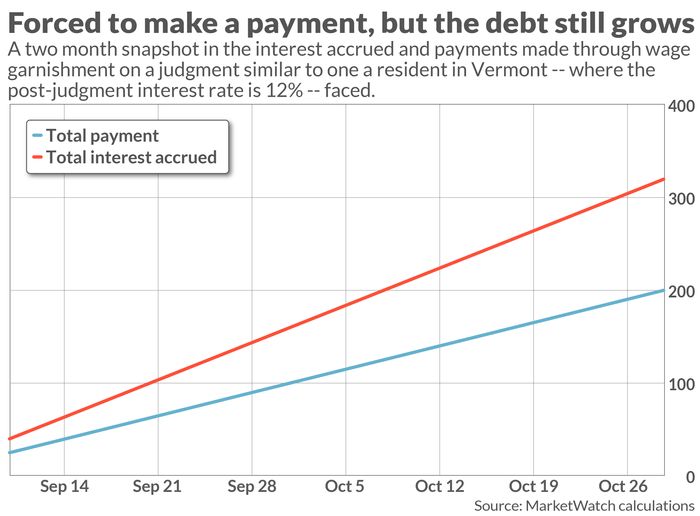
For years, Jean Murray, a staff attorney at Vermont Legal Aid, has been concerned about the post-judgement interest rate in her state of 12% — one of the highest rates in the country. She started lobbying lawmakers on the issue in 2017. A bill that would have suspended or reduced interest on judgments related to some consumer credit card debt passed the state’s house of representatives in 2018. Ultimately, “it didn’t get anywhere,” Murray said. 


Terrence Horan/MarketWatch

Murray recalls working with one client starting in 2016, a hotel housekeeper who came to Murray when she discovered a debt buyer was suing her for the renewal of a judgment. (In Vermont, the statute of limitations on a judgment is eight years, but a creditor can file to renew that judgment before the eight years is up.) The original debt of $17,319 was related to medical expenses the woman put on her credit card in 2008 when her husband, who had since passed away, was sick. The woman paid $9,575 towards the debt between 2008 and 2015 through wage garnishment, but by 2016 the debt had ballooned to $22,685. The experience made the woman “petrified to go into debt” again, Murray said, so when an ailment started to plague her she didn’t seek medical treatment. 

“Before I could finish her representation she had died,” Murray said. 

For years, consumer advocates have unsuccessfully been pushing Massachusetts lawmakers to bring the state’s 12% post-judgement interest rate down, among other consumer-friendly reforms to the debt-collection process. “We see it as a cycle of poverty where poor people just can’t get out,” Nadine Cohen, managing attorney, consumer rights unit at Greater Boston Legal Services, said of the consequences of the 12% interest rate. The legislation is still pending and advocates are hopeful it will pass this year, Cohen said. 

In many states, the purpose behind laws establishing interest on a judgment is to compensate a creditor for the time when they couldn’t use or invest the money, according to a law review article by Christine Abely, a faculty fellow at New England Law, Boston law school. In a few cases, another goal of the statute may be to incentivize debtors to pay the funds quickly, Abely said. 

But when a state’s fixed interest rate is much higher than the market rate, which is the case today in many states, or even when there’s a high premium attached to a rate that tracks the market, the interest would likely overcompensate the collector, and “grant it a windfall; that windfall would be largest in times of extremely low market interest rates,” Abely wrote. The high rates on the judgments and the low rates in the market mean that if consumers can afford to invest to pay off the judgment, that money isn’t growing as fast as the judgment. 

Massachusetts lawmakers haven’t changed the statutory post-judgement interest rate since 1982, Abely found, a period of historically high rates. Though interest rates have plunged since those days, the rate has not been updated. 

Consumer advocates in other states have had more success. Ashlee Highland, a supervising attorney at CARPLS Legal Aid in Chicago, first became concerned about the impact of post-judgement interest on consumers in 2006, when Illinois’ rate was set at 9%. 

At the time, Highland was supervising the collection desk in one of the busiest courtrooms in the country and the desk would see about 30 clients a day dealing with judgments on payday loans, credit cards and other debts. She’d have to tell them that the collector was entitled to interest on the judgment of 9% and that the court couldn’t modify the rate. 

In other scenarios, she’d encounter clients who were having their wages garnished over these debts, but it was “just going straight to interest,” Highland said. “They were never going to pay off the balance.” 

So Highland decided to get involved in an effort to get the law changed. Will Guzzardi, the Illinois state house representative who sponsored the bill, said stories from consumer advocates about how these judgments, which targeted low-income people and predominantly people of color could “just hang out there,” seemed “pretty unfair.” He saw it as his responsibility as a lawmaker to limit the ability of industry to engage in “predatory behavior” against struggling residents. 

Highland and other consumer advocates wanted to bring the rate down to a fixed 2% on judgments for amounts under $50,000 that do not involve bodily injury or death. Creditor industry representatives spoke in opposition to the measure in a 2018 hearing. 

But through negotiations with the association of lawyers who represent creditors, the two sides were able to agree on a rate of 5% for judgments worth less than $25,000, which the legislature was willing to pass into law. 

Robert Markoff, an Illinois-based creditor attorney who was involved in the negotiations, said the back and forth was just one example of the “natural tension” that exists between consumer advocates and collectors. 

“We just compromised,” he said. “If consumer groups had their way there would be no interest, if creditors had their way interest would be 25%.” 

In Washington, statewide advocacy pushed the legislature to lower the interest rate from 12% to 9% in 2019. Nine percent is “where it came out of the legislative machine at,” as Scott Kinkley, an attorney at the Northwest Justice Project legal aid organization, put it. One proposal would have set the rate as low as 7.5%, but was abandoned after lobbying from the collection industry, the Seattle Times reported at the time

***

Legal aid attorneys across the country say post-judgment interest is part of a long process that’s stacked against consumers. Over the past few decades, state civil courts have primarily become a venue for creditors and debt buyers to collect debts. Between 1993 and 2013, the debt collection cases being filed each year grew from 1.7 million to 4 million, according to The Pew Charitable Trusts. As of 2013, roughly one in four civil cases was related to debt collection. 

Research indicates that between 2010 and 2019, in many many jurisdictions where data are available, just 10% of defendants facing a debt collection lawsuit had representation, according to Pew. More than 70% of debt collection cases are resolved through default judgment, according to data in several jurisdictions examined by Pew, meaning the consumer has not even appeared in court to defend themselves. 

Defendants may not show up because of work, childcare or other conflicts. But in many cases, they don’t show up because they’re not aware they’ve been sued, legal aid attorneys say. Since ownership of a debt likely changed multiple times by the time a collector goes to sue a consumer, they may not have the most up-to-date address or other contact information. 

In addition, litigation, and regulatory scrutiny suggest that in some cases the process servers hired by debt collectors don’t make much effort to provide consumers with notice of the lawsuit — a phenomenon consumer advocates refer to as “sewer service,” because the process server theoretically throws the lawsuit into the sewer. Servers are typically required to file a court affidavit with information about where and how they served the lawsuit.

Between 1993 and 2013, the debt collection cases being filed each year grew from 1.7 million to 4 million, according to The Pew Charitable Trusts. As of 2013, roughly one in four civil cases was related to debt collection. 

In a conversation with a client facing an issue with a default judgment, it became clear to Desirée Nguyen Orth how little effort the process server put into notifying her client. The director of the consumer justice clinic at East Bay Community Law Center in Berkeley Calif., was going over the proof of service document with the client. The client did not live at the address where the service occurred and the description of the person served was generic, describing a female recipient between 5’2 and 5’8, between the ages of 25 and 35 and weight between 160 and 200 pounds.

“My client laughed,” Orth said. When she asked why the description was funny, he told her there was no one in that home who weighs under 400 pounds.  

It’s rare that there’s such compelling evidence available that a consumer wasn’t served, Orth said. Typically, if a client believes they haven’t been notified of a suit, she advises them to find receipts, location and date-stamped photos, or any other type of documentation that would indicate they weren’t at the address the server visited at the time they visited. That task can be particularly challenging because creditors will wait several years before filing their case and it’s hard for clients to remember exactly where they were so long ago, Orth said. 

Exacerbating both the impact of the high interest rate and the spotty service is that in many states these lawsuits and judgments have relatively lengthy statutes of limitations. In addition, they can often be renewed.  “If you don’t get legal services assistance, people end up paying these judgments and they’ll pay them their entire lives because the interest keeps accruing,” said Carolyn Coffey, director of litigation for economic justice at Mobilization for Justice.

Orth and other consumer attorneys suspect that creditors wait out these periods for as long as possible in part to see if the consumer gets to a phase in life where they may have more income to put towards the judgment and in part to let the interest accrue. 

“That ensures both the ability to collect and a high amount,” she said. 

Donald Maurice, legal counsel for the Receivables Management Association International, said the creditors and debt collectors that are members of his organization don’t sit on judgments and any interest that would accrue on them during the intervening period wouldn’t offset collection costs. Some smaller companies in RMAI’s membership have expressed concern about a provision in the New York bill that would retroactively apply lower rates to past judgments that haven’t been paid because it could cost them to recalculate those judgments, he said. 

“Persons who have judgments against them are financially distressed, the problem is not trying to collect more on the judgment, the problem is trying to collect any amount,” he said. “It just doesn’t make sense that anyone who is practicing good compliant business practices is going to want to sit on judgments to accrue interest.” 

Metals Stocks: Gold futures slip ahead of Fed update

Gold futures slipped early Wednesday as investors awaited an update from the Federal Reserve, which could influence trade for a swatch of assets in the final month of 2021 and into the next year.

Commodity investors are expecting the Fed to cut its monthly bond purchases more aggressively than previously planned, bringing its buying program to a halt by March rather than June. That would allow the Fed, which isn’t expected to raise interest rates until it has halted the purchases, to begin the hiking process earlier than expected.

For gold, higher rates and tighter monetary policy may overshadow concerns about inflation, which have been percolating amid the spread of the new omicron variant of the virus that causes COVID-19.

Buyers of precious metals will be attuned to the so-called dot plot that tracks rate expectations of individual Fed policy makers and is expected to show a consensus for multiple interest rate increases in 2022. In September, the dot plot penciled in only one rate rise next year, though the majority of market participants in surveys expect two hikes. The projections showed a gradual hike in the fed-funds rate to only 1.8% at the end of 2024.

The Fed will release a policy statement at 2 p.m. Eastern, a half-hour after the metals market on Comex closes. Chairman Jerome Powell’s news conference starts at 2:30 p.m.

Against that backdrop, February gold 
GCG22,
-0.07%

GC00,
-0.07%

was trading $1.90, or 0.1%, lower at $1,770.50 an ounce, following a 0.9% decline on Tuesday, which marked its lowest finish since Dec. 2, F
SIH22,
-0.22%

actSet data show.

Meanwhile, March silver
SIH22,
-0.22%

 declined by 13 cents, or 0.6%, to around $21.80, after gold’s sister metal declined 1.8% a session ago.

A batch of U.S. data, including retail sales, saw metals flit in and out of positive territory briefly. U.S. November retail sales rose 0.3% in November, falling below forecast of 0.8%. Retail sales, excluding autos rose 0.3%, also lower than consensus estimates for 1%, from economists polled by Dow Jones.

Meanwhile, New York’s Empire State factory index rose to 31.9 in December from 30.9 in prior month.

Inflation surges to 5.1%: what does it mean for investors?

Image source: Getty Images


Inflation is now running at 5.1% year on year according to the latest ONS data. This means prices are rising at their fastest pace in over 10 years.

So what does rising inflation mean for investors? And how can you protect the value of your cash? Let’s explore.

Why is inflation so high?

The Office for National Statistics (ONS) has revealed that inflation is now running at 5.1% compared to this time last year. This figure is 0.9% higher than a month ago, which means the inflation rate has continued to accelerate over the past few weeks. At 5.1%, the UK’s inflation rate is now at its highest since September 2011.

The ONS says accelerating inflation can be attributed to rising costs of transport, fuel, energy, clothing and used cars. The government’s independent statistics provider also says higher costs of raw materials have played a part.

Rising costs mean many Brits will now have to make big sacrifices to afford everyday goods. As Sarah Coles, senior personal finance analyst at Hargreaves Lansdown explains: “What’s particularly alarming about many of these price rises is that once we’ve shopped around and traded down, there’s nothing we can do to cut costs except make horrible sacrifices.

“It’s why so many people are having to make difficult decisions about heating their homes and the journeys they can afford to make, and are having to put off essential home repairs and maintenance that will cost them far more in the long run.”

It’s worth knowing that today’s 5.1% inflation rate is calculated using the Consumer Price Index (CPI). This is done by monitoring price rises of a typical ‘basket of goods’. Critics of the CPI suggest isn’t as accurate as the less popular Retail Price Inflation (RPI) measure which, according to the ONS, is now at 7.1%!

This extraordinary RPI figure, the highest in over 30 years, suggests inflation may be running higher than the government claims. For more on this, see our article that explains how inflation is measured.

Where will inflation go in 2022? 

The International Monetary Fund recently suggested that inflation would hit 5.5% early next year. Meanwhile, the Bank of England has made similar estimates, suggesting inflation would hit a peak of 5% in the spring.

It’s worth knowing that the Bank of England has the power to curb rising inflation by upping its base rate. Its Monetary Policy Committee is due to meet on 16 December to decide whether to increase it. However, markets do not expect a base rate rise to happen just days before Christmas, though it is possible in early 2022.

Why are prices rising by so much?

While economists often argue about the causes of inflation, many point the finger at the Bank of England’s quantitative easing policies.

That’s because quantitative easing, a more formal term for ‘printing money’, increases the supply of money. This action, particularly when conducted on a large scale, can devalue currency and lead to higher prices of everyday goods. 

The Bank’s lack of action on the base rate has been cited as another factor behind rising inflation, as has the government’s spendthrift attitude to public money during the ongoing pandemic. To put this into context, public spending in 2020/21 was £167 billion higher than had been planned before the pandemic.

What does rising inflation mean for investors?

Rising inflation has the potential to negatively impact stock prices. That’s because businesses may find it a struggle to pass on higher prices to customers. It could be that customers will be unwilling to pay more for goods or services that were previously cheaper, or simply that they cannot afford higher prices.

Rising inflation also makes it more difficult for businesses to make future investing decisions, which can limit growth. Both of these factors can cause the share prices of individual companies to fall.

As well as stock prices, bond prices rarely escape the effects of rising inflation. That’s because inflation essentially erodes the purchasing power of a bond’s future cash flow, which can harm returns.

Knowing where to stash your wealth during periods of high inflation is challenging to say the least. Sadly, there is no clear strategy guaranteed to come up trumps. That being said, it’s worth knowing that investors often turn to commodities, such as gold, in periods of high inflation, hoping that these assets will hold their value in real terms.

Others turn to property, or simply maintain faith in the stock market. That’s because in the past, returns from investing in a diversified portfolio have typically outperformed inflation in the long run. However, there are no guarantees that this will be the case in future!

To learn more about investing, take a look at The Motley Fool’s investing basics guide.

Was this article helpful?

YesNo


Some offers on The Motley Fool UK site are from our partners — it’s how we make money and keep this site going. But does that impact our ratings? Nope. Our commitment is to you. If a product isn’t any good, our rating will reflect that, or we won’t list it at all. Also, while we aim to feature the best products available, we do not review every product on the market. Learn more here. The statements above are The Motley Fool’s alone and have not been provided or endorsed by bank advertisers. John Mackey, CEO of Whole Foods Market, an Amazon subsidiary, is a member of The Motley Fool’s board of directors. The Motley Fool UK has recommended Barclays, Hargreaves Lansdown, HSBC Holdings, Lloyds Banking Group, Mastercard, and Tesco.


Why buying UK shares can protect me from rocketing inflation!

Inflation in the UK is rising at an alarming pace. Official data today showed consumer price inflation (CPI) hit 5.1% in November, up almost a full percentage point from October. Prices are tipped to keep soaring in 2022 too as product supply issues linger and energy costs soar.

This creates a particularly worrying issue for savers. It means the value of the money they have locked away is diminishing at a staggering pace. And analysts believe that the issue will persist even if the Bank of England acts soon.

5 Stocks For Trying To Build Wealth After 50

Markets around the world are reeling from the coronavirus pandemic… and with so many great companies trading at what look to be ‘discount-bin’ prices, now could be the time for savvy investors to snap up some potential bargains.

But whether you’re a newbie investor or a seasoned pro, deciding which stocks to add to your shopping list can be a daunting prospect during such unprecedented times.

Fortunately, The Motley Fool UK analyst team have short-listed five companies that they believe STILL boast significant long-term growth prospects despite the global upheaval…

We’re sharing the names in a special FREE investing report that you can download today. And if you’re 50 or over, we believe these stocks could be a great fit for any well-diversified portfolio.

Click here to claim your free copy now!

Even if a base rate rise is imminent, any subsequent increase to interest rates on things like simple savings accounts will fall far short of where inflation sits,” says Colin Dyer, client director at abrdn.

He added: “Savers need to consider all options to make sure that their money is keeping pace with, or outpacing inflation. Anything less means their funds will slowly but surely be eroded in real-terms, every day buying that little bit less.”

UK shares to help me beat inflation

This is why I think it’s extra important for me to own UK shares right now. Okay, more cyclical stock sectors like retailers and travel could suffer if consumer spending power is damaged by surging inflation. But I can buy many stocks which allow me to capitalise on rising prices, instead of being a victim.

For example, prices of precious metals tend to rise when inflation jumps. I have an opportunity to exploit this and make decent returns by buying gold and silver producers like FTSE 100-listed Fresnillo. Prices of other non-safe-haven commodities also increase at times like these, which is why buying stocks like copper miner Antofagasta and platinum producer Jubilee Metals could be another good idea.

More rock-solid British stocks

Rising global inflation also often helps profits at banking stocks like HSBC and Santander. This is because these firms can earn more on their lending activities when central banks raise rates to curb price rises. Finally, owning real estate stocks is another good way for me to make money from the inflation boom. This is because property prices and rent levels move higher when broader inflation increases.

I’m confident my stake in warehouse operator Tritax Big Box REIT will therefore help protect me against the inflationary wave. There are many other property stocks I can buy to give me added insulation too, from healthcare facility operator Assura and student accommodation giant Unite to residential property landlord Grainger.

Of course, one advantage of savings accounts is that they provide a guaranteed return unlike stocks. Share prices can go down as well as up. And there’s a broad range of economic as well as company-specific factors that can send prices sinking. Still, I believe there remain many UK shares I think could help me make decent money from the inflation boom. And experts like The Motley Fool can help me to dig them out.

Inflation Is Coming: 3 Shares To Try And Hedge Against Rising Prices

Make no mistake… inflation is coming.

Some people are running scared, but there’s one thing we believe we should avoid doing at all costs when inflation hits… and that’s doing nothing.

Money that just sits in the bank can often lose value each and every year. But to savvy savers and investors, where to consider putting their money is the million-dollar question.

That’s why we’ve put together a brand-new special report that uncovers 3 of our top UK and US share ideas to try and best hedge against inflation…

…because no matter what the economy is doing, a savvy investor will want their money working for them, inflation or not!

Best of all, we’re giving this report away completely FREE today!

Simply click here, enter your email address, and we’ll send it to you right away.


Royston Wild owns Tritax Big Box REIT. The Motley Fool UK has recommended Fresnillo, HSBC Holdings, and Tritax Big Box REIT. Views expressed on the companies mentioned in this article are those of the writer and therefore may differ from the official recommendations we make in our subscription services such as Share Advisor, Hidden Winners and Pro. Here at The Motley Fool we believe that considering a diverse range of insights makes us better investors.

Financial News

Daily News on Investing, Personal Finance, Markets, and more!

Financial News

Policy(Required)