
3 FTSE 100 stocks I’d buy for my ISA as inflation booms

Jaw-dropping inflation reports have become the norm all over the world. Strained supply chains, rising labour costs, and rocketing energy prices are forcing consumers to pay more and more for their goods and services. It looks like prices are on course to continue soaring in 2022 too.

The Consumer Prices Index (CPI) rose by 5.1% in the 12 months to November, the Office for National Statistics said today. That’s up significantly from the 4.2% growth seen a month earlier and represents a fresh 10-year high.

5 Stocks For Trying To Build Wealth After 50

Markets around the world are reeling from the coronavirus pandemic… and with so many great companies trading at what look to be ‘discount-bin’ prices, now could be the time for savvy investors to snap up some potential bargains.

But whether you’re a newbie investor or a seasoned pro, deciding which stocks to add to your shopping list can be a daunting prospect during such unprecedented times.

Fortunately, The Motley Fool UK analyst team have short-listed five companies that they believe STILL boast significant long-term growth prospects despite the global upheaval…

We’re sharing the names in a special FREE investing report that you can download today. And if you’re 50 or over, we believe these stocks could be a great fit for any well-diversified portfolio.

Click here to claim your free copy now!

It seems that the Bank of England will resist hiking interest rates to combat the problem, too, as the emergence of Omicron batters the British economy, giving the inflationary boom extra stamina. The smart money remains on rates remaining at record lows of 0.1% when the rate-setting committee sits on Thursday.

Why I’m investing in my Stocks and Shares ISA

UK shares are a riskier place to park your cash than in something like a bog-standard savings account. Stock prices can go down as well as up, of course, whereas the rate of return you’ll get from something like a Cash ISA is fixed.

Still, the prospect of receiving paltry returns from a savings account means, aside from my emergency savings, I’ll continue to primarily invest in my Stocks and Shares ISA. Studies show that the average long-term investor receives an average annual return of 8%. Compare that with the sub-1% interest rates that cash savers have been receiving in recent years.

Indeed, moneysupermarket.com says the best-paying Cash ISA on the market from Paragon Bank offers a rate of just 0.65%. With inflation now at 5%, the value of any money held in one of these products is dwindling rapidly.

3 FTSE 100 shares I think could thrive

This is why I plan to continue buying UK shares for my Stocks and Shares ISA. That’s even though the inflation boom threatens the economic recovery, and rising Covid-19 infection rates and problems in China’s real estate sector pose additional risks.

There are plenty of stocks on the FTSE 100 alone that I believe could thrive in 2022. Unilever is one of these blue chips I expect to perform strongly as the immense pricing power of brands like Dove soap and Magnum ice cream should allow it to pass rising costs onto its customers efficiently. I think it’ll thrive despite the problem of rising competition among local product manufacturers.

I actually reckon B&M European Value Retail could benefit from rising inflation. Demand for its low-cost goods could well balloon as shoppers try to stretch their shopping budgets that little bit further. I’d buy it even though its lack of an online operation could see it lose out to retailers with an internet presence.

And finally, although consumer concerns over the environmental impact of fast fashion is rising, the same rush for value could also boost sales at Associated British Foods’ budget fashion division Primark. I also think this FTSE 100 share will have a solid 2022 because of its ultra-defensive food ingredients business.

Inflation Is Coming: 3 Shares To Try And Hedge Against Rising Prices

Make no mistake… inflation is coming.

Some people are running scared, but there’s one thing we believe we should avoid doing at all costs when inflation hits… and that’s doing nothing.

Money that just sits in the bank can often lose value each and every year. But to savvy savers and investors, where to consider putting their money is the million-dollar question.

That’s why we’ve put together a brand-new special report that uncovers 3 of our top UK and US share ideas to try and best hedge against inflation…

…because no matter what the economy is doing, a savvy investor will want their money working for them, inflation or not!

Best of all, we’re giving this report away completely FREE today!

Simply click here, enter your email address, and we’ll send it to you right away.


Royston Wild owns Unilever. The Motley Fool UK has recommended Associated British Foods, B&M European Value, Moneysupermarket.com, and Unilever. Views expressed on the companies mentioned in this article are those of the writer and therefore may differ from the official recommendations we make in our subscription services such as Share Advisor, Hidden Winners and Pro. Here at The Motley Fool we believe that considering a diverse range of insights makes us better investors.

Should I Get More Than One Travel Credit Card?

For any frequent traveler, it’s a good idea to have at least one credit card that comes with travel benefits. Depending on the card, you may receive valuable benefits such as:

Even if you already have one credit card with travel benefits, you may not have considered the value of having more than one card. So, if you’re wondering, “Should I get multiple credit cards for travel?” Or, “Is it bad to have more than one credit card?” We’ll answer these questions — and more — in this article.

What are travel cards?

Examples of benefits you can get with travel credit cards

Travel credit cards usually come with a number of valuable benefits for cardholders, which can vary dramatically from card-to-card. Below are examples of some of the benefits:

  • An annual discounted companion ticket.

  • First checked bag free on every Alaska flight.

  • 50% off day passes for Alaska lounges.

  • One free weekend rewards night.

  • Hilton Honors Diamond status.

  • An annual $250 airline fee credit.

Terms apply.

  • Trip cancellation/interruption insurance.

  • A $50 annual hotel stay credit.

  • The ability to transfer your points to several hotel and airline partners, such as United Airlines, Southwest Airlines and Emirates.

The benefits of having more than one travel credit card

When you have more than one travel card, you can take advantage of the benefits each one offers to get the most out of your trips. Using the three travel credit cards outlined above, here is an example of how you can manage all the benefits in a single trip.

Let’s say you want to travel from Los Angeles to Cabo San Lucas, Mexico, for a weekend getaway with your partner. For this trip, you decide to book a flight on Alaska Airlines so that you can take advantage of the annual Companion Fare benefit from your Alaska Airlines Visa Signature® credit card, which you earned after marking purchases of $2,000 or more within the first 90 days of opening your account.

Although you would be flying Alaska and could book the flight with your Alaska credit card, you’d be better off paying for both flights with the Chase Sapphire Preferred® Card. In this way, you can take advantage of the card’s trip insurance — which provides protection in case your flight is delayed or canceled. You can also take advantage of the rental insurance that comes with the Chase Sapphire Preferred® Card if you book a car on your trip.

On your trip, you can use the Hilton Honors American Express Aspire Card in a few ways. Even if you don’t want to stay at a Hilton, you can take advantage of the $250 annual airline credit by using the card to purchase in-flight food or even pay for an upgrade from the main cabin to a premium seat. Terms apply. As a Diamond member, suppose you decided to stay at a Hilton on your trip, such as the Hilton Los Cabos or the Waldorf Astoria Los Cabos Pedregal. In that case, you would be able to take advantage of free daily breakfast and space-available upgrades. Depending on the hotel, you could also receive a $100 on-property credit or a $250 resort credit.

As you can see from the above example, by having three travel credit cards, you could receive several valuable benefits by taking advantage of the unique perks that each card offers.

Is it bad to have more than one credit card?

While the answer may vary depending on your particular financial situation, we believe that it’s a good idea for most consumers to have more than one credit card. In addition, having more than one credit card can help improve your credit score — provided that you keep a low balance on your cards.

On top of the potential help to your credit score, having more than one credit card can help in a few other ways. For example, you can take advantage of unique benefits offered by each card and have an alternate way to pay on credit if there’s a problem with one of your cards — which can sometimes happen when you’re traveling.

The bottom line

As long as you are aware of the benefits your credit cards carry and plan strategically to take advantage of those perks, there is significant value in having more than one travel credit card.

All information about the Hilton Honors American Express Aspire Card has been collected independently by NerdWallet. The Hilton Honors American Express Aspire Card is no longer available through NerdWallet.

How to maximize your rewards

You want a travel credit card that prioritizes what’s important to you. Here are our picks for the best travel credit cards of 2021, including those best for:

This dividend stock’s yield is higher than the 5% UK inflation level!

The UK’s Consumer Prices Index (CPI) inflation number for the 12 months to November was revealed this morning to be 5.1%. This is a 10-year high, meaning the value of my cash in the bank is dwindling. To combat this, I am on the lookout for dividend stocks for my portfolio with a yield that beats 5.1%! Imperial Brands (LSE:IMB) is one such stock.

Inflation rising

November’s 5.1% CPI number was greater than October’s 4.2%. Expectations were for it to be 4.7%, so the news this morning came as a surprise, but not a good one. Experts did not expect inflation to head above the 5% figure until next spring!

5 Stocks For Trying To Build Wealth After 50

Markets around the world are reeling from the coronavirus pandemic… and with so many great companies trading at what look to be ‘discount-bin’ prices, now could be the time for savvy investors to snap up some potential bargains.

But whether you’re a newbie investor or a seasoned pro, deciding which stocks to add to your shopping list can be a daunting prospect during such unprecedented times.

Fortunately, The Motley Fool UK analyst team have short-listed five companies that they believe STILL boast significant long-term growth prospects despite the global upheaval…

We’re sharing the names in a special FREE investing report that you can download today. And if you’re 50 or over, we believe these stocks could be a great fit for any well-diversified portfolio.

Click here to claim your free copy now!

ONS chief economist Grant Fitzner said, “A wide range of price rises contributed to another steep rise in inflation”. These rising costs are pushing up the cost of living. This includes essentials such as food, clothing, and fuel. The costs of goods produced by factories and the price of raw materials are also surging. These factors are also likely to put more pressure on consumer prices in the coming months.

Looking for dividend stocks

A way I am looking to beat inflation is by looking for the best dividend stocks. A dividend yield is calculated by reviewing the annual dividend per share paid out, compared to the share price when I purchase the shares. This provides me with a percentage yield.

With my spare cash sitting in my bank and its value dwindling, I could use it to buy dividend stocks that provide a yield higher than 5%.

There are a couple of risks to consider, however. As mentioned, new inflation figures are revealed each month. Current uncertainty and rising levels means it could well go up again in the coming months. So for example, if the stock I target has a dividend yield of 5.5%, and new figures revealed next month were to surpass that level, the yield would not exceed the new level of inflation.

Furthermore, dividends are not guaranteed and are intrinsically linked to the well-being and performance of a company. They can be cancelled or cut. If either of these risks come to fruition, the value of my investment would be negative.

Dividend stock with a 9% yield!

Imperial Brands currently has a dividend yield close to 9%! Smoking firms don’t always have the best reputation among investors, especially in recent times but as a smoker myself, this doesn’t bother me.

At current levels, the shares are trading for 1,566p compared to a year ago when they were trading for 1,575p. Imperial sports a price-to-earnings ratio of just 6 which I consider cheap for a large, well-established company with a long track record of performance and dividends. I understand past performance is not a guarantee of the future but I use it as a gauge.

Imperial’s recent full-year results were promising and showed it is adapting to changing market conditions and sentiments towards smoking. Revenue, profit, and dividend per share increased. It has decided to cut costs and streamline where possible. Furthermore, it is pulling out of under-performing markets as well as looking at innovative “next generation” products.

I would happily add Imperial shares to my holding at current levels as a dividend stock to beat inflation levels.

FREE REPORT: Why this £5 stock could be set to surge

Are you on the lookout for UK growth stocks?

If so, get this FREE no-strings report now.

While it’s available: you’ll discover what we think is a top growth stock for the decade ahead.

And the performance of this company really is stunning.

In 2019, it returned £150million to shareholders through buybacks and dividends.

We believe its financial position is about as solid as anything we’ve seen.

  • Since 2016, annual revenues increased 31%
  • In March 2020, one of its senior directors LOADED UP on 25,000 shares – a position worth £90,259
  • Operating cash flow is up 47%. (Even its operating margins are rising every year!)

Quite simply, we believe it’s a fantastic Foolish growth pick.

What’s more, it deserves your attention today.

So please don’t wait another moment.

Get the full details on this £5 stock now – while your report is free.


Jabran Khan has no position in any shares mentioned. The Motley Fool UK has recommended Imperial Brands. Views expressed on the companies mentioned in this article are those of the writer and therefore may differ from the official recommendations we make in our subscription services such as Share Advisor, Hidden Winners and Pro. Here at The Motley Fool we believe that considering a diverse range of insights makes us better investors.

How I’d start investing with £200

Some people are curious about starting to buy shares but have the notion that it will require large sums of money. In fact, I think it’s possible to start investing with a couple of hundred pounds. Here’s how I would do it.

Some challenges of starting small

While it’s possible to start investing on a comparatively small scale, say with £200, that doesn’t mean it isn’t without challenges. I see two key ones, which are connected.

5 Stocks For Trying To Build Wealth After 50

Markets around the world are reeling from the coronavirus pandemic… and with so many great companies trading at what look to be ‘discount-bin’ prices, now could be the time for savvy investors to snap up some potential bargains.

But whether you’re a newbie investor or a seasoned pro, deciding which stocks to add to your shopping list can be a daunting prospect during such unprecedented times.

Fortunately, The Motley Fool UK analyst team have short-listed five companies that they believe STILL boast significant long-term growth prospects despite the global upheaval…

We’re sharing the names in a special FREE investing report that you can download today. And if you’re 50 or over, we believe these stocks could be a great fit for any well-diversified portfolio.

Click here to claim your free copy now!

First, most share trades attract some sort of fees or charges. These often have a minimum value no matter how large the trade. That can eat up a disproportionately large amount of a £200 investment compared to a larger amount.

Secondly, in order to reduce my risk, I try to diversify across different shares. But if I am trying to minimise my dealing costs with my £200, it can be hard to diversify much. I would still try though.

Using the £200, I could take a couple of different approaches to start investing.

First approach to start investing: buy a tracker fund

The first would be for me to put the £200 into what is known as a tracker fund. These are basically baskets of shares bought to mirror a well-known index, such as the FTSE 100. There are a few different such funds in which I could buy shares, such as such as Vanguard FTSE 100 Index Unit Trust.

This would give me a couple of advantages. I could benefit from the diversification of the index, even with just £200. Also, as such funds are not actively managed by share pickers, their overhead is low. That can allow them to charge low fees. In fact, that is why legendary investor Warren Buffett reckons most investors ought to put their funds in low-cost index funds.

But there are some disadvantages and risks to this approach too. By tying myself to the index, I might forego larger gains I could potentially get by investing in individual shares, for example. The FTSE 100 index is a broad reflection of economic health. So if there is a recession, the value of my holdings may decrease.

Second approach

An alternative would be to pick individual share myself and buy them, for example, in a Stocks and Shares ISA.

As an investor, I may think that I can choose individual shares that will outperform the index. That could be in terms of capital growth, but it may also be from an income perspective. For example, I may want to target a higher yield than that offered by an index fund, through investing in a couple of specific companies. But if I pick companies which perform poorly, I risk losing some or even all of my money over time.

£200 would be enough for me to invest £100 in each of two companies. I’d want to minimise dealing and account charges, so first would do some research on what the best share account might be for my purposes. Then I’d take time to figure out which shares met my own personal investing objectives. My £200 might not put me in the big league – but it could be the first step in the journey there!


Christopher Ruane has no position in any of the shares mentioned. The Motley Fool UK has no position in any of the shares mentioned. Views expressed on the companies mentioned in this article are those of the writer and therefore may differ from the official recommendations we make in our subscription services such as Share Advisor, Hidden Winners and Pro. Here at The Motley Fool we believe that considering a diverse range of insights makes us better investors.

Deep Dive: After a dazzling 2021, Apple and Tesla stocks are expected to be duds in 2022

A report from Goldman Sachs shows how much of investors’ money is concentrated in only five high-flying stocks. And a screen of the biggest contributors to this year’s excellent performance for the S&P 500 index highlights two that are expected not to perform well in 2022: Apple and Tesla.

Just five stocks — Microsoft Corp.
MSFT,
Alphabet Inc.
GOOGL,
Apple Inc.
AAPL,
Nvidia Corp.
NVDA
and Tesla Inc.
TSLA
— contributed over a third of the S&P 500 Index’s
SPX
26% total return for 2021 through Dec. 9, according to analysts at Goldman. And from the end of April through Dec. 9, they contributed 51% of the index’s 13% return.

Moreover, only 25 stocks accounted for 58% of the index’s gains, including reinvested dividends, through Dec. 9, Goldman said. Its list of those stocks is below, along with screens of Wall Street analysts’ expectations for the group as we look ahead to 2022 and 2023.

The analysts, led by David Kostin, pointed out that “market breadth has narrowed substantially” over the past several months. In other words, investors have concentrated more of their money (and risk) in the largest tech companies, by market capitalization.

That said, the Goldman analysts continue to recommend that long-term investors “own high-growth, high-margin stocks.”

Digging into the 25 biggest contributors to the S&P 500’s returns this year

This list shows each of the 25 stocks and their “contributions” to the gains, expressed in basis points. (A basis point is one 100th of a percent. ) The table also includes pricing information — closing prices as of Dec. 14 with declines from 52-week highs and the dates of those highs.

Company

Ticker

Total return – 2021 through Dec. 9

Contribution to S&P 500’s return for 2021 through Dec. 9 (basis points)

Closing Price – 12/14/21

Decline from 52-week high

Date of 52-week high

Microsoft Corp.

MSFT 51%

271

$328.34

-6.1%

11/22/2021

Alphabet Inc. Class A

GOOGL 68%

224

$2,878.14

-4.7%

11/19/2021

Apple Inc.

AAPL 32%

217

$174.33

-4.3%

12/13/2021

Nvidia Corp.

NVDA 134%

137

$283.37

-18.2%

11/22/2021

Tesla Inc.

TSLA 42%

71

$958.51

-22.9%

11/04/2021

Home Depot Inc.

HD 58%

52

$402.20

-4.4%

12/06/2021

Meta Platforms Inc. Class A

FB 21%

43

$333.74

-13.2%

09/01/2021

UnitedHealth Group Inc.

UNH 37%

39

$479.46

-0.7%

12/14/2021

Bank of America Corp

BAC 50%

36

$44.13

-9.4%

11/03/2021

JPMorgan Chase & Co.

JPM 29%

36

$159.13

-8.0%

10/25/2021

Exxon Mobil Corp.

XOM 61%

34

$61.54

-7.3%

11/08/2021

Berkshire Hathaway Inc. Class B

BRK 23%

32

$295.03

-0.5%

12/14/2021

Amazon.com Inc.

AMZN 7%

31

$3,381.83

-10.4%

07/13/2021

Pfizer Inc.

PFE 47%

30

$55.54

-0.7%

12/14/2021

Wells Fargo & Co.

WFC 67%

26

$48.89

-7.0%

11/03/2021

Chevron Corp.

CVX 47%

24

$116.22

-2.5%

12/08/2021

Intuit Inc.

INTU 76%

24

$639.48

-10.8%

11/19/2021

Lowe’s Companies Inc.

LOW 63%

23

$252.46

-4.1%

12/13/2021

Accenture Plc Class A

ACN 44%

23

$369.73

-3.0%

12/13/2021

Thermo Fisher Scientific Inc.

TMO 37%

22

$632.11

-5.2%

11/26/2021

Costco Wholesale Corp.

COST 40%

21

$545.34

-2.8%

12/10/2021

Broadcom Inc.

AVGO 36%

20

$614.91

-4.6%

12/10/2021

Adobe Inc.

ADBE 26%

20

$614.86

-12.1%

11/22/2021

Danaher Corp.

DHR 44%

20

$307.70

-7.9%

09/10/2021

Eli Lilly and Co.

LLY 46%

19

$249.38

-9.6%

08/17/2021

Sources: Goldman Sachs, FactSet

We included the declines from 52-week highs through Dec. 14 to illustrate how volatile the stocks of rapidly growing tech giants can be. Shares of Nvidia, for example, were down 18% from the high reached Nov. 22. Tesla has tumbled into bear-market territory three times in 2021 and is down 23% from its high reached Nov. 4.

You can click the tickers for more about each company. Click here for Tomi Kilgore’s detailed guide to the wealth of information for free on the MarketWatch quote page.

Screening the 25 stocks: sales, earnings and ratings

Leaving the list in the same order, here are consensus estimates among analysts polled by FactSet for sales (in millions of dollars) for calendar years through 2023, with projected compound annual growth rates (CAGR):

Company

Ticker

Estimated revenue – 2021

Estimated revenue – 2022

Estimated revenue – 2023

Two-year estimated sales CAGR

Microsoft Corp.

MSFT $182,593

$210,753

$240,396

14.7%

Alphabet Inc. Class A

GOOGL $254,060

$296,677

$341,671

16.0%

Apple Inc.

AAPL $369,729

$389,037

$413,789

5.8%

Nvidia Corp.

NVDA $25,754

$31,175

$36,380

18.9%

Tesla Inc.

TSLA $51,678

$73,183

$89,639

31.7%

Home Depot Inc.

HD $148,615

$153,285

$158,252

3.2%

Meta Platforms Inc. Class A

FB $117,569

$139,805

$164,737

18.4%

UnitedHealth Group Inc.

UNH $286,410

$316,412

$342,740

9.4%

Bank of America Corp

BAC $89,268

$93,591

$99,180

5.4%

JPMorgan Chase & Co.

JPM $123,128

$123,405

$130,270

2.9%

Exxon Mobil Corp.

XOM $294,130

$308,304

$292,830

-0.2%

Berkshire Hathaway Inc. Class B

BRK $294,667

$294,894

$309,287

2.5%

Amazon.com Inc.

AMZN $470,607

$553,097

$649,246

17.5%

Pfizer Inc.

PFE $81,333

$92,070

$72,748

-5.4%

Wells Fargo & Co.

WFC $76,024

$72,048

$75,462

-0.4%

Chevron Corp.

CVX $155,748

$168,114

$159,898

1.3%

Intuit Inc.

INTU $10,714

$12,980

$14,881

17.9%

Lowe’s Companies Inc.

LOW $95,152

$97,459

$100,080

2.6%

Accenture Plc Class A

ACN $52,819

$58,906

$63,622

9.8%

Thermo Fisher Scientific Inc.

TMO $37,210

$39,493

$42,053

6.3%

Costco Wholesale Corp.

COST $203,027

$222,877

$238,794

8.5%

Broadcom Inc.

AVGO $27,976

$30,877

$32,521

7.8%

Adobe Inc.

ADBE $15,957

$18,393

$21,000

14.7%

Danaher Corp.

DHR $29,116

$30,792

$32,437

5.5%

Eli Lilly and Co.

LLY $27,601

$27,774

$30,366

4.9%

Source: FactSet

Here’s another look ahead, this time at earnings-per-share estimates

Company

Ticker

Estimated EPS – 2021

Estimated EPS – 2022

Estimated EPS – 2023

Two-year estimated EPS CAGR

Microsoft Corp.

MSFT $8.60

$9.85

$11.44

15.3%

Alphabet Inc. Class A

GOOGL $108.65

$113.97

$130.48

9.6%

Apple Inc.

AAPL $5.64

$5.85

$6.27

5.4%

Nvidia Corp.

NVDA $4.18

$5.08

$6.15

21.3%

Tesla Inc.

TSLA $5.99

$8.64

$11.46

38.3%

Home Depot Inc.

HD $15.17

$16.13

$17.30

6.8%

Meta Platforms Inc. Class A

FB $13.94

$14.24

$16.94

10.3%

UnitedHealth Group Inc.

UNH $18.84

$21.63

$24.58

14.2%

Bank of America Corp

BAC $3.52

$3.19

$3.63

1.5%

JPMorgan Chase & Co.

JPM $14.98

$12.03

$13.23

-6.0%

Exxon Mobil Corp.

XOM $5.03

$5.79

$5.59

5.4%

Berkshire Hathaway Inc. Class B

BRK $11.65

$12.63

$14.13

10.1%

Amazon.com Inc.

AMZN $41.31

$51.54

$76.68

36.2%

Pfizer Inc.

PFE $4.19

$5.75

$4.87

7.8%

Wells Fargo & Co.

WFC $4.63

$3.72

$4.41

-2.4%

Chevron Corp.

CVX $8.36

$9.42

$8.78

2.5%

Intuit Inc.

INTU $10.56

$12.51

$14.70

18.0%

Lowe’s Companies Inc.

LOW $11.71

$12.86

$14.40

10.9%

Accenture Plc Class A

ACN $9.25

$10.48

$11.59

11.9%

Thermo Fisher Scientific Inc.

TMO $23.45

$21.17

$23.34

-0.2%

Costco Wholesale Corp.

COST $11.63

$13.06

$14.33

11.0%

Broadcom Inc.

AVGO $28.83

$33.53

$36.69

12.8%

Adobe Inc.

ADBE $12.63

$14.47

$16.88

15.6%

Danaher Corp.

DHR $9.82

$10.16

$10.72

4.5%

Eli Lilly and Co.

LLY $8.02

$8.13

$9.71

10.1%

Source: FactSet

Here’s a summary of Wall Street analysts’ opinions about the stocks:

Company

Ticker

Share “buy” ratings

Share neutral ratings

Share “sell” ratings

Closing price – 12/14/21

Consensus price target

Implied 12-month upside potential

Microsoft Corp.

MSFT 90%

10%

0%

$328.34

$366.41

12%

Alphabet Inc. Class A

GOOGL 94%

6%

0%

$2,878.14

$3,333.70

16%

Apple Inc.

AAPL 79%

19%

2%

$174.33

$174.35

0%

Nvidia Corp.

NVDA 81%

12%

7%

$283.37

$341.51

21%

Tesla Inc.

TSLA 43%

30%

28%

$958.51

$860.35

-10%

Home Depot Inc.

HD 65%

32%

3%

$402.20

$417.16

4%

Meta Platforms Inc. Class A

FB 76%

22%

2%

$333.74

$398.32

19%

UnitedHealth Group Inc.

UNH 85%

11%

4%

$479.46

$490.88

2%

Bank of America Corp

BAC 64%

25%

11%

$44.13

$49.83

13%

JPMorgan Chase & Co.

JPM 61%

32%

7%

$159.13

$179.70

13%

Exxon Mobil Corp.

XOM 39%

51%

10%

$61.54

$72.97

19%

Berkshire Hathaway Inc. Class B

BRK 43%

57%

0%

$295.03

$332.50

13%

Amazon.com Inc.

AMZN 94%

6%

0%

$3,381.83

$4,102.98

21%

Pfizer Inc.

PFE 38%

58%

4%

$55.54

$53.67

-3%

Wells Fargo & Co.

WFC 67%

33%

0%

$48.89

$54.90

12%

Chevron Corp.

CVX 68%

32%

0%

$116.22

$130.36

12%

Intuit Inc.

INTU 83%

13%

4%

$639.48

$756.29

18%

Lowe’s Companies Inc.

LOW 73%

24%

3%

$252.46

$272.43

8%

Accenture Plc Class A

ACN 70%

26%

4%

$369.73

$383.68

4%

Thermo Fisher Scientific Inc.

TMO 83%

13%

4%

$632.11

$682.47

8%

Costco Wholesale Corp.

COST 59%

35%

6%

$545.34

$551.75

1%

Broadcom Inc.

AVGO 84%

13%

3%

$614.91

$682.70

11%

Adobe Inc.

ADBE 81%

19%

0%

$614.86

$720.69

17%

Danaher Corp.

DHR 82%

14%

4%

$307.70

$350.29

14%

Eli Lilly and Co.

LLY 67%

28%

5%

$249.38

$279.72

12%

Source: FactSet

Here are six data highlights to consider:

  • Two of this year’s best performers are expected to be poor performers next year, based on the price targets: Apple and Tesla.

  • Apple is expected to show much slower sales and earnings growth than the rest of the top five companies on the list through 2023.

  • Tesla’s expected two-year sales CAGR of 31.7% is by far the highest on the list. But only 43% of analysts polled by FactSet rate the stock a “buy.”

  • Tesla also has the highest expected EPS CAGR through 2023 at 38.3%, but Amazon.com Inc.
    AMZN
    is right behind, with a projected EPS CAGR of 36.2%. Next on the list by this measure is Nvidia, at 21.3%.

  • From the price targets, Nvidia and Amazon are Wall Street analysts’ favorite stocks on the list, with implied 12-month upside of 21%.

  • Pfizer Inc.’s
    PFE
    sales are expected to rise in 2022 but fall in 2023 to a level below that of 2021, according to analysts polled by FactSet. That could reflect expectations that the coronavirus pandemic will be ending.

Don’t miss: These are Wall Street’s 25 favorite semiconductor stocks for 2022

Market Extra: Fed days have produced a weak record under Powell but here’s the time when stock-market performance really gets dicey

Wednesday marks an important Fed decision day on Wall Street, the final one of 2021, but one could hardly blame investors for bracing for an ugly response to the central bank’s policy update.

The analysts at Bespoke Investment Group write that for the S&P 500 index
SPX,
-0.25%

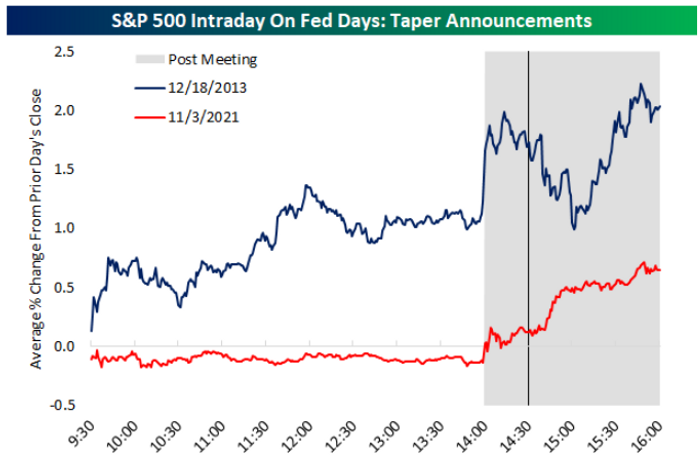
market reaction has been typically weak, and the most recent note highlights that markets tend to unravel not upon the release of the policy update, at 2 p.m. Eastern Time and the usual press conference a half-hour later, but in the final hour of trade on day that the Fed updates its policy stance.

Read: Powell says time to retire ‘transitory’ when talking about inflation—and stock markets tank

“Historically, the S&P 500 has averaged nice gains on Fed days, but price action has been weaker during Chair Powell’s tenure, especially in the final hours of trading following the 2 PM ET announcement and subsequent press conference,” writes Bespoke, in a Wednesday research report.

Bespoke notes the stock market’s reaction to Powell, in particular, had been weaker before the pandemic, “during Powell’s pressers and would average a full-day decline of 20 [basis points].” 

However, Powell has averaged a 29 basis-point gain by the close since the March 2020 meeting, when COVID-19 pandemic woes were buffeting financial markets most intensely.


Bespoke Investment Group

For Wednesday’s Fed meeting, it is widely assumed the central bank will double the pace at which it is tapering its asset purchases, to $30 billion from $15 billion, at the conclusion of its gathering later Wednesday. The Fed’s dot plot projections of interest rates also is expected to show more rate increases by 2024, around nine from six. That would place the median dot close to the Fed’s assessment of the neutral rate of 2.5%, where Fed policy is neither helping the economy expand or trying to slow it down.

Read: It’s Fed day. Here are two big questions for markets from a trading veteran.

Here’s how that performance has looked.


Bespoke Investment Group

Meanwhile, the S&P 500, the Dow Jones Industrial Average
DJIA,
-0.29%

and the Nasdaq Composite Index
COMP,
-0.54%

were all trading slightly lower on Wednesday.

Coronavirus Update: Omicron variant remains a ‘very high’ risk as it spreads fast and shows resistance to vaccines, but WHO says more data needed to know if it’s more lethal

The omicron variant of the coronavirus that causes COVID-19 remains a very high risk and is spreading around the world faster than other variants, but for now there is too little data to be certain that it’s more lethal, the World Health Organization said Wednesday.

In its weekly epidemiological update, the agency said omicron has been detected in 76 countries and appears to have a “growth advantage” over delta, the variant that has been most dominant until now. It’s spreading faster in South Africa, which has low delta circulation, but also in the UK, which has high levels of delta.

“The data on the clinical severity of omicron remains limited,” said WHO. “More information on case severity associated with omicron is expected in the coming weeks due to the time lag between an increase in the incidence of cases and an
increase in the incidence of severe cases, and deaths.”

For now, initial data suggests there is a reduction in efficacy of the existing vaccines in protecting against infection and an increased risk of reinfection. However, further studies are needed to better understand the impact on vaccines, said the agency.

New modeling analyzed by the Centers for Disease Control and Prevention is warning of an imminent surge in U.S. COVID cases, driven by omicron, according to a report in The Washington Post.

 Officials at the CDC were briefed on a worst-case, triple whammy scenario — an omicron wave on top of delta cases and influenza — hitting healthcare systems, notably in low-vaccinated areas of the U.S.

Read also: Pfizer’s COVID-19 antiviral proves almost 90% effective in latest trial data, as U.S. passes 50 million confirmed cases of the illness

“The implications of a big wave in January that could swamp hospitals … we need to take that potential seriously,” said a federal health official who had knowledge of the briefing and asked to remain anonymous.

A second scenario showed a smaller omicron wave coming in the spring. Early data shows fully vaccinated individuals with a booster can be largely shielded from serious disease and death from COVID-19, but government data shows just 55 million of more than 200 million fully vaccinated people in the U.S. have gotten the booster.

See: Vir, GSK’s COVID-19 antibody treatment works against omicron in a lab study, and WHO no longer recommends convalescent plasma

The U.S. is still averaging about 1,300 COVID deaths a day, according to a New York Times tracker, and passed 800,000 fatalities early Wednesday. New cases are averaging around 120,000 a day, and more than 67,000 people living in the U.S. are being hospitalized every day.

New Hampshire and Rhode Island are leading the country by cases, measured on a per capita basis. But Michigan, Indiana and Ohio have the highest hospitalization rates and some hospitals are struggling to treat the high number of patients.

There was bad news from Hong Kong in the form of a study that found China’s widely used Sinovac vaccine failed to produce sufficient antibodies to neutralize omicron. A team at the Department of Microbiology of the University of Hong Kong analyzed serum antibodies from 25 people fully vaccinated with CoronaVac, developed by Sinovac , as well as a separate group of 25 more who had received two doses of the COVID vaccine from Pfizer 
PFE,
+2.94%

and its German partner BioNTech
BNTX,
+3.13%
.

Read: ‘The days you were considered fully vaccinated with two shots are going to be a thing of the past’

None of the 25 vaccinated with two doses of the Sinovac vaccine showed any neutralizing antibodies against the omicron variant. The authors recommend a third dose of COVID-19 vaccines, though they say it remains unclear how effective that will be in enhancing neutralizing responses against omicron. The study’s results have been accepted for publication in the medical journal Clinical Infectious Diseases, and available online as a preprint.

In more promising news, Sanofi SA
SNY,
+1.06%

SAN,
+0.73%

and GlaxoSmithKline PLC
GSK,
+0.06%

GSK,
+0.15%

said that a single booster dose of their vaccine candidate delivered consistently strong immune responses, as Dow Jones Newswires reported.

The European Medicines Agency said it would recommend Johnson & Johnson’s
JNJ,
+0.15%

COVID-19 vaccine as a booster dose when administered at least two months after the first dose in people aged 18 years and older. 

A growing number of studies indicate Omicron is more resistant to current vaccines than previous Covid variants, though boosters seem to help. WSJ’s Daniela Hernandez gets an exclusive look inside a lab testing how antibodies interact with Omicron. Photo illustration: Tom Grillo

Elsewhere, U.S. Secretary of State Antony Blinken has cut short a planned trip to Southeast Asia after a journalist traveling with his team contracted the virus, according to media reports. Blinken was due to meet with Thai officials on Thursday, after a visit to Indonesia and Malaysia.

Italy has imposed mandatory testing for all arrivals from fellow European Union countries, AFP reported. It will also require a five-day quarantine for unvaccinated travelers.

Greece, Italy, Spain and Hungary have started to vaccinate children aged 5 to 11, the Guardian reported. The move comes after the EMA approved a reduced-dose vaccine from Pfizer and BioNTech.

Don’t miss: Cornell partially shuts down its campus due to nearly 500 COVID-19 cases in possible omicron outbreak

Latest tallies

The global tally for the coronavirus-borne illness climbed above 271.6 million on Wednesday, while the death toll edged above 5.32 million, according to data aggregated by Johns Hopkins University.

The U.S. continues to lead the world with 50.2 million cases and 800,821 deaths.

India is second by cases after the U.S. at 34.7 million and has suffered 476,135 deaths. Brazil has second highest death toll at 616,970 and 22.2 million cases.

In Europe, Russia has the most fatalities at 287,135 deaths, followed by the U.K. at 147,085.

China, where the virus was first discovered late in 2019, has had 112,498 confirmed cases and 4,809 deaths, according to its official numbers, which are widely held to be massively understated.

London Markets: Pound steady while gilt yields rise after hotter-than-forecast UK inflation data

The pound was steady while bond yields rose Wednesday after the release of faster-than-forecast U.K. inflation data.

Consumer prices rose 5.1% in the 12 months to November, ahead of the 4.8% forecast and a big jump from the 4.2% growth in October. The 5.1% reading also was ahead of the Bank of England’s forecast of 4.5%.

Markets were still hesitant to expect the central bank to lift interest rates from the current level of 0.1% on Thursday. “The reality is that without recent omicron developments, a rate hike would be nailed on at this meeting, given the recent U.K. data flow showing strong inflation and employment numbers. However, even the most hawkish member of the committee in Michael Saunders has sounded more balanced in recent days,” said Jamie Niven, senior fund manager at Candrian Asset Management.

“Our base case is that the [Monetary Policy Committee] will vote to keep the bank rate at 0.1%, adopting a ‘wait and see’ approach unitl more conclusive evidence on the new variant is revealed,” added Ellie Henderson, an economist at Investec.

The pound
GBPUSD,
-0.07%

exchanged hands at $1.3225, drifting lower from $1.3231 on Tuesday as U.S. stocks began to trade.

The yield on the 2-year gilt
TMBMKGB-02Y,
0.477%

rose 6 basis points to 0.495%.

The FTSE 100
UKX,
-0.53%

slipped 0.5% to 7,181.62 in afternoon trade. Rentokil Initial
RTO,
-5.48%

shares dropped for a second day, sliding 5% after announcing Tuesday its planned cash-and-stock offer for Terminix
TMX,
-2.54%
.

International Airlines Group
IAG,
-2.90%

dropped 3% after saying talks were at an advanced stage to terminate the planned acquisition of Air Europa, a deal that had run into antitrust scrutiny due to IAG’s control of Iberia.

DCC
DCC,
+8.54%

shares jumped 8% after reaching a $610 million deal to buy Philadelphia appliance distributor Almo Corp, a specialist sales company with revenue of $1.3 billion in fiscal 2021. DCC said adjusted earnings per share will jump 10% in its first full year of ownership.

Economic Report: Home builders grow more confident in the face of limited housing supply

The numbers: Home builder sentiment strengthens

Home builders grew more confident for the fourth consecutive month, according to an industry index, reflecting their positive outlook in light of the continued low supply of existing homes for sale.

The National Association of Home Builders’ monthly confidence index rose one point to a reading of 84 in December, the trade group said Wednesday. It represents the highest level for the index since February.

What happened

Two of the three gauges that underpin the overall builder confidence index also experienced one-point increases, including the index that measures current sales conditions and the component that tracks traffic of prospective buyers. The gauge that assesses sales expectations for the next six months remained unchanged for the second consecutive month.

Regionally, it was more of a mixed backed. The confidence index for the northeast rose 10 points on a monthly basis, and in the South the index increased by two points. But the index worsened by one point in both the Midwest and West.

The big picture

Home builders may be enjoying the current sales environment, but it may be fleeting. With the Federal Reserve expected to begin tapering its stimulus measures, which have included purchases of mortgage-backed securities, mortgage rates are expected to increase.

“While 2021 single-family starts are expected to end the year 24% higher than the pre-COVID 2019 level, we expect higher interest rates in 2022 will put a damper on housing affordability,” Robert Dietz, chief economist for the National Association of Home Builders, said in the report.

Plus, production headwinds continue to plague the industry. Sourcing workers and material delays both remain as significant challenges, making it difficult for builders to predict pricing on homes.

What they’re saying

“Apart from the three readings that ended 2020, this also matches the survey high (back to 1985),” Michael Gregory, deputy chief economist at BMO Capital Markets, said in a research note. “Despite construction taking longer to start (relative to permits) and complete (relative to starts), home builders are in a good mood to end 2021.”

Small business owners could save £4,701 a year by switching to an electric car!

Image source: Getty Images


In the UK, road transport contributes to 92% of domestic transport carbon emissions. These harmful emissions play a significant role in the current environmental crisis that is causing the temperature of the earth to rise. For this reason, it is considered vital that we cut down our use of petrol and diesel vehicles.

A large proportion of petrol cars in the UK are owned by small businesses that use them for a variety of business purposes. 

Here’s how your business could save over £4,000 per year by switching a petrol or diesel car for an electric one.

The benefits of using electric cars for your business

While you may have grown accustomed to your petrol or diesel car, new research by Asset Alliance has found that switching to an electric car could help your business make serious savings each year. Electric cars are also miles better for the environment and could significantly reduce your carbon footprint.

Lower fuel costs

The cost of fuel is at an all-time high, which has left many small business owners struggling to keep their vehicles running. Electric cars are much cheaper to run.

More specifically, the average cost per mile for a petrol car is £0.14, whereas the cost per mile for an electric car is just £0.037. This could lead to serious savings over time! If you do 7,000 miles every year for your business, that’s a saving of £721.

Exemption from London’s congestion and ULEZ charge

If you’ve driven through London for your business, you’ll know about the congestion charges for vehicles that use fossil fuels. These charges have been introduced in an attempt to cut down carbon emissions in the capital.

Consequently, electric cars are exempt from paying the extra costs. The congestion charge is currently £15 per day for each vehicle. If you drive through London every working day, the charge would total £3,825 a year! You could easily save this money towards more important expenses by switching to an electric vehicle.

Low maintenance costs

Electric cars have fewer moving parts than petrol and diesel vehicles. This means they typically require less maintenance throughout the year. For this reason, electric vehicles are associated with significantly lower maintenance costs than petrol or diesel cars, which could lead to excellent savings each year.

Exemption from road tax

The annual cost of road tax in the UK will differ depending on the vehicles you use for your business. However the flat rate is £155. This is a cost that small business owners could certainly do without! Alternatively, electric vehicles are exempt from road tax, which means that this expense could be completely cut from your budget! 

If you add together the savings made through lower fuel costs, congestion charge exemption and road tax exemption, that’s a potential saving of £4,701 every year for your business! 

Why aren’t businesses using electric cars?

The biggest deterrent to businesses swapping to electric cars is the large upfront costs that come with buying electric cars. Typically, electric cars are much more expensive than their petrol or diesel counterparts.

While upfront costs may seem large, businesses can make the money back through the ongoing savings electric vehicles offer. Furthermore, there are a number of EV grants and incentives available that could help your business to afford the switch to electric vehicles!

Currently, the government is offering an Electric Vehicle Homecharge Scheme that will provide homeowners with 75% of the money that it costs to install an electric charge point in their home. This is excellent for small business owners who work from home. 

William Patterson, CEO of Asset Alliance Group, recommends that businesses start planning for the transition to electric cars. He says, “A total switch to electric vehicles might seem like a long way off, but approaching deadlines are driving fleet operators to step up their strategies. For a smooth transition, businesses should be planning ahead as far as possible.”

Compare our top-rated business credit cards

A business card offers practical benefits that appeal to – and in many cases are extremely helpful to – business owners.

To help you see what kind of perks you could unlock, we’ve created a list of some of our top-rated business credit cards.

Was this article helpful?

YesNo


Some offers on The Motley Fool UK site are from our partners — it’s how we make money and keep this site going. But does that impact our ratings? Nope. Our commitment is to you. If a product isn’t any good, our rating will reflect that, or we won’t list it at all. Also, while we aim to feature the best products available, we do not review every product on the market. Learn more here. The statements above are The Motley Fool’s alone and have not been provided or endorsed by bank advertisers. John Mackey, CEO of Whole Foods Market, an Amazon subsidiary, is a member of The Motley Fool’s board of directors. The Motley Fool UK has recommended Barclays, Hargreaves Lansdown, HSBC Holdings, Lloyds Banking Group, Mastercard, and Tesco.


Financial News

Daily News on Investing, Personal Finance, Markets, and more!

Financial News

Policy(Required)