Not surprisingly, income investors take a keen interest in dividend forecasts. That’s because they help in identifying reliable sources of passive income.
But those looking for large dividends know that returns to shareholders are never guaranteed, especially when it comes to banking stocks. Barclays (LSE:BARC) is a good example of this.
History
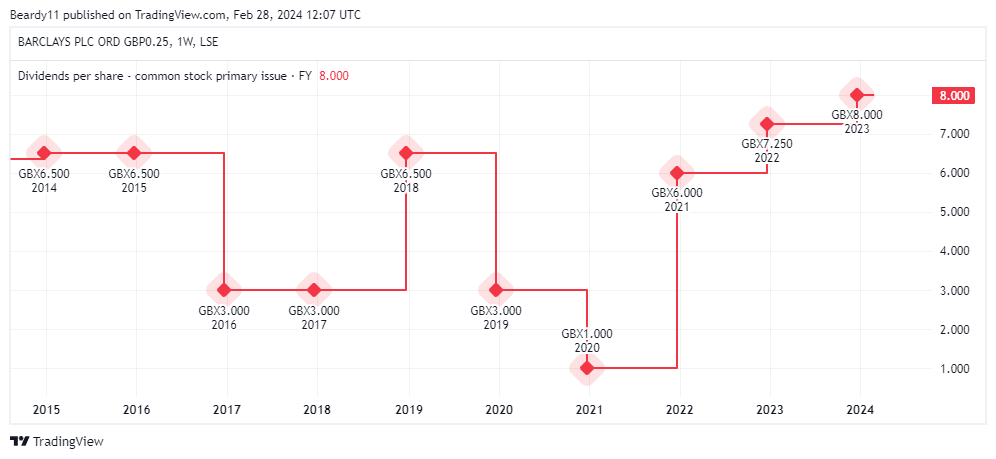
The chart below shows its annual payouts over the past 10 years, which range from 1p to 8p a share. This level of volatility doesn’t make it easy when it comes to preparing a forecast.
Chart by TradingView
However, during this period there’s been Brexit, a pandemic, and rampant inflation. It now looks as though the economy is going to enter calmer waters. KPMG is forecasting GDP growth of 0.5% in 2024, and 1% in 2025.
This should help ensure greater stability with Barclays dividends. However, much of the anticipated improvement in the domestic economy is due to an expectation of falling interest rates.
An improved margin
This is a double-edged sword for banks. Although lower borrowing costs will reduce those defaulting on their loans, it’s also likely to lead to a fall in the net interest margin (NIM).
NIM is the difference between the amount charged on loans and that paid on deposits, expressed as a percentage of interest-earning assets.
On 20 February, Barclays released its results for the year ended 31 December 2023 (FY23). These showed a NIM of 3.13%, up from 2.86%, in FY22. Total income (£25.4bn), credit impairment charges (£1.9bn) and profit after tax (£4.3bn), were all in line with the forecasts.
But analysts were expecting a dividend of 8.5p a share. Instead, the bank will pay 8p in respect of FY23.
This could mean the forecasts for 2024 (9.5p) and 2025 (10.8p) are overly optimistic.
A strong hint
However, the results announcement contained a big clue as to what future returns could be.
The bank plans to return £10bn to shareholders in FY24, FY25, and FY26, through a combination of dividends and share buybacks. It said it plans to keep the dividend stable in “absolute terms”. This means future growth will come from fewer shares being in circulation, as a result of the buybacks.
Based on the current number of shares in issue, an 8p payout will cost £1.21bn.
Assuming the current share price remains unchanged, the table below shows what Barclays new capital distribution policy could mean for the dividend.
| MEASURE | FY24 | FY25 | FY26 | TOTAL |
|---|---|---|---|---|
| Cost of dividend (£bn) | 1.21 | 1.21 | 1.21 | 3.63 |
| Cost of buybacks (£bn) | 2.12 | 2.12 | 2.13 | 6.37 |
| Total capital distributions (£bn) | 3.33 | 3.33 | 3.34 | 10.00 |
| Opening number of shares in issue (bn) | 15.17 | 13.92 | 12.67 | |
| Closing number of shares in issue (bn) | 13.92 | 12.67 | 11.42 | |
| Possible dividend per share (pence) | 8.7 | 9.6 | 10.6 | 28.9 |
If the FY24 estimate is correct, it means the shares are currently yielding 5.1% — comfortably above the FTSE 100 average of 3.9%.
But my calculations come with a health warning as it’s highly unlikely that the share price will remain unchanged over the next three years. And any downturn in the bank’s financial performance could mean it has to change its policy.
But without having access to a crystal ball, it’s my best estimate of Barclays’ future dividend.