
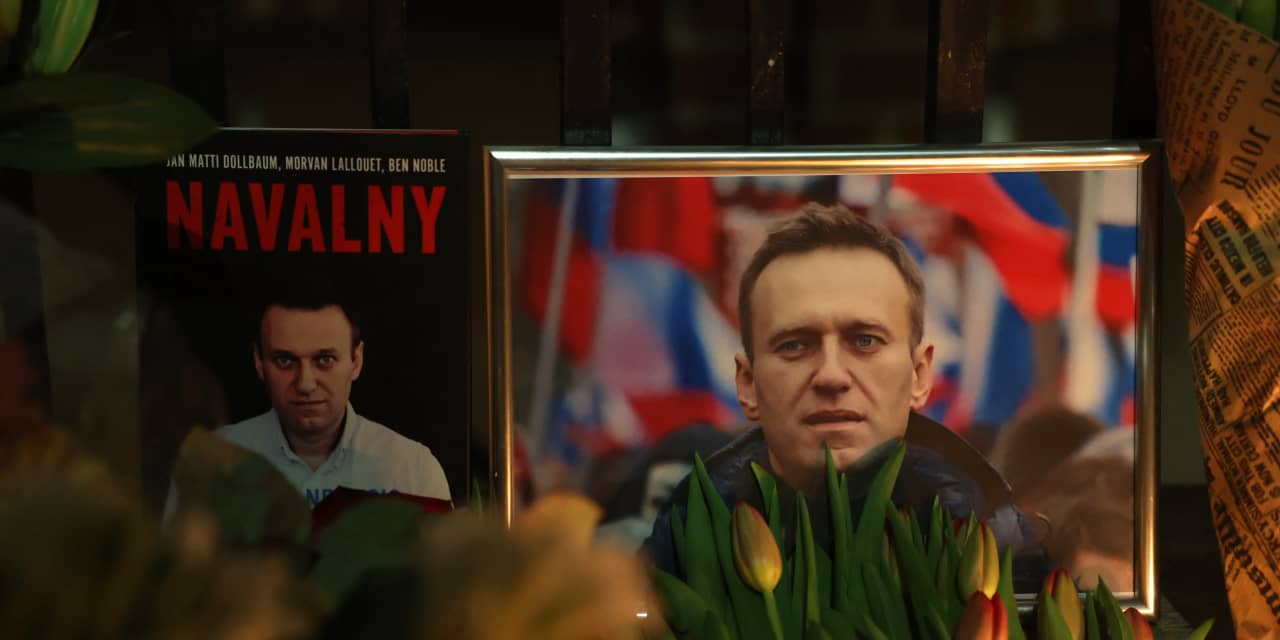
The U.K. government has sanctioned six Russian officials involved in running the “Polar Wolf” Arctic penal colony in response to the death of Putin opponent Alexei Navalny inside the prison camp last week.
The British response will see the head of the prison, Colonel Vadim Konstantinovich Kalinin, and five deputies subjected to travel bans and asset freezes, in what marks the first new set of sanctions against Russia since the 47-year-old campaigner’s death on Feb. 16.
Navalny was sent to the Polar Wolf colony in December 2023, where he was denied medical treatment, kept in solitary confinement for weeks at a time, and forced to walk in freezing temperatures of -32° Celsius (-25.6° Fahrenheit), the U.K. government said as it blamed the prison for his death.
“It’s clear that the Russian authorities saw Navalny as a threat and they tried repeatedly to silence him,” the U.K. foreign secretary, David Cameron, said. “FSB operatives poisoned him with Novichok in 2020, they imprisoned him for peaceful political activities, and they sent him to an Arctic penal colony. No-one should doubt the oppressive nature of the Russian system.”
“That’s why we’re today sanctioning the most senior prison officials responsible for his custody in the penal colony where he spent his final months. Those responsible for Navalny’s brutal treatment should be under no illusion — we will hold them accountable.”
The individuals sanctioned:
- Col. Vadim Konstantinovich Kalinin, head of IK-3 Arctic Penal Colony ‘Polar Wolf’
- Lt. Col. Sergey Nikolaevich Korzhov, deputy head
- Lt. Col. Vasily Alexandrovich Vydrin, deputy head
- Lt. Col. Vladimir Ivanovich Pilipchik, deputy head
- Lt. Col. Aleksandr Vladimirovich Golyakov, deputy head
- Col. Aleksandr Valerievich Obraztsov, deputy head
First opened in the 1960s as part of the Soviet Union’s system of so-called gulag forced-labor camps, the IK-3 penal colony, which is widely referred to as Polar Wolf, is considered to be one of Russia’s toughest maximum-security prisons due to its frequent subzero temperatures and remote location.
In a statement, the U.K. also called on Russia to “immediately” return Navalny’s body to his family, following reports it is currently being held for two weeks for “chemical analysis. Britain’s foreign office had previously called for a full investigation into Navalny’s death.
See: Navalny’s mother petitions Putin for access to her son’s body for dignified burial
Also: Kremlin dismisses claims by Navalny’s widow that he was killed by Putin
Prior to his arrival at Polar Wolf, Navalny had spent three years in Russia’s prison system after being arrested at an airport in Moscow for parole violations following his return from Germany in January 2021.
From the archives (January 2021): Kremlin critic Alexei Navalny, who survived poisoning, arrested after landing in Moscow
Also read (August 2020): Russian opposition leader Alexei Navalny comatose and on ventilator after suspected poisoning
The former lawyer had earlier been evacuated out of Russia to receive medical treatment in Berlin’s Charité Hospital in August 2020, after he started suffering serious symptoms that were later attributed to the impacts of poisoning with the deadly nerve agent Novichok.
Navalny’s death led to protests across Russia that resulted in at least 400 people being detained across 32 of the country’s cities in what was described as the largest show of public outrage since the start of the Ukraine war.