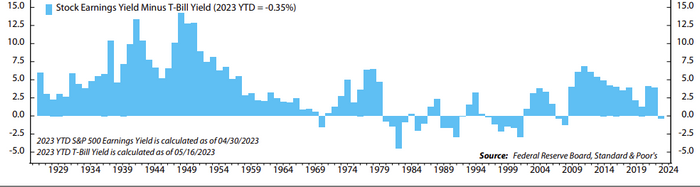
For the first time since 2009, the 3-month U.S. Treasury bill rate is now higher than the yield on earnings derived from generally accepted accounting principles for companies in the S&P 500 Index.
That’s according to Ed Clissold, chief U.S. strategist, and Thanh Nguyen, senior quantitative analyst, at Ned Davis Research. In a note, they said rates on short-term T-bills have risen to levels that have prompted some investors to debate whether equities are worth the risk anymore, given the uncertainties that are keeping the S&P 500 Index
SPX,
from breaking above 4,200.
After a dismal year for both bonds and stocks in 2022, high-quality fixed income such as T-bills and investment-grade corporate bonds are having their moment — offering what investors see as better competitive returns. The Fed’s determination to restore price stability is pushing T-bill rates to multi-year highs, while putting a dent in the performance of most U.S. stocks in 2023, aside from the Nasdaq Composite Index
COMP,
which is up 20.5% this year.
Earlier on Thursday, the three-month T-bill rate
TMUBMUSD03M,
rose to almost 5.29%, its highest level since January 2001, according to Tradeweb, after Dallas Fed President Lorie Logan said economic data don’t yet justify a pause from interest rate hikes in June.
Logan’s colleague, St. Louis Fed President James Bullard, suggested he’s inclined to back another rate hike as an “insurance” policy against inflation. The remarks left all three major stock indexes mixed in afternoon trading, as fed funds futures traders boosted the likelihood of a June rate hike by the Fed to 36%.
“After a decade of TINA (there is no alternative)” to equities, “markets have transitioned to TARA (there are reasonable alternatives),” Clissold and Nguyen wrote in their note. They cited the three month T-bill rate’s yield of more than 5.2% versus the S&P 500 GAAP earnings yield of 4.88% (see chart).
Source: Federal Reserve Board, Standard & Poor’s, Ned Davis Research
The S&P 500 has failed every attempt to break through the 4,200 level this year, and “the earnings outlook for 2023 does not appear to be strong enough by itself to save the market from competition from Treasury bills,” Clissold and Nguyen said.
Read: Buying stocks is just not worth the risk as equities are the most unattractive since 2007
For the year, the S&P 500 is up 8.6% and the Dow Jones Industrial Average
DJIA,
is up only 0.4%, as of Thursday afternoon.
Earlier this week, Mark Haefele, chief investment officer at UBS Global Wealth Management, said that “we see the risk-reward tradeoff for U.S. equities as unattractive.”
In a soft-landing scenario for the U.S. economy, UBS Global Wealth thinks the S&P 500 “could rise to 4,400 by year-end.” But if the economy slips into a recession, “we believe the market could fall to 3,300,” Haefele wrote in a note. “Given this asymmetric skew, we have a least preferred rating on equities relative to bonds, especially in an environment where high-quality fixed income offers competitive returns.”