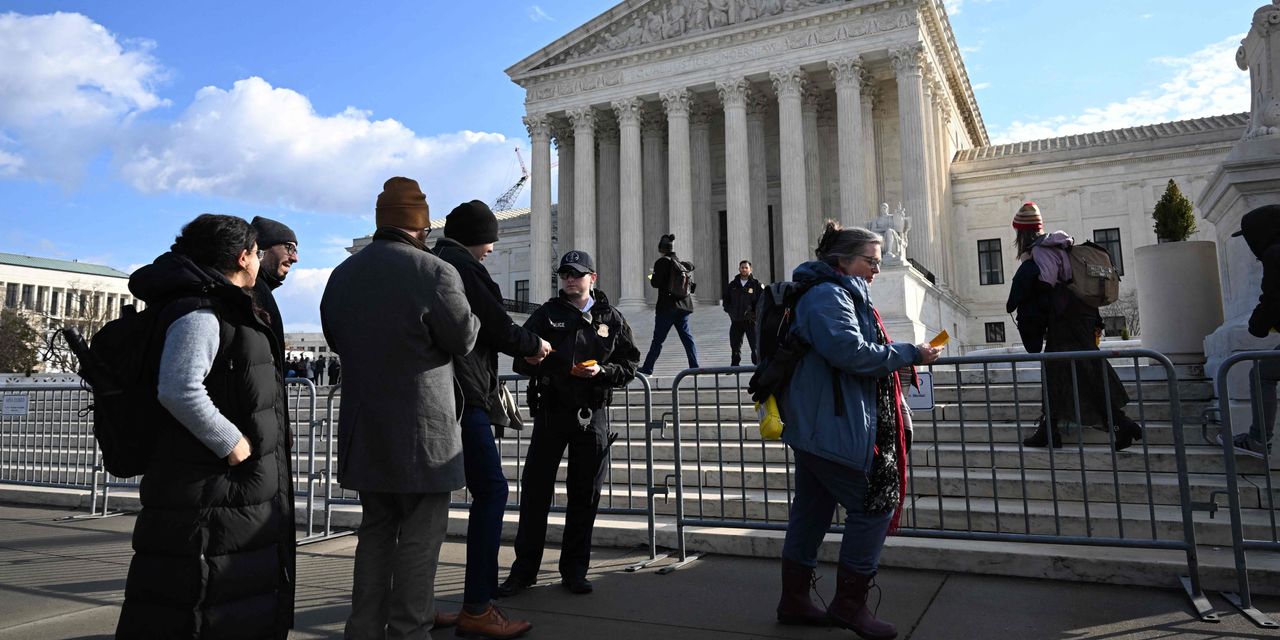
The U.S. Supreme Court on Thursday ruled unanimously on two cases that could have stripped internet companies of legal-liability shields that protect them from third-party posts on social media.
The decisions touched on Section 230 of the 1996 Communications Decency Act, which grants companies such as Alphabet Inc.’s
GOOGL,
GOOG,
Google and Facebook parent Met Platforms Inc.
META,
broad legal protections.
In the first case, Twitter v. Taamneh, plaintiffs claimed the microblogging company was liable for allegedly “aiding and abetting” an attack in Istanbul by Islamic State because Twitter failed to adequately block or remove content promoting terrorism. Twitter said it had no specific knowledge that any particular post furthered a terrorist act.
See also: The Supreme Court and algorithms: Is the internet at risk?
The nation’s highest court held that hosting, displaying and recommending videos is not aiding and abetting terrorism. It added that all content is sorted by algorithms and that using content-agnostic recommendation algorithms is insufficient to create liability.
Justice Clarence Thomas, who has repeatedly criticized Section 230 in past opinions and argued that the court should review the statute, authored the court’s unanimous opinion in Taamneh.
“It might be that bad actors like ISIS are able to use platforms like defendants’ for illegal — and sometimes terrible — ends,” Thomas wrote. “But the same could be said of cell phones, email or the internet generally.”
In the second case, Gonzalez v. Google, the family of a woman killed in Paris during a terrorist attack in November 2015 argued that YouTube used algorithms to push Islamic State videos and was therefore liable in her death.
Noting its earlier decision, the court noted that “little if any” of the plaintiffs’ claims in Gonzalez v. Google remained viable and it was unnecessary to address the question of whether Section 230 immunized the platform’s recommendation algorithms.
“Internet platforms and probably most First Amendment lawyers are breathing a sigh of relief today that the Supreme Court opted not to mess with Section 230 of the Communications Decency Act,” attorney Robert Nelon, an expert in First Amendment law, said. “Rather than wade into the murky world of algorithms that serve to prioritize content a user sees on a platform, the Court decided both cases on a ground far more familiar to the Justices––the common law.”
The Electronic Frontier Foundation applauded the decisions. “We are pleased that the Court did not address or weaken Section 230, which remains an essential part of the architecture of the modern internet and will continue to enable user access to online platforms. We also are pleased that the Court found that an online service cannot be liable for terrorist attacks merely because their services are generally used by terrorist organizations the same way they are used by millions of organizations around the globe,” EFF Civil Liberties Director David Greene said in a comment.
Emile El Nems, vice president for Moody’s Investors Service, also issued a statement underscoring the importance of the court’s decision: “Today’s Supreme Court rulings address one of a number of legal and regulatory exposures surrounding Alphabet, Meta and other social media platforms. While the debate over Section 230 may not be over, we view this ruling as marginally positive. The companies still have exposure to other regulatory concerns over perceived monopolistic behavior(s) that the DOJ and many states’ attorneys general are pursing. Nevertheless, we believe these regulatory risks are mitigated by Alphabet and Meta’s strong credit profiles and conservative financial policies.”