China’s reopening following three years of zero-tolerance COVID-19 policies is already running out of steam, producing a worrisome development for financial markets.
The concern is that the global economy may be losing one of its last major legs of possible support. Earlier this year, China’s reopening was seen as having the potential to reignite another round of inflation pressures worldwide. Now, though, inflation is steadily easing in the U.S., with much of the financial market’s focus instead turning to the prospects for economic weakness domestically and overseas.
Read: How China’s reopening has the potential to shake financial markets
In the currency market on Wednesday, China’s offshore yuan
USDCNH,
and onshore yuan
USDCNY,
weakened against the greenback, trading at more than 7 per U.S. dollar or close to that level for the first time this year. And among commodities, copper and oil were recovering on Wednesday from their respective declines in the prior session, when disappointing economic data from China raised questions about demand that sent crude down and the metal to its lowest finish since November.
Tuesday’s batch of April data on the world’s second-biggest economy behind the U.S. showed China’s industrial output and retail sales missing forecasts, while statistics released on Wednesday pointed to slowing growth in home prices. Now that China’s reopening recovery appears to be petering out, ‘”it has broader implication for the global economy,” said Thierry Wizman, a global FX and interest rates strategist at Macquarie.
“People have doubts about the sustainability of the U.S.’s recovery and fear that the U.S. could go into a recession. There are also doubts about Europe, albeit to a lesser extent. So people were still hoping China could carry the torch for the global recovery, and help mitigate the extent of any global downturn,” Wizman said via phone on Wednesday. Now, though, “people may fear that every major center of the global economy is set to slowdown and any global downturn may be more pronounced.”
In a note released on Wednesday, Wizman and other Macquarie strategists wrote that “a complex of worries around China’s recovery has gripped traders in recent days” following the series of poor data prints from China.
Optimism around “an ‘out of the gates’ recovery” has clearly faded in China, and the negative turn in sentiment toward the Asian country “is also undercutting the view that economic performance outside the U.S. will stay more robust than inside the U.S.,” the strategists wrote. This was “probably a key reason behind the broad rally in the dollar since last week that has also set back the euro, British pound, the yen, the Australian dollar, and the Canadian dollar.”
On Wednesday, one gauge of the greenback, the ICE U.S. Dollar Index
DXY,
rose 0.4% to 103, extending an upward trajectory since May 4. Meanwhile, all three major U.S. stock indexes
DJIA,
COMP,
were higher in afternoon trading, along with most Treasury yields, as U.S. President Joe Biden expressed confidence on achieving a debt-ceiling deal.
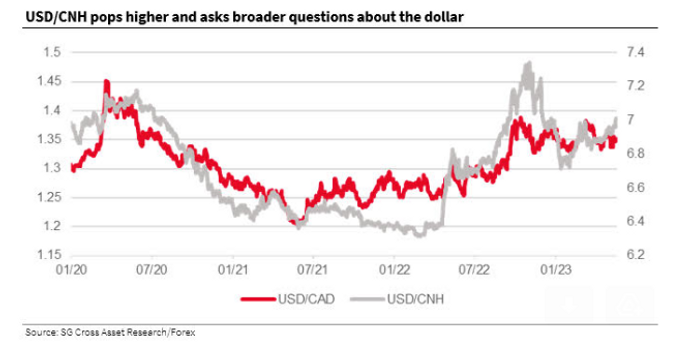
The dollar’s bounce likely has further to go if the yuan is the proverbial canary in the coal mine, according to Société Générale’s Kit Juckes. He said the wider question behind the USD/CNH’s move above 7 (see chart) is whether it reflects the market’s “disappointment” in China’s data “or the fact that demand for the dollar is stronger,” the latter of which would point “to a bigger dollar bounce than I expect,” he wrote in a note on Wednesday.
Source: Société Générale Cross Asset Research/Forex