There’s no need to play Wall Street’s guessing game of trying to predict when the Federal Reserve will bring its rate-hike cycle to an end.
That game certainly gives the legions of Fed watchers something to do. And it certainly seems plausible that the end of a rate-hike cycle would be an opportune time to bet on equities. But there’s little hard evidence that the odds of beating the market become meaningfully higher by winning the game.
It would be one thing if Wall Street’s game were harmless, but it isn’t. It induces a fear of missing out among retirees and others who are not inclined to pay close attention to every nuance in the Fed’s policy statements. We should all just relax.
A review of past rate hike cycles suggests there’s no reason for the FOMO.
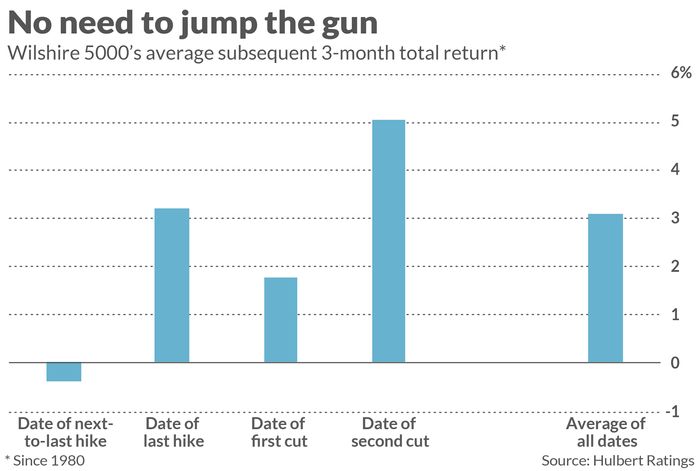
Take a look at the accompanying chart, which reflects all rate hike cycles since 1980. I chose that start date for the chart because it was only in late 1979 that the Federal Reserve began announcing its target interest rate following meetings of its rate-setting committee. Focus first on the stock market’s average three-month total return from the dates of every hike that immediately precedes a cut. Notice that this average is essentially no different than the average of all dates since 1980.
This statistic alone is reason to wonder what all the fuss is about. But there’s an even stronger argument for not playing the Fed guessing game: Only in retrospect do you know the date on which the Fed makes its last hike. The only way to know for sure that a rate hike cycle has come to an end is to wait until the first rate cut, but if you wait until then your subsequent gain is likely to be lower (as judged by past experience, as you can see from the chart).
Another risk you face when playing the Fed guessing game is being premature, betting that the rate hike cycle has come to an end when in fact it still has more to run. In that event, your odds are even poorer. On average since 1980, the stock market lost 0.4% over the three months following the second-to-last increase in a rate-hike cycle.
Your odds of success seemingly go up for the three-month period following the second cut in a rate-cutting cycle, as you can see from the chart. But there’s less here than meets the eye, since there are only a few complete rate cycles since 1980. Because of this small sample size, the differences shown in the chart between buying on the date of the first rate cut and buying on the second are not significant at the 95% confidence level that statisticians often use to determine whether a pattern is genuine.
The bottom line: The Fed guessing game has poor odds. The rewards of winning the game are minimal, and the risks of losing can be considerable. The shrewd strategy is to not play the game in the first place.
Mark Hulbert is a regular contributor to MarketWatch. His Hulbert Ratings tracks investment newsletters that pay a flat fee to be audited. He can be reached at mark@hulbertratings.com.