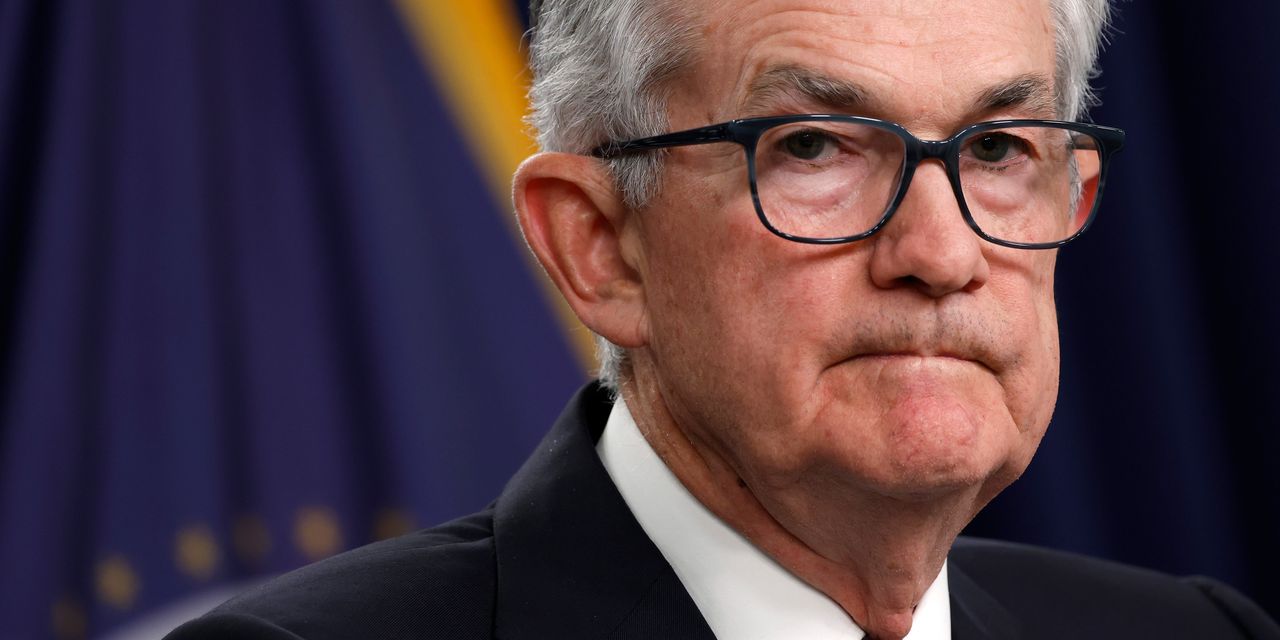
Just one day after Federal Reserve Chairman Jerome Powell signaled that rate cuts anytime soon are off the table, following the central bank’s 10th consecutive hike, traders took in all of his words — and ignored them.
The 2-year Treasury yield
TMUBMUSD02Y,
dropped 23 basis points to 3.72% Thursday afternoon and headed for its third decline in as many sessions amid an aggressive rally in government debt. Fed funds futures traders briefly priced in a 16% chance of a June rate cut, up from 6.6% a day ago.
And three-month contracts tied to the Secured Overnight Financing Rate, or SOFR, traded at levels which implied that “there’s a decent chance Fed policy makers take back Wednesday’s rate hike at their June or July meeting,” said Tom Graff, head of investments at Baltimore-based financial planning firm Facet.
Simply put, Graff said via phone, rates traders are “taking out the hike that just happened.”
In the corners of the financial market most focused on the likely trajectory of interest rates, traders continue to diverge from what Powell has been saying. Mohamed El-Erian, the former chief executive of Pimco, said in a tweet he could not recall another time in his career when there’s been such a persistently large gap between the Fed’s guidance and what the markets are expecting, particularly after Powell explicitly pushed back on Wednesday against the idea of any rate cuts soon.
Read: 4 things we learned from Powell’s press conference after latest Fed rate hike
“At some point, one side is going to capitulate to the other, but until then there’s going to be a lot of volatility,” said Will Compernolle, a macro strategist at FHN Financial in New York. “Right now, markets are trading on banking-sector developments much more than they are on monetary policy tied to the economic landscape.”
U.S. regional banks were back at the forefront on Thursday, overshadowing the Fed’s prior-day decision to lift rates above 5% or the highest level since 2007. After a report that the company’s executives were weighing a possible sale, PacWest Bancorp
PACW,
shares were down more than 40% in Thursday’s session after being halted throughout the day — taking other bank stocks with it.
Big names stepped into the fray on Wednesday and Thursday, with Jeffrey Gundlach, CEO of DoubleLine, saying that “deposits are going to keep drifting out,” and hedge-fund billionaire Bill Ackman adding that “we are running out of time to fix this problem.”
“There are a lot of forces at play which are making the baseline scenarios for the Fed and markets different,” FHN’s Compernolle said via phone on Thursday. Two of them are that markets are pricing in “a higher probability of a greater contraction in credit conditions, and think inflation is going to decline more than the Fed expects because of higher recession risks.”
Those views have contributed to the drop in Treasury yields, he said, though some of the declines are due to “the natural forces of money moving around” during flight-to-safety trades as investors move away from stocks and into money-market funds holding short-term government debt.
As of Thursday afternoon, all three major U.S. stock indexes
DJIA,
COMP,
were lower, led by an almost 300-point drop in Dow industrials that leaves it on pace for a year-to-date decline. Meanwhile, 2-month through 30-year Treasury yields
TMUBMUSD30Y,
were also down amid broad-based buying of government debt.
Three-month contracts tied to SOFR — the successor to the scandal-plagued London interbank offered rate known as Libor — began reflecting the likelihood of a Fed rate cut sometime between June and September, as of late Wednesday when PacWest shares were tumbling, said Graff of Facet, which manages about $2 billion in assets.
“It was more or less the market saying there could be a rate cut relatively soon, and I think it is saying rate cuts could be large because of a big reset in the Fed’s plans,” he said. Unlike fed funds futures contracts, which reflect expectations looking out over a period of months, SOFR contracts trade on expectations that are years out, making it easier to read where the market thinks rates are headed over a longer period of time, according to Graff.
“Going back to other big turning points in monetary-policy history, there is often a big divergence between what the Fed says and the market thinks,” Graff said. “Because the Fed can’t always be fully transparent with us — it needs to burnish its inflation-fighting credibility even as new risks keep cropping up, for instance — Powell is limited on what he can say, whereas the market is going to make its own opinion about what’s going on.”
Read: Is Fed signaling a ‘pause’ without saying ‘pause’?
Right now, “the market is saying, ‘You’re worried about inflation, but we’re not.’ The market is also saying that the rate hike which just happened may well turn out to be a mistake.”