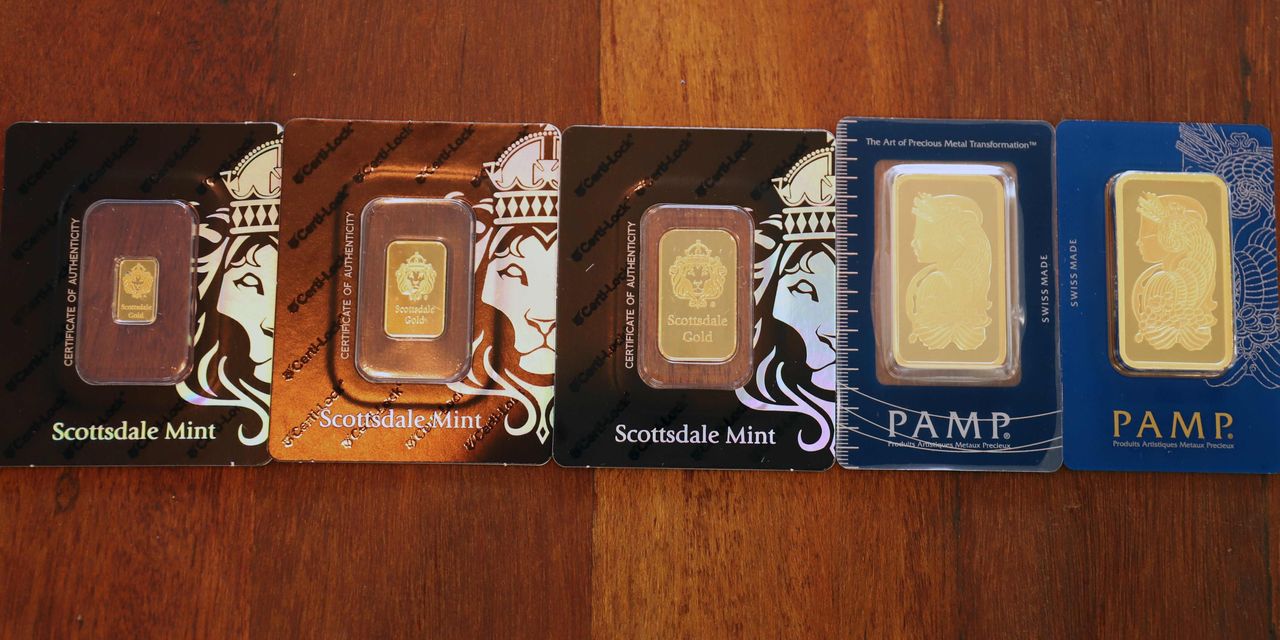
Gold futures topped $2,000 an ounce on Monday to mark their highest intraday price in more than a year, as fears of a crisis in the banking sector led to a rise in demand for gold as a safe-haven investment.
Prices for the precious metal, however, failed to hold at their highest level of the session after posting a nearly 6% rally last week, raising the question of whether gold’s rally is set to last amid efforts to avoid a global banking crisis.
For now, the precious metal has been “reveling in its safe-haven status given the global banking sector uncertainty,” said Tim Waterer, chief market analyst at Kohle Capital Markets, in emailed commentary.
SVB Financial Group’s Silicon Valley Bank on March 10 become the first major bank since the global financial crisis in 2008 to be taken over by the Federal Deposit Insurance Corp. Concerns over the health of other large banks followed, and over the weekend, news of UBS’s
UBS,
deal to buy Credit Suisse
CS,
emerged.
Read: Here’s why UBS’s deal to buy Credit Suisse matters to U.S. investors
Switzerland authorities “orchestrated a forced takeover of Credit Suisse by UBS, committing up to a third of the country’s GDP to rescue its banking system,” said Brien Lundin, editor of Gold Newsletter, in comments to clients Monday.
In response to the news, as well as to gold’s “huge run” on Friday, spot prices for gold dropped, then moved to claw back its losses, said Lundin.
It’s important to understand that the move higher for gold will “come in waves,” he said. “We shouldn’t chase prices on feverish moves like we saw on Friday, but look to build positions on pullbacks.”
On the futures market, the most-active gold contract
GC00,
registered a weekly gain of 5.7% on Friday — the biggest weekly advance since April 2020, according to Dow Jones Market Data.
On Monday, prices for April gold futures
GCJ23,
climbed to as high as $2,014.90, the highest intraday level for a most-active contract since March 10, before settling at $1,982.80, up $9.30, or 0.5%. The settlement was still the highest since April 18 of last year.
Lundin said there’s “little doubt that there’s much more to come in this emerging banking crisis.” The risk-hedging policies of Silicon Valley Bank, “or lack thereof, were likely duplicated by numerous banks in the U.S. and around the world.”
Paul Wong, market strategist at Sprott Asset Management, told MarketWatch, that he expects gold to continue to gain in the short to medium term, with woes in the banking sector likely “still in its early stages.”
“Physical buyers have driven gold, and now investment buying has likely joined in,” he said.
Investors will also focus their attention on the Federal Open Market Committee’s monetary policy decision due Wednesday.
Read: What’s at stake for stocks, bonds as Federal Reserve weighs bank chaos against inflation fight
The Fed “cannot fight inflation and fight a banking crisis at the same time,” said Wong. The central bank needs to “shore up the banking system first. This opens the window for left-tail inflation outcomes, which high favor gold.”
Fed-funds traders generally expect the Fed to announce a quarter-percentage-point move higher in its benchmark interest rate on Wednesday, though not everyone expects a rate hike.
Even so, “you don’t raise rates at arguably the fastest pace in history, after building a financial system on the foundation of 5,000-year-lows in interest rates without breaking something — and probably a lot of things,” said Lundin.
“In short, there’s much more to come in this crisis, so make sure you’re ready to ride the waves higher in metals and mining stocks,” he said.