A slight majority of actively-managed mutual funds that invest in U.S. large-cap stocks lagged the S&P 500 index again in 2022, struggling over the long term to beat the index, according to an annual scorecard from a division of S&P Global.
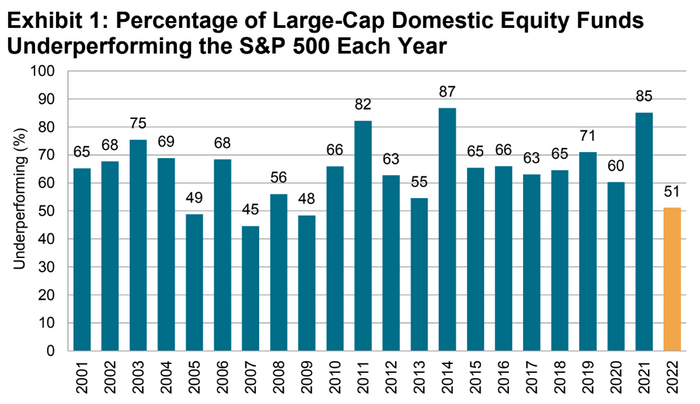
Out of active mutual funds focused on U.S. large-cap equities, “the largest and most closely watched category” of the stock market, 51% underperformed the S&P 500 last year, a report from S&P Dow Jones Indices, a division of S&P Global, shows.
“So it’s roughly a coin flip,” said Anu Ganti, a senior director of index investment strategy at S&P Dow Jones Indices, in a phone interview. Although a “slim majority” of U.S. large-cap equity managers failed to beat the S&P 500 in last year’s volatile stock market, she said 2022 turned out to have the lowest underperformance rate for the category since 2009.
S&P DOW JONES INDICES
Investors tend to pay higher fees for actively-managed funds in hopes that the professional stock pickers running them will deliver market-beating gains. But actively-managed U.S. large-cap equity funds have struggled over the past two decades to outperform the S&P 500
SPX,
The index, a gauge of large-cap stocks in the U.S., tumbled 19.4% last year as the Federal Reserve rapidly raised interest rates to battle high inflation, according to FactSet data. On a total return basis, the S&P 500 lost 18.1% in 2022.
That was the S&P 500’s worst year since 2008, when the U.S. stock market was reeling from the global financial crisis.
S&P Dow Jones Indices found that 2005, 2007 and 2009 were the only three years over the past two decades in which a majority of large-cap domestic equity funds managed to outperform the S&P 500.
The S&P 500 is a market-capitalization weighted index, with heavy exposure to mega-cap companies. The benchmark has risen 5.4% this year through Monday, according to FactSet data.
“In years when the average constituent” of the S&P 500 beats the benchmark, “it should be easier to select stocks that do so,” the report from S&P Dow Jones Indices says. “And when the very largest companies lag, the ability of active managers to deviate from market-capitalization weightings has a greater chance of generating outperformance.”
In 2022, the S&P 500 Equal Weight Index, “which offers a proxy for the performance of the average stock in the benchmark,” outperformed, the report says. Meanwhile, the S&P 500 Top 50, which represents its largest weights, lagged “materially” last year.
According to Ganti, the S&P 500 Equal Weight Index beat the S&P 500 11 times from 2004 through 2022. That includes 2005 and 2009, two of the three years over the past two decades in which a majority of large-cap active managers outshined the S&P 500, her research found.
Got skill?
Actively managed large-cap funds tend to underweight the largest stocks in the index, according to Ganti. This could have been a tailwind last year for active large-cap managers, along with the “greater dispersion” in individual stock returns in 2022’s volatile equity market, she said by phone.
Such volatility means “if you’re a stock picker there’s greater potential to add value,” she said, but “if you have the skill.”
Rates of underperformance are high for U.S. large-cap equity managers when viewed over long-term time horizons. For example, Ganti said 95% of such managers lagged the S&P 500 over a 20-year period and 91% percent underperformed over a 10-year stretch.
During last year’s brutal market, large-cap value stocks trounced growth equities even as both categories suffered losses.
The S&P 500 Growth index plunged 29.4% last year on a total return basis while the S&P 500 Value index lost 5.2%, representing “the top and bottom extremes of relative performance among equity benchmarks” spanning across sizes, styles and internationally, the report shows.
Managers of small-cap and mid-cap mutual funds broadly struggled to exceed the performance of their benchmarks last year, generally faring worse than large-cap funds in that regard, according to the annual scorecard.
In mid-cap funds 63% underperformed the S&P MidCap 400 in 2022, while 57% of small-cap funds trailed the S&P SmallCap 600, the report says.
Digging deeper within the two size categories, S&P Dow Jones Indices highlighted U.S. mid-cap growth managers as having the highest annual underperformance rate last year at 91%. By contrast, the report shows “small-cap core” managers saw the lowest underperformance rate among domestic equity funds, with 40% lagging their benchmark last year.