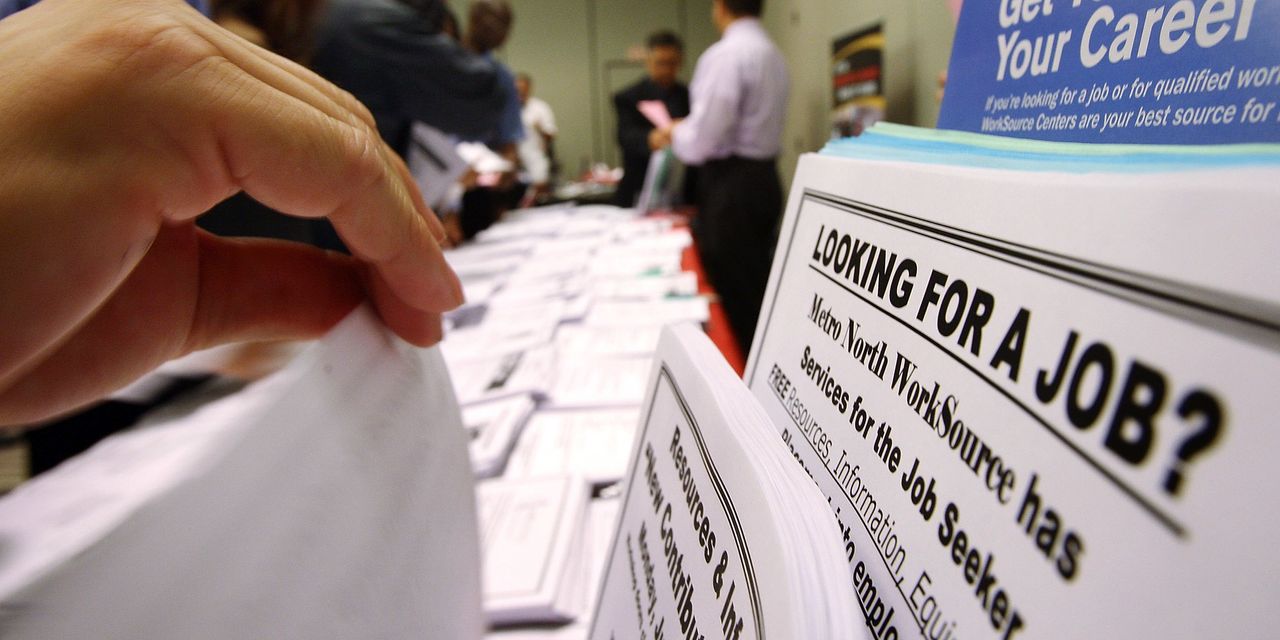
Something funny is going on in the U.S. jobs market.
The economy has slowed since last year. More large companies such as Amazon
AMZN,
Dell
DELL,
and Disney
DIS,
have announced layoffs. And the odds of recession are rising.
And yet, the labor market is as tight as a drum. Companies are still hiring — and available workers are still hard to find.
Take the unemployment rate. It drifted to a 54-year bottom of 3.4% in January and shows little sign of rising. Or look at new applications for jobless benefits, a proxy for layoffs. They are also stuck near the lowest level on record.
Economists have a name for it: Labor hoarding.
“While some businesses are letting go of workers, many others are opting to cut workers hours and keep them on the payroll rather than resort to layoffs,” said chief economist Ryan Sweet of Oxford Economics.
Put another way, businesses are only cutting jobs in a time of economic duress when they have few or no other options. By and large they are avoiding the usual prescription of mass layoffs.
How come? For one thing, many business leaders think the economy might improve later in the year, especially if Europe and Asia continue to rebound.
“Many companies [have] opted to maintain workforce levels to support projected second-half growth,” said Timothy Fiore, chairman of a closely followed survey of manufacturing companies published by the Institute for Supply Management.
The scarcity of labor is another big factor. Companies have struggled mightily to hire. They are reluctant to lay off workers who were hard to find in the first place.
That’s especially true in manufacturing and other highly skilled occupations where the potential talent pool has been shrinking for decades.
“Quality skilled labor has always been a hot commodity,” said Anthony Nieves, chairman of the ISM’s survey of service-oriented companies.
The story might be a bit different among service-oriented businesses, particularly those that rely on less skilled labor such as retailers and restaurants. It’s generally been easier to find people to fill those jobs. Nieves said he’s seen little indication of labor hoarding so far in those occupations.
Yet even low-skilled industries face tremendous pressure to fill open jobs and maintain their current level of employment.
Even now, three years after the onset of the pandemic, employment in retail and leisure and hospitality has still not returned to pre-pandemic levels. The size of population has grown by several million, meanwhile, and demand for such services has climbed to a record high.
In short, the pressure to add workers is still there.
Consider a recent announcement by Home Depot
HD,
the huge home-center chain. The company said it would invest $1 billion in worker wages and benefits in the next year even as it cut its profit projections.
“There is mounting evidence that businesses are actually hoarding labor,” said money market economist Thomas Simons of Jefferies LLC in a recent note to clients. “The bottom line is that labor supply is not increasing in any meaningful way, and there is no evidence that this will change any time soon.”
To be sure, companies eventually will resort to layoffs if sales fall sharply enough and earnings soften. A raft of technology companies, for instance, have announced more than 100,000 combined job cuts recently.
Most of these people have not ended up on the unemployment rolls, however, adding to the air of mystery surrounding the labor market. Some speculate tech workers have been addled by generous severance packages or that they are finding new jobs relatively quickly.
Whatever the case, few economists predict the unemployment rate will rise much above 4%, let alone 5%, in the next year or two.
Such a relatively small increase in unemployment would be extraordinary, especially if, as many economists predict, the U.S. suffers a mild recession. Only once since the 1960s has the jobless rate stayed below 6% during or immediately after a recession.
The tight labor market poses a conundrum for the Federal Reserve, however.
Senior Fed officials consider the strong jobs market an antidote to potential recession as the central bank jacks up U.S. interest rates to tame high inflation. Rising rates reduce inflation by slowing the economy, but they also raise the odds of economic contraction.
Yet the tight labor market has also driven up wages at the fastest pace in four decades, raising the specter of a dreaded wage-price spiral that makes it harder for the Fed to curb inflation.
In a best-case scenario, the Fed slows the economy just enough to squelch inflation without triggering mass layoffs.
But wishful thinking might only exist in fables, economists say.
“Goldilocks is unlikely to reign supreme on Wall Street for much longer,” quipped Scott Anderson, chief economist of Bank of the West.