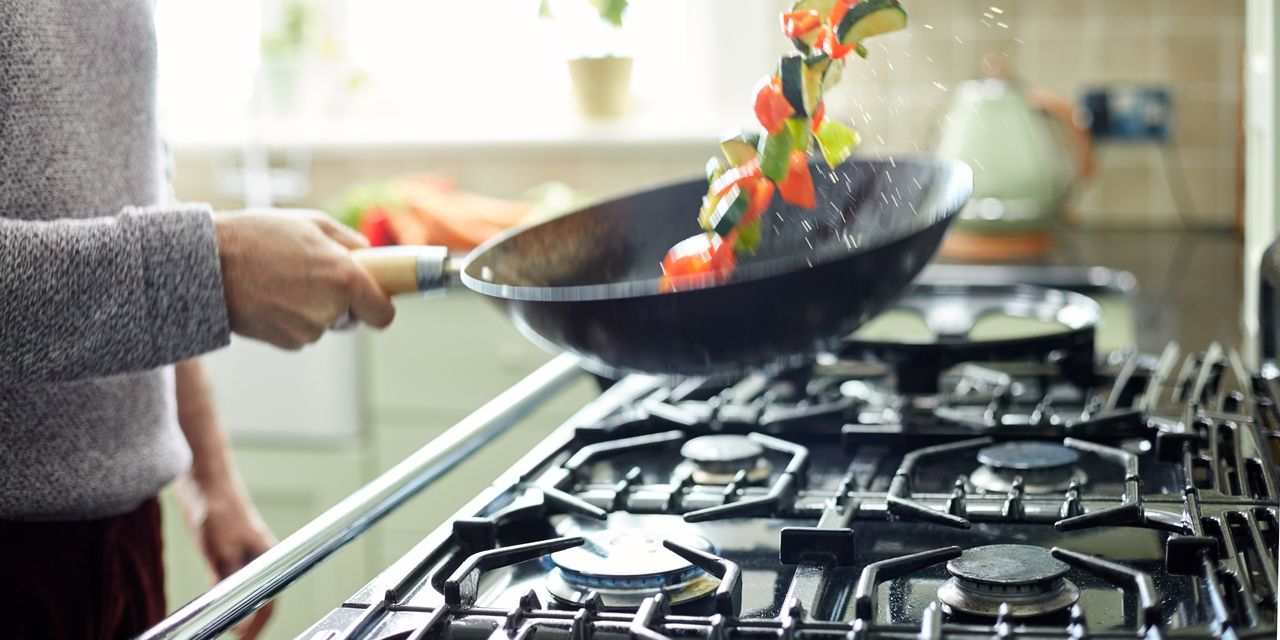
The appliance and energy industries, scientists and the medical professions, plus the public at large are urged to submit research and possible solutions to potential health hazards associated with gas stoves.
That’s the all-call this week from the Consumer Product Safety Commission, the independent federal body known for recalls and other regulations, limited to newly made products. It was a CPSC member whose early-year comments on the risks to individuals and the environment from gas stoves — based on the findings of some studies — roiled both sides of the argument over a future with or without gas.
Announced this week, the CPSC’s open request aims to examine the scope and scale of risks associated with using natural gas-powered
NG00,
ranges and ovens. Other household appliances, including water heaters, may also use gas. But it’s been the close proximity of kitchen appliances, and lax venting practices among most Americans, that put gas stoves in the spotlight.
The commission wants data that can be analyzed and possible solutions, the CPSC said as part of regular proceedings. No regulatory change is currently being proposed and no ban is under consideration, it added.
Related: Gas-stove ban: As U.S. moves closer to action, cooks want to know, ‘What’s the real risk?’
“The chronic hazards that can arise from toxic emissions should be studied, and that is what we are doing with this RFI [request for information],” CPSC Chairman Alexander Hoehn-Saric said.
Read: Biden’s first veto could impact your 401(k) and how companies react to climate change
Fresh scrutiny of the gas cooking method used in about 40% of U.S. households also stems from two recent studies sourced to Harvard and Stanford Universities. One examined respiratory ailments, such as childhood asthma, and certain cancer risks linked to gas-stove use, as well as research on their contribution to global warming from the greenhouse gases that the combustion of natural gas and other fossil fuels releases into the atmosphere.
Gas stoves, particularly those that are not well ventilated — or for which homeowners do not consistently use ventilation — emit air pollutants such as nitrogen dioxide, carbon monoxide and fine particulate matter into the home at levels the Environmental Protection Agency and World Health Organization have said are unsafe and that are linked to respiratory illness, including asthma, cardiovascular problems, cancer and other health conditions. That’s according to reports by groups such as the Institute for Policy Integrity and the American Chemical Society.
And just last month, peer-reviewed research published in the International Journal of Environmental Research and Public Health found that more than 12% of current childhood asthma cases in the U.S. can be attributed to the use of gas stoves.
The American Gas Association, the trade group that supports gas-powered utilities, has said that research falls short proving a link. And, it says, keeping natural gas in a mixed U.S. energy portfolio is the key to lower consumer costs and more U.S. security from volatile global energy markets.
“According to the [2013] study Cooking Fuels and Prevalence of Asthma: A Global Analysis of Phase Three of the International Study of Asthma and Allergies in Childhood (ISAAC), which analyzed 512,707 primary- and secondary-school children from 108 centers in 47 countries, there is ‘no evidence of an association between the use of gas as a cooking fuel and either asthma symptoms or asthma diagnosis,’” said Richard Meyer, AGA’s vice president of energy markets, analysis and standards.
In a separate statement this week, CPSC Commissioner Richard Trumka Jr., whose comments in January set off industry fears and political pushback over a potential federal ban on gas stoves, said the information request could help identify technologies that could mitigate possible health hazards.
“I am hopeful that by bringing this information-seeking process public, companies will create new solutions or notify us of their commitment to implement existing solutions that were previously unknown to us,” Trumka said this week.
That’s a different tone from earlier, when Trumka said in a Bloomberg News interview that gas appliances are “a hidden hazard” and stressed the agency’s ability to ban new products that can’t be made safely. He said the agency could also consider other actions, including setting standards on emissions from the appliances, or take no action at all.
Trumka later tweeted: “To be clear, CPSC isn’t coming for anyone’s gas stoves. Regulations apply to new products. For Americans who CHOOSE to switch from gas to electric, there is support available – Congress passed the Inflation Reduction Act, which includes a $840 rebate.”
Read more on the IRA and its incentives for electric induction stoves and other energy-efficiency steps for homes and businesses.
Don’t miss: Americans baffled by ‘climate law’ and energy tax breaks. Al Gore wants to teach them.
Direct impacts from gas stoves are a much more urgent concern for human health than for Earth’s climate, argues Daniel Cohan, associate professor of civil and environmental engineering at Rice University.
Gas stoves are a leading indoor source of nitrogen dioxide, or NO₂, which can cause or worsen respiratory illnesses in people who are exposed to it, he writes in a commentary for The Conversation. For example, scientific studies show that living in a home with a gas stove increases children’s risk of asthma by nearly one-third and contributes to pulmonary disease in adults.
“The climate doesn’t care what fuel we use to cook,” he suggests. “Gas stoves account for just 0.1% of U.S. greenhouse gas emissions.”
A spokeswoman for the Association of Home Appliance Manufacturers, which represents companies such as Whirlpool Corp.
WHR,
LG Electronics
066570,
and Samsung Electronics America
005930,
told The Wall Street Journal the group is already working with the CPSC on a task force studying gas cooking and indoor air quality.
Nearly 40% of the ranges and cooktops delivered to U.S. retailers and home builders annually use gas as a fuel source, while the rest use electricity, according to the association.
The group has said that induction cooking, a more-expensive, but also modernized, subset of electric cooktops that uses a magnetic field to heat specialized cookware is gaining in popularity. Induction has the quick-to-heat-and-cool control that gas is known for and acts as a usable counter surface when not cooking.
But scrutiny of gas appliances is coming from other corners as well. The U.S. Department of Energy last month proposed a regulation that would govern the appliances’ energy consumption. It said it isn’t seeking a ban and that nearly 50% of the current gas-cooktop market wouldn’t be affected by the proposal.
The home-appliances manufacturers trade group told The Wall Street Journal that such a regulation would require almost all current models to be redesigned.