Pros
- Audi style, inside and out
- Quiet, comfortable ride
- Choice of body styles & drivetrains
Cons
- Total range is just ok
What’s new?
- A few cosmetic additions
- Some variants gain new headlights
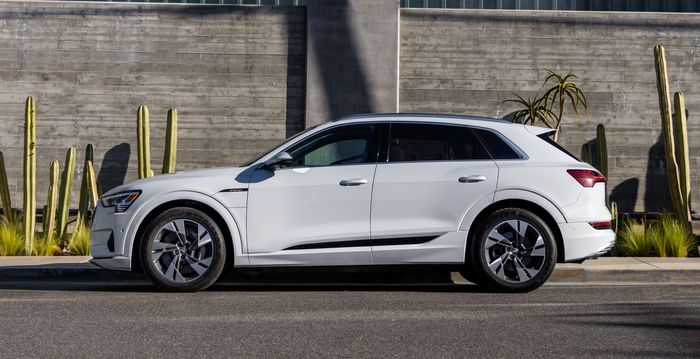
The all-electric 2023 Audi e-tron luxury midsize SUV brings all the usual upscale Audi attributes while cutting vehicle emissions to zero. Prices start at $66,800.
Available as a regular SUV or a sleeker Sportback version, the 2023 Audi e-tron also provides 2-motor or 3-motor variants, the latter wearing the S label that Audi bestows upon its spicier creations. Every e-tron runs solely on battery power. Maximum range is 222 miles.
The Audi e-tron
Audi
That’s not much, considering something like the BMW
BMW,
iX has roughly another 100 miles under its tires. But the Audi e-tron might easily hit many buyers’ sweet spots from both aesthetic and financial perspectives. The iX is almost $20K more.
For the sake of clarity, there’s also the Audi e-tron GT, which is an all-electric sedan. And the Audi Q4 e-tron, a smaller all-electric SUV. They each have their own reviews.
Read: What is EV, BEV, HEV, PHEV? Here’s your guide to types of electric cars
2023 Audi e-tron pricing
The 2023 Audi e-tron lineup starts at $66,800 and will stretch into six figures for a fully loaded S Sportback model. Most buyers opt for something in the middle of that range, with the average price paid coming in around $91,000 as this is written.
Keep in mind that all variants of the 2023 e-tron are eligible for a federal tax credit of up to $7,500. A 2-year/250-kWh program of free charging with the Electrify America network is also included.
Before buying a new e-tron all-electric luxury SUV, check the KBB.com Fair Purchase Price to see what others in your area paid for theirs.
Driving the 2023 Audi e-tron
The fun thing about electric motors is that they produce their maximum thrust from a virtual standstill. So when the 717 lb-ft of torque in the 2023 e-tron S variant is applied to the ground through a standard (though not conventional) all-wheel-drive system (AWD), it can hit 60 mph in just 4.3 seconds.
Non-S models need another second or so, but that’s still pretty good for an SUV weighing nearly 3 tons. (The less fun thing about electric motors is that they need heavy batteries to run them.)
Audi has done the smart thing, though, of placing the battery pack under the floor, giving the e-tron a relatively low center of gravity, which contributes to the feeling of stability.
A standard adaptive air suspension contributes greatly to a feeling of cushioned refinement. Even with 21-inch alloy wheels, the ride quality is sumptuous. This suspension can also lift to improve ground clearance in off-road or snowy situations.
The other quality a lot of electric vehicles have is one-pedal driving. This happens when the amount of brake regeneration is set to its highest level, so drivers can slow down appreciably just by lifting off the accelerator pedal. That’s not a feature in the 2023 e-tron, sadly.
The Audi e-tron
Audi
Interior comfort
Overall, the 5-seater interior of the 2023 e-tron luxury electric SUV is yet another example of inspired Audi-ness, with high-quality materials fashioned into simple yet attractive shapes, plus a bit of innovation thrown into the mix — such as the unusual shift lever.
Some makers of electric vehicles are fitting one large infotainment touchscreen, others are fitting dual displays in one unit set horizontally. Audi is going another way. The instrument cluster is the latest iteration of the company’s Virtual Cockpit while the center console has a 10.1-inch upper screen for accessing the infotainment system, while a lower 8-inch display is for things like climate settings.
Another screen at the back of the center armrest allows rear passengers to set their own temperatures of the standard 4-zone automatic climate control.
Occupant space is more than ample, and the Sportback has the same 39.1 inches of rear legroom as its conventional SUV counterpart, with about an inch less of headroom.
Cargo space in the SUV goes from 28.5 cubic feet behind the rear seats to 56.4 when they’re folded down. The Sportback starts with 27.2 and expands to 54.5 cubic feet. A small storage area beneath the hood holds the 14.5-foot charging cable.
Also on MarketWatch: Tempted to chase fat yields in money market accounts? Why it might not pay to switch.
Interior updates for 2023
A black headliner, optional in 2022 models, becomes standard in the 2023 e-tron Sportback. The 3-motor e-tron S and e-tron S Sportback models receive carbon inlays, plus the LED Interior Lighting Plus package with a greater choice of colors. The non-S e-tron Sportback in top Prestige trim also gains rear side airbags, along with illuminated seat belt buckles.
Exterior styling
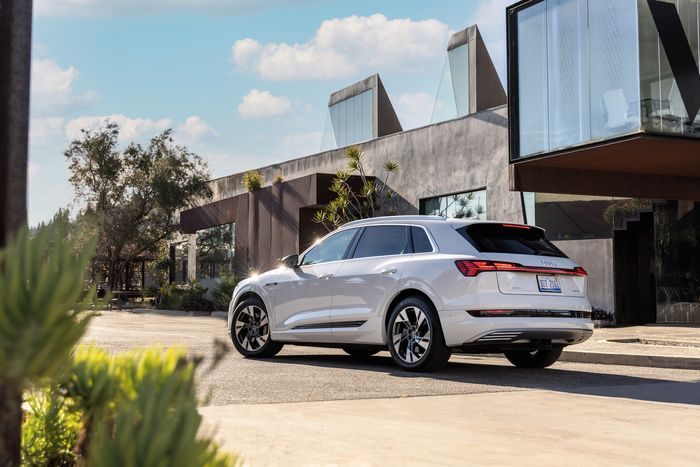
There’s the conventional midsize SUV version of the all-electric 2023 e-tron and the Sportback variant with a lower, sleeker, slightly less practical, roofline. Each buyer is going to have their own reasons for choosing one over the other.
Both have a grille like a combustion-engined vehicle. There’s no engine to keep cool, but it does provide a prominent spot for the company’s 4-ringed badge. It keeps the e-tron at the conventional end of the style spectrum and retains that much-admired Audi design language.
Most exterior changes to the 2023 e-tron take place with the Sportback in Prestige trim. This version gains the previously optional Black Optic cosmetic package as standard, along with 22-inch 5-spoke turbine-design alloy wheels, orange brake calipers, and Digital Matrix-design LED headlights. This last feature is also added to Prestige versions of the e-tron S and e-tron S Sportback.
You might like: The 2024 Volvo EX90: This understated, luxury electric SUV offers Volvo’s best in safety and design
Favorite features
1. Adaptive air suspension
Most luxury vehicles would have an adaptive air suspension on their options list. The 2023 e-tron lineup includes it as standard equipment. The non-S models have theirs tuned for comfort; the S versions have a sport-tuned counterpart.
2. Virtual Cockpit
This 12.3-inch configurable digital driver information display is standard across the board. It can show the usual information, plus things like the navigation system’s maps. It’s easy to use, and the learning curve is short and shallow.
3. Audi Phone Box
Wireless charging and phone signal boosting, courtesy of the Audi Phone Box, comes on board at the Premium Plus level. This is part of an infotainment system that also includes wireless Apple
AAPL,
CarPlay/Android Auto smartphone integration as standard.
4. Heat pump
Yes, this is a bit dull, but a heat pump scavenges warm air from the drivetrain and sends it into the cabin. By doing so, it eases the burden of the climate control system and therefore saves battery. It’s a standard feature in every 2023 e-tron.
5. Matrix-LED headlights
These have many small LED light sources that can shine a lovely bright pool of light for the driver to enjoy, but not dazzle those in other vehicles. They become standard at the Premium Plus level. The digital versions in Prestige trims are even more sophisticated.
6. Dual-pane side windows
Because the 2023 e-tron is both a luxury car and an electric vehicle, the cabin is already wonderfully quiet. Available dual-pane side glass provides even more acoustic insulation. Occupants can enjoy the available, superb Bang & Olufsen surround-sound system to its fullest.
Also see: The 2023 Mercedes-EQ EQB: The all-electric small SUV is superb family transport
Engine and transmission
Every 2023 e-tron has the same 95-kWh lithium-ion battery pack. It’s just a question of how many electric motors are powered by it.
The regular e-tron SUV and e-tron Sportback have a pair of electric motors, one for each axle, creating a form of AWD as standard. Total output is 355 horsepower and 414 lb-ft of torque. In Boost mode, output is temporarily raised to 420 horsepower and 490 lb-ft of torque. The e-tron SUV is estimated to have a range of 222 miles, while the Sportback can cover 218 miles.
Audi e-tron S versions add a third electric motor, so each rear wheel has its own. They combine to create 429 horsepower (or 496 in Boost mode) and an extremely muscular 717 lb-ft of torque. Range varies according to body shape and wheel size, going from 181 to 212 miles.
Charging times also vary depending on the source. A DC fast charger can take the battery from 5% capacity to 80% in about half an hour. A Level 2 240-volt setup at home can accomplish a full recharge in approximately 10.5 hours. Audi provides a warranty for the battery that lasts for 8 years or 100,000 miles, whichever occurs first.
Maximum towing ability is 4,000 pounds, but pulling the equivalent of another vehicle will reduce the range significantly.
The Environmental Protection Agency (EPA) calculates miles-per-gallon equivalents (MPGe) for electric vehicles. The following estimates are from 2022, but 2023’s figures shouldn’t be any different.
Two asynchronous electric motors (e-tron)
355 horsepower (402 w/Boost mode)
414 lb-ft of torque (490 w/Boost mode)
EPA city/highway fuel economy: 78/77 MPGe (SUV), 76/78 MPGe (Sportback)
EPA-estimated range on a full charge: 222 miles (SUV), 218 miles (Sportback)
Three asynchronous electric motors (e-tron S)
429 horsepower (496 w/Boost mode)
717 lb-ft of torque
EPA city/highway fuel economy: 72/75 MPGe (SUV, 20-inch wheels), 62/64 MPGe (SUV, 20-inch/21-inch wheels), 73/78 MPGe (Sportback, 20-inch wheels), 64/66 MPGe (Sportback, 21-inch/22-inch wheels)
EPA-estimated range on a full charge: 208 miles (SUV, 20-inch wheels), 181 miles (SUV, 21-inch/22-inch wheels), 212 miles (Sportback, 20-inch wheels), 185 miles (Sportback, 21-inch/22-inch wheels)
Check out: The 2024 Honda Prologue: Honda’s new electric SUV is attractive and spacious. When can you get one?
Audi e-tron shoppers also consider
Most rivals have better ranges, but several are also more expensive. For example, the BMW iX (range: 324 miles) starts at $84,100. The Mercedes-EQ EQS SUV (approximately 290 miles) is in the $90K region. The smaller Jaguar I-Pace (234 miles) is $71,300. Or the Tesla
TSLA,
Model Y (318 miles) costs about $66K, but doesn’t qualify for any federal tax credit.
More affordable alternatives could be the smaller Genesis GV60 (248 miles; $59K) or Lexus RZ 450e (225 miles; about $52K).
KBB’s car review methodology.
This story originally ran on KBB.com.