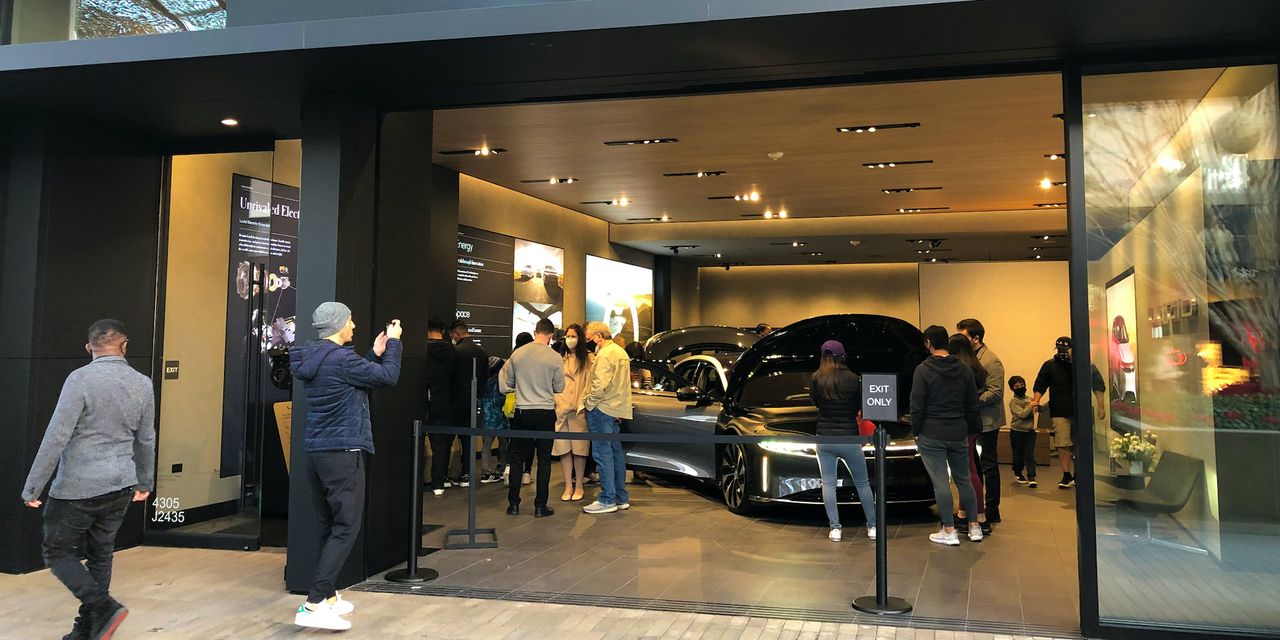
Lucid Group Inc.’s stock on Thursday was on track to mark its biggest drop in more than a year, after quarterly results that did little to allay ongoing concerns about the electric-vehicle maker. Those concerns include worries that a takeover could happen soon.
Lucid
LCID,
late Wednesday reported a narrower-than-expected fourth-quarter loss but sales that were below Wall Street expectations. The company’s order book shrunk further, and production guidance was lower than analysts had hoped.
The combination of quarterly loss, “disappointing” production guidance and the declining reservation count, among other issues, “will do little to alleviate investor concerns surrounding the company,” CFRA analyst Garrett Nelson wrote in a note.
Don’t miss: Lordstown stock falls over 10% after EV maker halts production, deliveries
“We think the weak outlook could prompt renewed talk regarding a takeover” by Lucid’s majority shareholder, Saudi Arabia’s sovereign-wealth fund, Nelson said.
BofA Securities’ John Murphy dropped his rating on Lucid shares to the equivalent of hold from buy and lowered his price target on the stock to $10 from $18 in view of the quarterly results, “light” 2023 outlook and lower production guidance.
“In addition, we are pushing out 2024+ estimates and now expect it could take until 2027+ to break even on an operating and free cash flow basis (prior 2026),” the analyst said in his note.
See also: Tesla may get into the lithium-mining business, and these stocks are cratering
Lucid “will need to raise more capital sooner than we had previously expected,” Murphy said.
The hold rating on the stock, however, is “appropriate,” he said, as Lucid still is “one of the most attractive among the universe of start-up EV automakers.”
Moreover, he said, Lucid is “steered by a management team with impressive experience, and there has been speculation that the Saudi Arabia Investment Fund could increase its stake in the company … or take the company private.”
Lucid guided for the production of between 10,000 and 14,000 vehicles this year, up from the 7,180 vehicles produced in 2022. That’s below expectations going into the report of about 20,500 units, Emmanuel Rosner with Deutsche Bank said.
In addition, the guidance “remains below its original goal for 2022, which was at [20,00] units initially before being revised down twice to just [7,000] units due to parts constraints and production volatility,” Rosner said.
The 2023 guidance “would suggest no sequential improvement from the 2022 exit rate, since Lucid assembled 3,493 EVs in [the fourth quarter] alone, and delivered 1,932 units in the quarter,” the analyst said.
Chris McNally with Evercore ISI zeroed in on the reservation number. Lucid said Wednesday it had more than 28,000 reservations for its luxury EVs, down from more than 34,000 in November and 37,000 reported in August.
Presuming 28,000 “fully active” reservations, or those held by people truly serious about buying the cars down the road, and a production rate between 10,000 and 14,000 vehicles, one would be looking at a wait of about two years for a new Lucid car, McNally said.
That is not the case for Lucid, however, where new deliveries show wait times around three to five months.
“Even assuming 6+ months wait time, [Lucid] likely has as few as ~7-10k ‘active’ order conversions,” or about 25% of the total, with the rest “implied to have uncertain conversion potential/timing” as the reservations are nonbinding, McNally said.
The analyst kept his rating on the stock at the equivalent of neutral but cut his price target to $8 from $12, implying a 3.5% upside from Thursday prices.
Lucid shares are down 86% from a record closing high of $58.05 hit on Feb. 18, 2021, and are down 66% in the last 12 months. That compares with a loss of around 6% for the S&P 500
SPX,