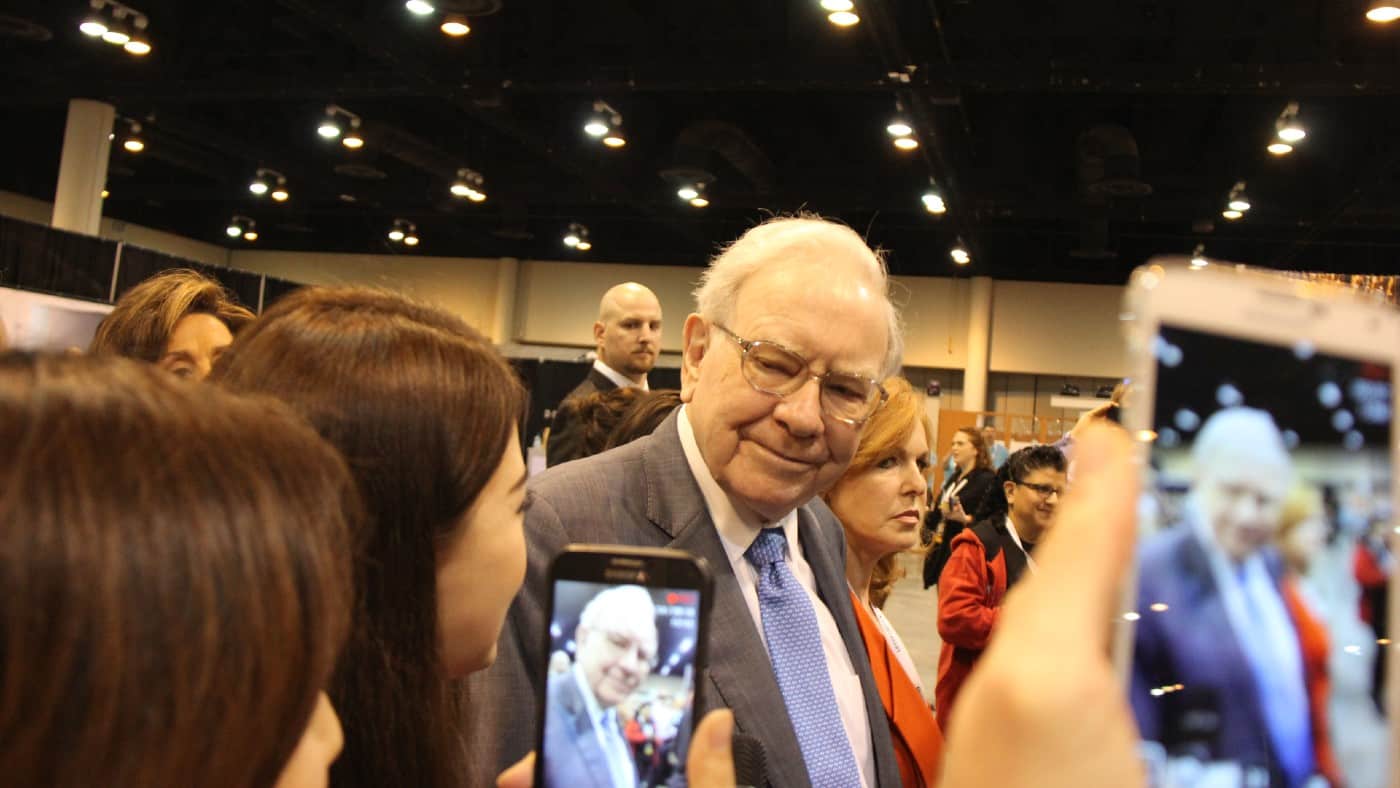
Todd Combs, the CEO of GEICO – a Berkshire Hathaway insurance subsidiary – once outlined what Warren Buffett looks for in investment opportunities. There are three conditions.
One is a forward price-to-earnings (P/E) ratio below 15, another is a 90% chance of making more money five years from now, and a third is a 50% chance of growing at 7% per year. That’s it.
A low price
A forward P/E ratio below 15 is relatively easy to identify. A good illustration of why this is important comes from looking at a stock like Microsoft (NASDAQ:MSFT).
Over the last five years, Microsoft’s grown its earnings per share at 18% a year. That’s hugely impressive and the company seems highly likely to be making more in 2029 than it does today.
The trouble is, the stock trades at a forward P/E ratio of 26, implying an earnings yield of 3.85%. That means the business needs to grow to generate a good return for shareholders.
If Microsoft keeps growing at 18% a year, the earnings yield will be 27.18% over the next five years. But a stock trading at a P/E ratio of 15 with no growth will have a yield of 33%.
That’s why a low P/E’s so important. It ensures a decent earnings yield from the outset, meaning the investment return doesn’t depend on waiting for future growth.
Better in future
Sometimes, stocks trade at low P/E multiples due to unusual short-term opportunities. Croda International’s (LSE:CRDA) a good example of this.
Back in 2021, the stock was trading at around 15 times forward earnings. But those earnings were boosted by extreme demand for Covid-19 vaccines, which the firm provided chemicals for.
When this died down, the company’s earnings fell away sharply. While the stock traded at a forward P/E multiple below 15 in 2021, it wouldn’t have been a good investment.
This is what Buffett’s second condition’s designed to filter out. The aim is to find businesses that have a durable competitive advantage, rather than ones enjoying a short-term surge in demand.
Croda has this to some extent – its patents provide it with durable protection. But it’s important to know when this means a company will make more money in the future and when it doesn’t.
7% growth
Buffett’s 7% growth condition only requires a 50% probability. That’s because a durable business at a P/E multiple of 15 can be a decent investment.
Despite this, the difference between a business that can grow and one that can’t becomes significant over time. And this matters for investors with a long-term outlook.
A P/E multiple of 15 implies a 6.6% earnings yield at the outset. If this grows by 3% annually, the implied return in year 10 is 9.2% of the original investment.
That’s not bad, but if the company’s earnings grow by 7%, the earnings in year 10 represent a 13.25% return. And the gap only gets wider over time.
This is why Buffett prefers buying shares in a great business at a decent price than shares in a decent business at a great price. Over the long term, growth potential’s important.